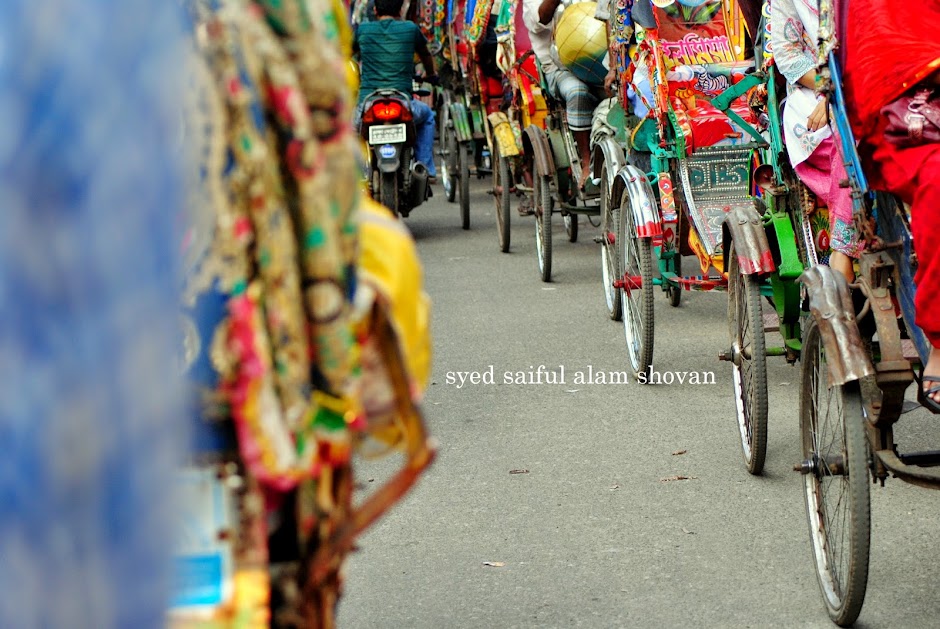
RICKSHAW

Showing posts with label Rickshaw. Show all posts

Thursday, November 27, 2014

Breaking records: Dhaka rickshaws make the Guinness Book of World Records


Breaking records: Dhaka rickshaws make the Guinness Book of World Records


For years, city officials have complained that “no other city has as many rickshaws as Dhaka,” somehow equating rickshaws with poverty and backwardness. Now, with Guinness recognizing Dhaka as an exceptional city for its many lakh non-polluting, truly green rickshaws, we can proudly say that “no other city has as many rickshaws as Dhaka!”

The city streets of Dhaka are choked with cars, despite only 5% of trips being made by car. Imagine if that figure doubled to 10%? Traffic would come to a complete standstill, or we would have to bulldoze more and more buildings in order to build ever wider roads, thus making destinations ever farther apart and generating even more traffic. Rickshaws, meanwhile, fit easily down all but the narrowest lanes. They move about as quickly as the average car in crowded streets. They require no fuel to operate and spew out no poisonous fumes. They provide much-needed employment to countless people, and offer the comfort and convenience of door-to-door transport to city dwellers.


European transport officials talk proudly of the high percentage of trips that are made by bicycle in their cities. Bicycles represent green transport, requiring no fuel to operate and very few resources for their construction or disposal. The “cleanest” car is still dirty when we consider the source of its fuel (electricity often comes from coal, which is even worse than petrol) and all the resources needed to build and dispose of it. And what is a rickshaw but a three-wheeled bicycle?

The fact that we can still breathe the air in Dhaka, and that it is still possible to move about the city (albeit slowly and with difficulty) is in large part thanks to the presence of the rickshaws. Even if we get a great system of public transit, people will still need “last mile connectivity”: a way to get to and from the public transit stops. Rickshaws will be essential for that service. They are also essential for short trips, especially given how miserable and dangerous the conditions currently are for walking and cycling. Rickshaws offer a relatively independent mode of travel for people with disabilities. And all without generating pollution.

The eyes of the world are now turning to Dhaka. For many years, the rickshaw has been a symbol of pride, an example of local art cum transport. It is exhibited in the Dhaka airport, at various hotels, and at local and international events. Yet there are those who have been keen to see it banned or restricted on city streets, despite the mounting evidence that reducing the rickshaw has absolutely no beneficial effect whatsoever on the flow of traffic, and that rickshaw bans likely contribute to ever-increasing air pollution. With this welcome recognition from Guinness, it is time to match our actions to our gestures. The rickshaw should indeed be a source of national pride, and it should be welcomed and encouraged on our city streets. We all need to recognize that the rickshaw is a solution, not a problem, in terms of traffic congestion, pollution, affordable transport, and employment. 

We all can
join in 
celebrating 
Dhaka as the City 
of the Rickshaw.


http://youtu.be/oaN9fTpYxzY

Monday, January 27, 2014

Traffic congestion: are trains the culprit or the solution?

Traffic congestion: are trains the culprit or the solution?

Traffic congestion: are trains the culprit or the solution? A news item in the New Age newspaper on 24 March states that “Bangladesh Railway has agreed to suspend rail operations between Tejgaon and Kamalapur stations during the peak travel hours to reduce tailback in the capital. The move follows a recent request from the Dhaka Metropolitan Police to the railway authorities for assistance in mitigating huge tailbacks that have become a common feature in the capital city.


 According to DMP, many of the city’s roads are too frequently blocked for trains arriving at or leaving Kamalapur Railway Station.” The question naturally arises as to whether we wish to carry out a symbolic measure to reduce congestion on the city’s roads, or actually to facilitate transport of our city’s residents? If the aim of transport policy is the movement of people not cars, then the decision is counter-productive. After all, trains (like cars and buses) move people. But a train can move 20 times as many passengers as cars per land space. Even without trains, there will be traffic jams, but trains do ensure a large number of people moving in small space while using far less fuel than if they were traveling by car. Further, by giving priority to rail, traffic congestion would actually decline, whereas giving priority to cars will only increase driving and thus congestion—and all the related costs in terms of traffic fatalities and pollution. 


A recent comprehensive analysis of transportation system performance in 130 U.S. cities identified a number of benefits to those cities connected by rail rather than only by bus and car. The study found that cities with large, well-established rail systems have lower per-capita traffic congestion costs, lower per-capita traffic fatalities, and lower per capita consumer and government transportation expenditures. The study also found that residents in cities with large, well-established rail systems experience about half the per capita traffic congestion delay as people who live in comparable size cities that lack rail.

This occurs because residents of cities with good train service drive less. Cities with large rail systems have about a third lower per capita traffic fatality rates, as travel is far safer by rail than bus or car. Residents of these cities save approximately $450 annually per capita in transportation costs compared with consumers living in cities that lack rail systems. The study concludes that rail service costs are repaid several times over by reduced congestion, road and parking facility costs, reduced traffic accident costs, and consumer cost savings. Why, then, the priority in Bangladesh of cars and other road-based transport over trains? When people cannot easily travel by rail, they are likely to shift instead to bus or–for the few who can afford to–private car. 

This raises the question of whether the policy is indeed intended to reduce congestion, or simply to raise the profits of bus owners and car salesmen. Rather than cancel trains, rail service should be expanded to give people a positive choice over the use of cars. This would reduce not only traffic congestion but also fuel use, transport costs, and road deaths and injuries. With the possibility of saving lives, reducing costs, and effectively reducing congestion, the choice is clear: it is private cars, not trains that need to be taken out of service at peak hours. 

Thursday, September 6, 2012

Do we need any ‘VIP’ roads?

Do we need any ‘VIP’ roads?

In a civilised society every citizen should be treated as a VIP by his or her 
own merits, irrespective of social or economic status. No public infrastructure 
such as roads should be designated for a specific privileged class. Rather than 
assigning roads for a few advantaged sections of the society, functional 
classifications should be decided on the basis of scientific approaches. 

Consider the irony of feeling that rickshaws are the source of our image 
problems. In contrast, widespread corruption, illiteracy, erosion in social 
norms and values, unacceptable rates of noise pollution, and lack of good 
governance should be our sources of shame. After all, wealthy countries have 
rickshaws—but Dhaka constantly outscores the rest of the world on 
corruption. 


Rickshaw Bans in Dhaka City:  An Overview of the Arguments For and Against

Sunday, May 2, 2010

Rickshaw puller in Dhaka earns Tk 6,300 per month:


Rickshaw puller in Dhaka earns Tk 6,300 per month: JICA study
Hard-working rickshawpuller earns upto Tk 14,000


Munima Sultana

An hard working rickshaw puller in the capital earns up to Tk14,000 a month --- eight times the basic minimum wages of a garment worker, a Japanese study on city's transport sector has revealed.

Dhaka's half a million rickshaw pullers may be gaunt and emaciated but their average monthly income is more than a police constable or a second tier government officer, the study by Japan International Cooperation Agency said.

"Some 35 per cent of Dhaka's half a million rickshaw-puller earn between Tk5000 and Tk7000 while 25 percent earn between Tk7000 and Tk9000," according to the Dhaka Urban Transport Network Development Study (DHUTS).

On average a rickshaw-puller earns Tk 6300 a month by driving rickshaws six to eight hours a day. Even an irregular rickshaw-puller can earn Tk3000 a month, it said.

"The highest earnings by some rickshaw pullers were found to be Tk 14,000 a month," said Yoichi Sakurada, leader of the study team.

"Some eight per cent of the rickshaw pullers we interviewed said that their monthly income was Tk10,000 or more," he said.

The study demolishes the myth that the rickshaw pullers are one of the lowest earning working groups in the city, regularly portrayed as "oppressed" and "deprived" people in the country's popular media.

According to the study, an average rickshaw puller earns nearly four times more than an average garment worker, whose basic minimum wage is Tk1662.50 set in 2006.

Their average income is also nearly twice the average per capita Gross Domestic Product (GDP) of the country. Bangladesh's per capita GDP was US$620 in the last financial year, or nearly Tk3600 a month.

Rickshaws are the most dominant mode of transporation in Dhaka, accounting for one-thirds of the city's 23 million daily trips.

The study said an average rickshaw puller carries 40 person a day, mostly in shorter trips with median size 2.4 kilometre.

A driver usually demands Tk 10 for every kilometre distance. The maximum distance he drives is 10km, it said.

Students are the most frequent users of rickshaws, making up 52.2 per cent of the vehicles' trips followed by businessmen with 39.5 per cent.

Dhaka Transport Coordination Board commissioned the DHUTS, the most wide-ranging in recent years, as part of its feasibility study on metro rails and elevated expressway in the capital.

In the first phase, the study examines recent trend in the transport sector, current level of public services, trip characteristics and expansion of the Dhaka city.

People having income above Tk 50,000 a month use cars for only 17 per cent of their trips, the study says. They also use rickshaws and buses for daily commuting.

The Financial Express

Monday, September 14, 2009

Why not limit cars instead of banning cycle rickshaws, HC asks NDMC

Why not limit cars instead of banning cycle rickshaws, HC asks NDMC

Terming the approach to ban cycle rickshaws in parts of the city "unrealistic", the Delhi High Court on Wednesday slammed the New Delhi Municipal Corporation for not fixing a limit to the number of cars a person can possess.

A division bench comprising Chief Justice A P Shah noted that the in place of regulation pollution, "the government seems more interested in dumping the eco-friendly mode of transport".

"We find the guidelines are unrealistic. Why are you so enthusiastic in banning cycle rickshaws? Why do not you issue guidelines limiting the number of cars a person can have in the city?" the bench observed while hearing a PIL filed by Manushi, an NGO.

The NGO submitted that the measure to ban rickshaws in some parts of the city has taken away the livelihood of poor people.

"It seems the total number of cars in Delhi are more than the combined number of cars in three metros Mumbai, Chennai and Kolkata," noted the Bench and said that in view of the increasing pollution, people in several countries including China and Holland have adopted bicycles and cycle rickshaws as a mode of transport.

Appearing for the petitioner NGO, senior counsel Prashant Bhushan submitted that the guidelines issued by NDMC were violative of Fundamental Rights under Article 14 (Right to livelihood) of the rickshaw pullers in the city.

Bhushan said a ceiling of 99,000 licences compels most of the six lakh cycle rickshaws to ply illegally.
The government allows plying of rickshaws in parts of the city, the lawyer said and added that they are most eco-friendly among all other vehicles.

The court has fixed February 19 as the date for further hearing of the matter.

www.dhaka-rickshaw.blogspot.com/ Dhaka Rickshaw
www.dhaka-transport.blogspot.com/ Pro-people Transport Plan www.dhakanewspapers.blogspot.com/ All Newspapers on one click


Syed Saiful Alam
Save the Environment Movement

Sunday, September 6, 2009

save city parks and playgrounds.


Save the Environment Movement (SEM) and WBB Trust form a human chain in front of Faculty of Fine Art on Dhaka University campus yesterday with a call to save city parks and playgrounds.Staff Correspondent
Environmentalists at a human chain yesterday demanded the parks in the city be saved.
They also demanded more open spaces and playgrounds to ensure sound physical and mental development of the children.

Save the Environment Movement (SEM) and WBB Trust formed the human chain in front of Faculty of Fine Art on Dhaka University campus.
Chairman of SEM Abu Naser Khan said physical exercise and outdoor games are very important for sound mental growth of a man.

The children are being deprived of the opportunity to play outdoor games due to lack of playgrounds and parks, he said.

Project Manager of WBB Trust Syed Mahbubul Alam said people are suffering from different kinds of diseases like diabetes, obesity and cardiac problem due to lack of outdoor games and physical exercise.

The children are the worst sufferers of the process and to address the problem it is necessary to ensure that they get outdoor games facilities since their childhood, he said.

Secretary General of Citizens' Rights Movement Tushar Rehman said amusement facilities should get special attention in urban planning.
Singer Abdul Kuddus Boyati, President of Nirapad Foundation Ibnul Sayed Rana and President of Khilgaon Samajik Unnayan Sangstha Hafizur Rahman Mayna also spoke.


Call to protect parks, open spaces in city
Green activists on Thursday urged the government to take immediate measures for protecting the existing open spaces, parks and playgrounds in the city. They also called on the authorities concerned to set up more parks and playgrounds for city dwellers, including children. They demanded cancellation of leasing system of playgrounds and open spaces, ensuring people’s representation in park management and strict enforcement of water body conservation act 2000.
Environmental activists made the demands at a human chain programme organised by Save the Environment Movement and Work for Better Bangladesh Trust in front of the fine arts faculty at Dhaka University. SEM chairman Abu Naser Khan, WBB Trust project manager Syed Mahbubul Alam, Citizen’s Rights Movement secretary general Tusher Rehman, folk singer Quddus Boyati, Nirapad Development Foundation president Ibnul Sayed Rana and Khilgaon Samajik Unnayan Sangstha president Hafizur Rahman, among others, took part in the programme. ‘There is no alternative but to keep open spaces and playgrounds for sound mental health of children. But the children are being deprived of such facilities,’
Naser Khan said. ‘Both mental and physical growth of the children are being hampered due to the absence of sufficient open spaces and playgrounds,’ he said, calling upon the government to take immediate steps for saving the existing open spaces, parks and playgrounds. Syed
Mahbubul Alam said, ‘City people are exposed to many diseases like diabetes as they don’t get sufficient open spaces for doing physical exercise.’ They also blasted Rajuk for its failure to compel the house owners to keep a portion as open space. Children also lodged their protest against unplanned urbanisation leaving no space for them to play. They queued up inside a makeshift cage.
www.dhaka-rickshaw.blogspot.com/ Dhaka Rickshaw
www.dhaka-transport.blogspot.com/ Pro-people Transport Plan www.dhakanewspapers.blogspot.com/ All Newspapers on one click
Syed Saiful Alam
Save The Environment Movement
shovan1209[at]yahoo.com

Monday, June 1, 2009

অর্থনীতি, জ্বালানী সঙ্কট ও রিকশা


পরিবেশ বাচাঁও আন্দোলন (পবা)র একদল সেচ্ছাসেবক রিকশা বিষয়ক পেপার তৈরি করেছে। রাজধানী ঢাকার রিকশা চলচলের সুবিধা, সম্ভবনা, চলাচলে প্রতিবন্ধকতা, বৈজ্ঞানিক ভিত্তি, চলাচলের যুক্তিকতা, পরিবহন পরিকল্পনা, অর্থনীতি, পরিবেশ, রাজনীতি, সামাজিকতা, দারিদ্র বিমোচনসহ অনেকগুলো বিষয়ই উঠে এসেছে। তারপরও নেহাতই সময় সল্পতা, পেপারটির আকার নিয়ন্ত্রণ করার বাধ্য বাধ্যকতা থাকায় বেশ কিছু বিষয় বাদ দিতে হয়েছে। কিন্তু কোন অংশেই সেই বিষয়গুলো ছোট করে দেখার কিছু নেই। এই পেপারটি তৈরি পেছনে থাকা সকলের প্রতি আন্তরিক কৃতজ্ঞতা প্রকাশ করছি। পাশাপাশি আশা করি এই ব্লগের অনেকেরই বিভিন্ন সময় মন্তব্য প্রকাশের মাধ্যমে এই লেখাটিকে সমৃদ্ধ করেছেন এবং নানা ভাবে সমর্থন দিয়ে সহয়তা করেছেন তাদের প্রতি কৃতজ্ঞতা প্রকাশ করছি। আমরা বিশ্বাস করি এই লেখাটি যদি বিভিন্ন পযায়ে মানুষের কাছে পৌছে দেওয়া যায় তাহলে ঢাকার আগমীর পরিবহন পরিকল্পনায় বিশেষ ভূমিকা রাখবে।


রিকশা অর্থনীতি
ঢাকা শহরের অধিকাংশ যাতায়াত স্বল্প দূরত্বের। আর স্বল্প দূরত্বে বিরতীহীনভাবে যাতায়াতের জন্য রিকশা হচ্ছে সাশ্রয়ী ও জনপ্রিয় বাহন। রিকশা জ্বালানীমুক্ত, পরিবেশবান্ধব ও নিরাপদ বাহন। এর মাধ্যমে প্রচুর মানুষের কর্মসংস্থানের সুযোগ রয়েছে। সুতরাং রিকশা চলাচলকে কিভাবে সুষ্ঠু ব্যবস্থাপনার আওতায় আনা যায় সেই ধরনের পদক্ষেপ গ্রহণ করা প্রয়োজন। রিকশা দেশের পরিবহণ খাতে প্রতি বছর ৫ হাজার কোটি টাকার জ্বালানী সাশ্রয় করছে। রিকশা পরিবেশের ক্ষতি থেকেও রক্ষা করছে, যার মূল্য বছরে ১০ হাজার কোটি টাকা। হিউম্যান রিসোর্স সেন্টার (এইচডিআরসি) এর সমীক্ষায় দেখা যায় বাংলাদেশ বিমান, রেল, সড়ক ও নৌপরিবহণ খাত থেকে বছরে যত টাকা আয়, রিকশা থেকে এককভাবে তার চেয়ে বেশি অর্থ আয় হয়। ঢাকার রিকশা চালকরা প্রতি মাসে ২শ কোটি টাকা গ্রামে পাঠান। বাংলাদেশ পরিসংখ্যান বু্যরোর তথ্যমতে ২০০৪-০৫ অর্থবছরে রিকশা থেকে সরকার আয় করেছে ১ হাজার ৯শ ৮০ কোটি টাকা। প্রাইভেট কার জিপ ও ট্যাক্সি থেকে ৬৪ কোটি টাকা।


জ্বালানী সঙ্কট ও রিকশা :
বর্তমানে সারা বিশ্বে জ্বালানী অত্যনত্দ আলোচিত একটি বিষয়। দিন দিন জ্বালানী চাহিদা বৃদ্ধির ফলে দেখা দিয়েছে নানাতর সঙ্কট। এছাড়া বিশেষজ্ঞরা বিশ্বে জ্বীবাশ্ম জ্বালানীর মজুদ নিকট ভবিষ্যতে ফুরিয়ে যাবার আশঙ্কা প্রকাশ করেছেন। সেক্ষেত্রে জ্বালানী নিরাপত্তার জন্য এর চাহিদা নিয়ন্ত্রণ করা জরুরী হয়ে পড়েছে। এক্ষেত্রে ঢাকার বিভিন্ন সড়ক থেকে রিকশা নিষিদ্ধ করায় পরিবহণ খাতে জ্বালানীর ব্যবহার বৃদ্ধি পাচ্ছে। পত্রিকার সংবাদের ভিত্তিতে জ্বালানী সমস্যা সম্পর্কে জাতীয় ও আনত্দর্জাতিক পর্যায়ের কিছু বিষয়ে আলোকপাত করা হলো।

১.দি নিউইয়র্ক টাইমস এর ওয়েবসাইট সংস্করণে বিশেষজ্ঞদের মতামত শিল্প কলকারখানার চিত্র তুলে ধরে জানায় জ্বালানী তেল রফতানীকারক কয়েকটি নেতৃস্থানীয় দেশ আগামী দশ বছরের মধ্যে নিজস্ব জ্বালানী চাহিদা মেটাতে তেল আমদানীকারক দেশ হিসেবে পরিণত হতে পারে। ইতোমধ্যেই ইন্দোনেশিয়া এরকম পরিস্থিতির সম্মূখীন হয়েছে, অন্যদিকে মেক্সিকো আগামী পাঁচ বছরের মধ্যেই তেল আমদানীতে যেতে পারে। (আমাদের সময়, ১০ ডিসেম্বর ২০০৭)

২.ইন্টারন্যাশনাল এনার্জি এজেন্সি (আইইএ) জানিয়েছে ২০০৮ সালে গড়ে প্রায় ২.২ মিলিয়ন ব্যারেল তেলের চাহিদা বাড়বে, যা এ বছর রয়েছে ১.৫ মিলিয়ন ব্যরেল। এ ক্রমবর্ধমান চাহিদা সামাল দিতে ওপেক অনত্দর্ভূক্ত দেশগুলোকে তেল উৎপাদন বাড়াতে হবে বলে আইইএ জানিয়েছে। (যায়যায়দিন, ১৪ জুলাই ২০০৭)

৩.পেট্রোবাংলার হিসেবে ২০১১ সাল থেকে গ্যাসের সংকট শুরু হবে। আর ২০১৫ সালের মধ্যে আবিস্কৃত মজুদ শেষ হয়ে যাবে। ফলে ব্যাপক হারে নতুন গ্যাস আবিস্কার ও কয়লা খনি উন্নয়ন করতে না পারলে বাংলাদেশে জ্বালানী সংকট ভয়ঙ্কর রূপ নেবে। (সমকাল, ৮ সেপ্টেম্বর ২০০৭)

৪.পেট্রোল-অকটেনের দাম আকাশচুম্বী হওয়ায় সিএনজি এর চাহিদা বাড়ছে। প্রতিদিনিই অসংখ্য গাড়ি সিএনজিতে কনভার্ট করা হচ্ছে। দেখা যায় রিফুয়েলিং স্টেশনগুলিতে সকাল থেকে রাত্রি পর্যনত্দ দীর্ঘ লাইন পড়ে। ফলে যাত্রীদের শ্রমঘণ্টা নষ্ট হওয়ার পাশাপাশি বাড়ছে নানাবিধ বিড়ম্বনা ও দূর্ভোগ। (যুগানত্দর, ২১ আগস্ট ২০০৬) ৫.২০০৪-০৫ অর্থবছরে জ্বালানী তেল আমদানীতে ব্যয় হয়েছিল ২৫০ কোটি ডলার। আমদানী করা জ্বালানীর মধ্যে পরিবহণ খাতে ৫৫ শতাংশ, কৃষি খাতে ২১ শতাংশ ও বাকী ২৪ শতাংশ ব্যবহার করা হয় ক্ষুদ্র বিদ্যুৎ কেন্দ্র ও জেনারেটরে। (যায়যায়দিন, ২১ আগস্ট ২০০৬) ৬.রিকশার কারণে বাংলাদেশে পরিবহণ খাতে কমপক্ষে ৫ হাজার কোটি টাকার জ্বালানী সাশ্রয় হয়।

এছাড়া বিশ্ব ব্যাংকের হিসাবানুযায়ী আমাদের দেশে প্রতিবছর শুধু রিকশাকে কেন্দ্র করে ১০ হাজার কোটি টাকা আয় হয়ে থাকে। (দৈনিক ইনকিলাব, ২ আগষ্ট ২০০৭) জ্বালানী সঙ্কট উত্তরণের লক্ষ্যে পরিবহণ ব্যবস্থায় রিকশার গুরুত্ব অনুধাবন সাপেক্ষে এর চলাচল আরো সুদৃঢ় ও সুসংহত করা বাঞ্ছনীয়।


www.dhaka-rickshaw.blogspot.com/ Dhaka Ricksha
wwww.dhaka-transport.blogspot.com/ Pro-people Transport Plan www.dhakanewspapers.blogspot.com/ All Newspapers on one click

Syed Saiful Alam
Save The Environment Movement
shovan1209[at]yahoo.com

Sunday, May 31, 2009


Restriction on rickshaw movement fails to stop traffic jam in city
Mahbubur Rahman Khan


Imposing ban on rickshaw movement on different roads of the capital could not stop traffic jam rather it accentuated the economic woes of people, pushed more rickshaw pullers into poverty trap and created transport problem for a large number of commuters.


Hundreds of poor people in the capital mange their bare necessities of life by pulling rickshaw. The earnings of the rickshaw pullers, however meager, could make dent on poverty and alleviate sufferings of their family members in the countryside at least to some extent. Rickshaw pullers of the Dhaka city remit about tk 2 crore to their village homes each month. But imposition of ban on rickshaw movement on certain roads in the capital has robbed a good number of rickshaw pullers of their means of livelihood, according to Human Resource Centre (HRC).


The revenue earnings of the government from the rickshaw related industry and trade are much higher than those of the small automobiles. The government earned Tk 1,980 crore in revenue from rickshaw sector compared to Tk 64 crore from small automobiles in 2004-05 fiscal, said a report of the Bangladesh Bureau of Statistics.


Rickshaws in Dhaka city alone save fuel worth Tk 5,000 core every year and the yearly savings from the point of environment stand at Tk 10,000 crore, said a survey report of Paribash Bachao Andolon (PABA),an NGO.
There is no updated statistics on the actual number of rickshaws plying on different roads in the capital. Its number varies from two lakh to five lakh.
Imposition of ban on non-automobile transports on particular roads could not stop traffic congestion. A survey conducted by Human Development Resource Centre (HDRC) in 2004 found that the expenditure of rickshaw users has increased after the ban on rickshaws. Ban on the movement of rickshaws on certain roads in Mirpur area in the capital on the plea of reducing traffic jam has not produced the desired result. Rather the step increased traffic congestion on the roads which were made off-limit to rickshaws.
Citing example, the survey report said that following the imposition of ban on the movement of rickshaws on those roads, 25 percent of the commuters were compelled to walk through the roads in the absence of footpath. 42 percent of the people, who used to travel by rickshaws before the imposition of ban, are now hiring different modes of automobiles to go to different destinations. Extra pressure of mechanised transports on these roads made off-limit to rickshaws has simply choked them creating much discomfort for the commuters, the survey report added.


The imposition of ban on the movement of rickshaws has also reduced the income of rickshaw pullers by 32 percent, it claimed.


A survey report of Dhaka Urban Transport Project (DUTP) said rickshaws in no way create obstacle in the movement of mechanized transports. After making some roads in Mirpur off limit to rickshaws the average speed of buses plying in the area rather dropped by 3.8 kilometer, it mentioned.
Shakil Bin Kashem, Professor, Department of Urban and Regional Planning of Bangladesh University of Engineering and Technology (BUET), told The New Nation that the traffic system has deteriorated after imposition of ban on rickshaw on some roads in the capital.

Syed Saiful Alam
Save The Environment Movement
shovan1209[at]yahoo.com

Tuesday, May 26, 2009

কতটা গতির দরকার? কতটা গতিতে চললে রিকশা ঢাকায় চলতে পারবে?


লেখাটি  somewhereinblog প্রকাশিত 

যানজট একটি আমাদের সবার জন্য সমস্যা আর এই সমস্যাকে পুজিঁ করে দেশি বিদেশি ব্যবসায়ীক শ্রেনী নেমে পড়েছে ব্যবসায়। জনগণকে জিম্মি করে তারা বছরের পর বছর ঢাকায় জনগণের টাকায় কিংবা ঋণের টাকায় বিভিন্ন প্রকল্প বাস্তবায়ন করেছে। কিন্তু যানজট কমেনি। শুধু প্রকল্পের বৃদ্ধিই ঘটছে ধারাবাহিক ভাবে। এই রকম অনেক প্রকল্প নিয়েই সুনিদিষ্ট তথ্যসহ তাদের ব্যবসার কথা জনগন ইতিমধ্যে জেনেছে। গতকাল ঢাকার যাতায়াত ব্যবস্থার সাথে জড়িত একটি বিভাগের উর্ধতন কর্মকর্তার কথা আজ বিভিন্ন পত্রিকায় প্রকাশ পেয়েছে। তিনি রিকশা নিয়ে কথা বলছেন রিকশা ধীর গতি সম্পন্ন যান। আর তাই মহাসড়কে রিকশা উচ্ছেদ করতে হবে। কিন্তু অতীতেও বিভিন্ন রাস্তা থেকে রিকশা উচ্ছেদ করা হয়েছে ফলাফল শুভ হয়নি।

যাত্রীদের যাতায়াত সময়-ব্যয় বৃদ্ধি, পরিবেশ দূষণ, যানজট বৃদ্ধি, পরিবহণ কোম্পানীগুলোর পরিবহণ পরিচালনার ব্যয় বেড়েছে। এই বিষয়টি নিয়ে বিস্তারিত একটি পোস্ট দেওয়ার কথা ভেবেছিলাম কিন্তু পোস্টটি বড় হয়ে যাবে ভেবে কয়েকটি পোস্ট দিব ঠিক করলাম। তারই ধারাবাহিকতায় আজকের পোস্ট " রিকসা কি আসলেই ধীর গতি সম্পন্ন যান‍"আজ এই ফোরামে এই বিষয়টি নিয়ে লিখছি আমাদের সবার যাতে রিকসা ধীর গতি সম্পন্ন যান এই সম্পর্কে ভ্রান্ত ধারণা পরিবর্তন ঘটে। রিকশা উচ্ছেদের অন্য কোন কারণ থাকতে পারে কিন্তু ধীর গতি সম্পন্ন যান তা উচ্ছেদের যুক্তি সই কারণ নয়। রিকসা কি আসলেই ধীর গতি সম্পন্ন যান? যখন অধিকাংশ যান্ত্রিক যানবাহন অযান্ত্রিক যানবাহন অপেক্ষা গতিশীল, তখন গতি আসলেই বিবেচ্য একটি বিষয়। কিন্তু জনবহুল শহরের প্রেক্ষিতে গতির বিষয়টি একটু ব্যতিক্রম।


ঢাকা শহরের বৈশিষ্ট হচ্ছে এখানে স্বল্প পরিমান জায়গায় অনেক লোক চলাচল করে থাকে, ফলে স্বাভাবিক ভাবেই সৃষ্টি হয় যানজটের। ঢাকার মতো বিশ্বের অন্য শহরগুলোতেও এই সমস্যা বিরাজমান। অযান্ত্রিক যান না থাকা এবং ব্যয়বহুল রাস্তা নির্মাণের পরও বিশ্বের অধিকাংশ শহর থেকে এ সমস্যার সমাধান করা যাচ্ছে না। মধ্য লন্ডনে গাড়ির গতিবেগ ঘন্টায় ৮ কিঃ মিঃ যা ১৮৮০ সালে ঘোড়ার গাড়ির সমপরিমান। কখনো কখনো এ গতি সাইকেল থেকেও ধীর এবং কখনো কখনো পায়ে হেটে চলাচলের সমপরিমান হয়। বাইসাইকেলে ঘন্টায় ১০-১৫ কিঃমিঃ বা তার চেয়েও বেশি যাওয়া যায়। ঢাকা যে সকল রাস্তায় অনেক আগেই অযান্ত্রিক যান নিষিদ্ধ করা হয়েছে, সেখানে এখন অসহনীয় যানজট বিরাজ করছে এবং সার্বিক যাতায়াতের সময়সীমাও বেড়ে গেছে। এ অবস্থায় যান্ত্রিক যানবাহনে শহরের দূরবর্তী এলাকায় যেতে রিকসা/বাইসাইকেলের প্রায় সমান সময় প্রয়োজন হয়। সেখানে রাস্তায় যেহেতু কোন অযান্ত্রিক যানবাহন নেই সেহেতু সেখানকার রাস্তার গতিহীনতার জন্য অযান্ত্রিক যানবাহনকে দায়ী করা যাবে না।


অর্থাৎ যান্তিক যান নিষিদ্ধ করেও ভাল কোন সুফল পাওয়া যাবে না। বরং অধিক যান্ত্রিক যানের কারণে এই রাস্তাগুলোতে অত্যাধিক হারে বায়ুদূষণ ঘটছে এবং যাতায়াতের অনুপোযোগি হয়ে পড়ছে। মিরপুর রোড, ভিআইপি রোড থেকে রিকশা উচ্ছেদ করা হয়েছে কিন্তু যানজট আগের চেয়ে বেড়েছে। তাহলে রিকশার সাথে যানজটের বিষয়টি আমাদের কাছে ভুল ভাবে উপস্থাপন করা হচ্ছে? সমস্যা অন্য জায়গায় একটু লক্ষ্য করুন থাইল্যান্ডের ব্যাংকক, ফিলিপাই, ইন্দোনেশিয়া যানজটপূর্ণ শহরগুলোর কথা।

তাদেরই বিভিন্ন পরামর্শ এবং প্রকল্প বাস্তবায়নের ফলে শহরগুলো যানজটের শীর্ষস্থান অধিকারী শহর হিসেবে নাম লিখাতে পেরেছে। তারা সেখানেও একই ভাবে রিকশা উচ্ছেদ করেছে। ওখানে ব্যর্থ যানজট সমাধানে কাল্পনিক চেষ্টায় এখন যানজট আরো বৃদ্ধি পেয়েছে। কিন্তু  যানজটকে পুঁজি করে নাগরিকদের জিম্মি করা ব্যবসায়ীদের ব্যবসা বেড়েছে তাদে কয়েক গুণ।

আমাদের দেশেও একই র্ফমুলা প্রয়োগ করা হচ্ছে। আমাদের এখনই সোচ্চার হতে হবে নয়তো আমাদের প্রিয় ঢাকা ব্যাংককের মত যানজটপূর্ণ শহর হবে। ব্যাংককে মোট্রে রেল, স্কাইরেল, ফ্লাইওভার, নৌপথ সবই আছে। সাথে আছে প্রচন্ড যানজট। পাশপাশি ওদের ব্যবসা কিন্ত প্রতিবছরই বাড়ছে। আসুন চিনে নেই তাদের নয়তো আমাদেরও যানজট আর যানজট শব্দের ফাঁদে ফেলবে কোটি কোটি টাকার ব্যবসা করবে। কিন্তু যানজট থেকে মুক্তির স্বপ্ন আমাদের স্বপ্নই থাকবে।

লেখাটি  somewhereinblog প্রকাশিত


Syed Saiful Alam
shovan1209[at]yahoo.com

Sunday, September 21, 2008

আগামীকাল বিশ্ব কারমুক্ত দিবস / World Carfree Day

আগামীকাল বিশ্ব কারমুক্ত দিবস
আগামীকাল ২২ সেপ্টেম্বর বিশ্ব কারমুক্ত দিবস। জ্বালানী সমস্যা থেকে উত্তরণের জন্য সর্বপ্রথম ১৯৭০ সালে কারমুক্ত দিবস পালিত হয়। দিবসটি পালনের মূল উদ্দেশ্য প্রাইভেট কার নিয়ন্ত্রণে সচেতনতা বৃদ্ধি করা। পরিবহণ ব্যবস্থায় প্রাইভেট কার বৃদ্ধির মাধ্যমে যানজট, রাসত্দাঘাটের নির্মাণ ব্যয়, দূষণ, জ্বালানীর ব্যবহার ও দূর্ঘটনা বৃদ্ধি পায়। এছাড়া বিনোদনের জন্য উন্মূক্ত স্থান ও শিশুদের খেলাধূলার জায়গা কমে আসে। দীর্ঘস্থায়ী নগর পরিবহণ ব্যবস্থা গড়ে তুলতে পথচারী, সাইকেল, রিকশা ও উপযোগী পাবলিক পরিবহণের সমন্বয় করা প্রয়োজন। পাশাপাশি প্রাইভেট কার নিয়ন্ত্রণ করা জরুরী। এ লক্ষ্যে ইউরোপিয়ান বিভিন্ন শহরে ১৯৯০ সালে কারমুক্ত দিবস পালন করা হয়। এরপর ১৯৯৯ সালে ইউরোপিয়ান ইউনিয়ন প্রথম বিশ্ব কারমুক্ত দিবস পালন করলেও ২০০০ সাল থেকে বিশ্বের অন্যান্য অনেক দেশে দিবসটি পালিত হতে থাকে। এখন বিশ্বের অনেক শহরেই প্রাইভেট কার নিয়ন্ত্রণে নেয়া হচ্ছে জোর পদক্ষেপ। বাংলাদেশেও বিগত কয়েক বছর ধরে পরিবেশাবদী সংগঠনসমূহ দিবসটি পালন করে আসছে। আশা করা যায় আমাদের দেশে অতি শীঘ্রই প্রাইভেট নিয়ন্ত্রণের মাধ্যমে দূষণ ও যানজটমুক্ত এবং জ্বালানী সাশ্রয়ী পরিবহণ ব্যবস্থা গড়ে তোলার ক্ষেত্রে পদক্ষেপ গ্রহণ করা হবে।


September 22 is World Carfree Day

Coming September 22 is World Carfree Day. World Carfree Day is an annual celebration of cities and public life, free from the noise, stress and pollution of cars. Each year on September 22, people around the world organize events of all sizes to showcase alternatives to the automobile. World Carfree Network invites organisations and individuals everywhere to join.

World Carfree Day began as an open call for a grassroots celebration of cities without cars. The date, September 22, was chosen to coincide with the EU-sponsored European Mobility Week, but our hope is to involve people at all levels of society and from all over the world.

Carfree days were organised as early as during the oil crisis of the 1970s, and several carfree days were organised in European cities during the early 1990s. An international carfree day was organised in Europe in 1999, which was the pilot project for the European Union's "In Town Without My Car" campaign. This campaign continues as European Mobility Week.
In 2000, Car Busters (the precursor to World Carfree Network) issues an open call for a "World Carfree Day," to coincide with Europe's carfree day on September 22. Since then, we have continued to call for activists and citizens to organise World Carfree Day events on or near September 22

Monday, September 15, 2008

নিউ মার্কেটে গাড়ি পার্কিং ও মিরপুর সড়কে রিক্সা উচ্ছেদের পরবর্তী অবস্থা ও মিরপুর সড়কে রিক্সা উচ্ছেদের পরবর্তী অবস্থা


নিউ মার্কেটে গাড়ি পার্কিং ও মিরপুর সড়কে রিক্সা উচ্ছেদের পরবর্তী অবস্থা

যানজট নিরসনের নাম করে ইতিপূর্বে বিশ্বব্যাংকের ঋণ সহায়তায় একটি প্রকল্পের আওতায় মিরপুর সড়ক থেকে রিকশা উচ্ছেদ করা হয়েছে। কিন্তু প্রকল্প পরবর্তী সময়ে যানজট আরো বৃদ্ধি পেয়েছে। এছাড়া বাসের গতি কমেছে। মিরপুর সড়কে রিকশা উচ্ছেদ করা হলেও এখনও অনেক মানুষ ভেতরের (ধানমন্ডি এলাকার) সড়কগুলি দিয়ে রিকশা করেই চলাচল করছে। এর জন্য তাদের সময় ও খরচ দুইই বৃদ্ধি পেয়েছে। রিকশাচালকদের আয়ও কমেছে। মিরপুর সড়কে রিকশা বন্ধ করে ধানমন্ডি-১ (পুলিশ বক্স) থেকে নিউমার্কেট পর্যনত্দ রিকশা চলাচলের জন্য লেন প্রদান করা হয়েছে। কিন্তু যাত্রী অনুপাতে লেনের জন্য জায়গা প্রদান না করায় মানুষকে সীমাহীন দূর্ভোগ পোহাতে হচ্ছে। এই লেনটি দিয়ে একদিকে একটি সারিতে রিকশা চলতে পারে। আর লেনটি নিউমার্কেটের ভেতরের রাসত্দার সঙ্গে সংযুক্ত হওয়ায় রিকশায় চলাচলের জন্য অনেক পথ ঘুরতে হয়। এছাড়া নিউমার্কেটের ভেতর দিয়ে প্রাইভেট কারসহ অন্যান্য অনেক ধরনের যানবাহন চলাচল করে। ফলে রিকশা নির্বিঘ্নে চলতে পারে না। সেখানে একটি রিকশা আটকা পড়লে পেছনে শত শত রিকশা আটকা পড়ে। এর জন্য ধানমিন্ড-১ নম্বর সড়কে সৃষ্টি হচ্ছে রিকশা জট।


এই লেন-এ বরাদ্দকৃত জাযগা চাহিদানুযায়ী রিকশা চলাচলের জন্য যথেষ্ঠ নয়। অথচ লেনের বাইরে প্রায় সময় দুই লেন জুড়ে প্রাইভেট কার পার্কিং করা থাকে। সামান্য কয়েকজন মানুষকে পার্কিং সুবিধা দিতে গিয়ে রিকশা লেনে প্রয়োজনীয় জায়গা না দেওয়ায় হাজার হাজার মানুষের দূর্ভোগ সৃষ্টি হচ্ছে। এখানে অবিলম্বে গাড়ি পার্কিং বন্ধ করে রিকশা যাত্রীদের সংখ্যানুপাতে লেনের জায়গা দিলে নিউমার্কেট এলাকার ব্যবসা বৃদ্ধির সাথে সাথে জনসাধারণ উপকৃত হবে। সেই সাথে যানজট হ্রাসের সঙ্গে পরিবহণ ব্যবস্থায় সৃঙ্খলা ফিরে অসবে।


প্রাইভেট গাড়িতে গড়ে ২.২ জন যাত্রী থাকে। সে অনুযায়ী প্রাইভেট গাড়ি থেকে নিউমার্কেটের এই জায়গায় ঘন্টায় ৮৭ জন মানুষ সুুিবধা পাচ্ছে। একই জায়গায় রিকশা চললে প্রতি ঘন্টায় ৯ হাজার ৭৭ জন যাত্রী চলাচল করতে পারতো। এই লেন দুটিকে পার্কিং করার পরিবর্তে রিকশার জন্য বরাদ্দ দিলে ১০৩ গুন বেশি ব্যবহারযোগ্য করা সম্ভব।


নিউমার্কেটের এই লেনটি রিকশার জন্য বরাদ্দ দেয়া হলে প্রশ্ন উঠতে পারে প্রাইভেট গাড়ি কোথায় রাখা হবে? এর সমাধানে নিউমার্কেটের যেকোন একটি জায়গা পার্কিংয়ের জন্য নির্দিষ্ট করে দেয়া এবং জায়গা ও সময় অনুসারে খরচ নির্ধারণ করা। এ ধরনের নিয়ম করা হলে দুটি ইতিবাচক পরিবর্তন হবে। প্রথমত যারা এখন দীর্ঘ সময় গাড়ি পার্কিং করছে তারা কমসময় গাড়ি রাখবে বা পার্কিং খরচ কমাতে বিকল্প পরিবহণ ব্যবহার করবে। তাহলে প্রাইভেট গাড়ীতে যাতায়াত হ্রাস পাবে। দ্বিতীয়ত আশে-পাশের এলাকা হতে নিউমার্কেটে যাতায়াত করতে লোকজন রিকশা, সাইকেল বা হেঁটে চলাচলকে প্রাধান্য দেবে। এর মাধ্যমেও প্রাইভেট গাড়ীর ব্যবহার হ্রাস পাওয়ায় যানজট কমবে।
এই প্রক্রিয়ায় প্রাইভেট গাড়ী নিয়ন্ত্রণ করা হলে মিরপুর রোডে যানজট অনেকাংশে হ্রাস পাবে। গাড়ীর জন্য ঘন্টা অনুসারে অর্থ নেওয়ার ফলে পূর্বে পার্কিং করার জন্য যে পরিমান জায়গা প্রয়োজন হতো, তার থেকে কম ব্যবহার হবে, যারা মার্কেটে এসে দ্রুত কাজ সেরে চলে যেতে চায় তারা গাড়ি রাখার সুযোগ পাবেন। পার্কিং নিয়ন্ত্রণ হওয়ায় রাস্তায় রিকশা চলাচলের জায়গা বেরুনোর প্রেক্ষিতে আরো বেশি মানুষ যাতায়াত সুবিধার কারণে ব্যবসায়ীদের ক্রেতা সংখ্যা বৃদ্ধি পাবে।


বিনামূল্যে অথবা কম মূল্যে পার্কিং সুবিধা প্রদান করলে যাদের গাড়ী আছে তারা হেঁটে, সাইকেলে বা পাবলিক পরিবহন অপেক্ষা প্রাইভেট গাড়ীতে যাতায়াত করতে উৎসাহী হয়। যা যানজট বৃদ্ধির মাধ্যমে মানুষের যাতায়াতে বাধা সৃষ্টি করায় ব্যবসার উপরেও নেতিবাচক প্রভাব পড়ে। ব্যবসা প্রতিষ্ঠানের সামনে বেশি বেশি প্রাইভেট গাড়ী থাকলে যারা অন্যান্য মাধ্যমে আসতে চায় তাদের চলাচল বিঘি্নত হয়। গাড়ীর জন্য বিনামূল্যে পার্কিং সুবিধা দেয়ার অর্থ হচ্ছে অন্যদের চলাচলে বিঘ্ন সৃষ্টি করা। ঢাকায় খুবই কম সংখ্যম মানুষের গাড়ি রয়েছে। প্রাইভেট গাড়ী ব্যবহারকারীদের প্রাধান্য দেওয়া হলে ব্যবসায়ী এবং বেশিরভাগ ক্রেতা সঙ্কটে পড়বে। একটি দোকানের সামনে বেশি গাড়ি খুব দৃষ্টিকটু দেখায় এবং চলাচলে প্রতিবন্ধকতা সৃষ্টি করে। এর জন্য অনেকই ওইসব দোকানে যেতে নিরুৎসাহ বোধ করে।


অনেক সৌখিন মানুষ আছেন হাঁটা পথে কি পাওয়া যায় সেগুলি লক্ষ্য করে এবং কিছু পছন্দ হলেই কিনে ফেলে। কিন্তু দোকানের সামনে গাড়ি থাকার কারণে মানুষ কিছু দেখতে না পাওয়ায় বিক্রি কমে যায়। যা ব্যবসায়ীদের ক্ষতিগ্রস্থ করে। দোকানের সামনে গাড়ি না থাকলে পথচারীরা বাইরে থেকে জিনিসপত্র দেখতে পায় এবং কোন কিছু দ্বারা আকৃষ্ট হলে ভেতরে প্রবেশ করে কেনাকাটার সুযোগ পায়।


বিনামূল্যে বা নামমাত্র মূল্যে পার্কিং ব্যবসার জন্য ক্ষতিকর। পার্কিংয়ের জন্য টাকা নেওয়া ব্যবসার প্রসারের সহায়ক। সময় ও জায়গার দামের উপর নির্ভর করে গাড়ি পার্কিংয়ের জন্য টাকা দিতে হলে মানুষ কম সময় গাড়ি রাখার সুযোগ পাবেন এবং অন্য ক্রেতারা ঐ জায়গা ব্যবহার করতে পারবেন। একই জায়গায় অনেক বেশি ক্রেতাকে সুবিধা প্রদান করার কারণে দোকানীদের বিক্রি বাড়ে। কম সংখ্যক গাড়ী বেশি সময়ের জন্য পার্কিং করা হলে অল্প পরিমাণ জায়গায় অনেক গাড়ী পার্কিং করায় জায়গার সর্বোচ্চ ব্যবহার হয়।


গাড়ী বেশি সময় পার্কিংয়ে রাখার অর্থ হচ্ছে জায়গার অপব্যবহার করা। পার্কিং বিনামূল্যে বা কম মূল্যে হওয়ায় মানুষ বেশি সময়ের জন্য গাড়ি রাখতে উৎসাহিত হবে। এক্ষেত্রে অনেকেই গাড়ি রাখা জায়গা পেতে সমস্যায় পড়বেন। অল্প মানুষ বেশি সময় ধরে দোকানে অবস্থান করলেই ব্যাবসায়ীদের সুবিধা হতে পারে না। ব্যাবসায়ীদের জন্য প্রয়োজন অনেক বেশি ক্রেতা সমাগম। এর জন্য পার্কিং স্থানে যতবেশি গাড়ি রাখার সুযোগ তৈরি করা যাবে তত বেশি মানুষ আসার সুযোগ পাবেন। সেক্ষেত্রে সময়ানুযায়ী পার্কিং ফি বৃদ্ধি করা হলে মানুষ কম সময়ের জন্য গাড়ি পার্ক করবে।


রাস্তায় প্রাইভেট গাড়ী পার্কিং কমানো গেলে অনেক মানুষ যাতায়াত সুবিধা পাবে। পার্কিংয়ের খরচ বৃদ্ধি পেলে মানুষ কম সময় গাড়ি রাখবে এবং যাদের বেশি প্রয়োজন তারা সবসময় গাড়ি ব্যবহার করতে পারবেন। পার্কিং করার জায়গা একই পরিমান হওয়া স্বত্বেও গাড়ি কম সময় রাখার কারণে অনেকে মানুষ গাড়ি পার্কিং করার সুবিধা পাবেন। এর ফলে আরো বেশি মানুষ দোকান, কেন্দ্র বা হোটেলে আসবেন। এতে গাড়ী ব্যবহারকারী ক্রেতারা কম সময় থাকলেও ব্যবসা বাড়বে, গাড়ির ভীড় বাড়বে না।


গাড়ির আধিক্যে পার্কর্িংয়ের জায়গা না পাওয়া গেলে বিনামূল্যে পার্কিং সুবিধা দেয়া হলেও ব্যবসায়ীদের ক্রেতা সংখ্যা বাড়বে না। পার্কিংয়ের খরচ বৃদ্ধির মাধ্যমে অল্প জায়গায় বেশি গাড়ি পার্কিং এর ব্যবস্থা করা সম্ভব। দুইভাবে পার্কিং সুবিধা হতে পারে বিনামূল্যে অথবা সহজে জায়গা করে দেওয়া। বেশির ভাগ মানুষ চায় গাড়ি পার্কিং এর জায়গা পেতে। পার্কিংয়ের সঠিক মূল্য পরিশোধ করতে হলে সময়ের কথা বিবেচনা করেন বিষয়টি অনেকেই আনন্দের সাথে গ্রহণ করবেন। এতে যারা কম সময়ের জন্য দোকানে যেতে চায় বা কম সময় থাকতে চায় তারা সহজে গাড়ি পার্কিং করার সুযোগ পাবেন। আর কম জায়গায় পার্কিং এর ব্যবস্থা করতে পারলে ব্যবসায়ীরা পন্য সামগ্রী রাখা ও ব্যবস্যা সমপ্রসারণ ও ক্রেতাদের চলাফেরার জন্য আরো বেশি জায়গা দিতে পারবেন। বিনামূল্যে পার্কিং ব্যবসার জন্য লাভজনক নয়। খরচ বৃদ্ধি পেলে পার্কিংয়ের জায়গা সব সময় কিছু খালি থাকবে। ফলে ক্রেতারা সহজে মার্কেটে আসতে পারবে বিধায় ব্যবসায়ীর লাভ হবে।


ডিইউটিপি প্রকল্প

ডিইউটিপি এর প্রকল্প (২০০০-০৫) পরবর্তী প্রতিবেদনে উল্লেখ করা হয়েছে ''প্রাইভেট গাড়ি ব্যবহারের অন্যতম সমস্যা পার্কিং। যাতায়াত করার চেয়ে প্রাইভেট গাড়ি পার্কিং এর জন্য বেশি জায়গা দখল করে।'' গবেষণায় দেখা যায় প্রাইভেট গাড়ি ৯৫ ভাগ সময় পার্কিং অবস্থায় থাকে। প্রাইভেট গাড়ী পার্কিংয়ের জন্য প্রচুর জায়গার প্রয়োজন পড়ে। পার্কিংয়ের জায়গা এবং পার্কিং অবকাঠামো নির্মাণে প্রচুর খরচ হয়। কিন্তু জায়গা এবং অবকাঠামো নির্মাণের খরচ অনুযায়ী পার্কিং ফি সঠিকভাবে গ্রহণ না করায় পার্কিংয়ের চাহিদা বেড়েই চলেছে। জায়গা ও সময় অনুসারে পার্কিংয়ের সঠিকমূল্য নির্ধারণ এবং প্রাইভেট গাড়ি নিয়ন্ত্রণ করা না গেলে পার্কিংয়ের চাহিদা বাড়তেই থাকবে।


Thursday, September 4, 2008

London’s congestion charge cuts traffic jams by 30%

London’s congestion charge cuts traffic jams by 30 percent

By James Monaghan
London Mayor Ken Livingstone’s central London congestion charging system celebrated its first anniversary in February 2004 to general acclaim at home and abroad. Despite of the prophets of doom and even some of its supporters back in 2003, the centre of the UK capital has achieved and maintained its figure of 30 per cent fewer traffic delays inside the charging zone compared with the period before charging was introduced.


Transport for London (TfL), the city’s transport authority, told City Mayors: “Estimates of year-on-year changes in traffic levels show a reduction of 18 per cent in traffic entering the zone during charging hours." In the first six months after the introduction of the scheme in February 2003, the reduction had only dropped by 16 per cent. This is a small but gratifying sign that central London’s streets are becoming safer and more congestion- and pollution-free.


Ken Livingstone, who became London’s first ever directly elected Mayor in 2000, had made transport one of the main planks of his campaign. He stressed the need to ease traffic congestion in central London by persuading people to switch from private cars to public transport. He promised to do this by introducing a congestion charge while at the same time dramatically increasing the number of buses on London roads. Under the scheme, private car drivers entering central London pay a daily fee of five pounds (eight dollars) with heavy goods vehicles paying the same.


To a large extent, Mr Livingstone’s claims to City Mayors in July 2003 seem to have been vindicated. He said then, “It has helped to get London moving again after years of choking traffic. London has become the first of the great world cities to set about substantially reducing congestion in the central area.”


The congestion-charging scheme was at the heart of a larger transport strategy designed from the outset to tackle four key transport priorities for London: reducing congestion; improving bus services; improving journey time reliability for car -users; and making the distribution of goods and services more reliable, sustainable and efficient. It has also been designed to raise significant funds to improve London’s transport system.


The London congestion charge was strongly opposed by Conservative members on the London Assembly (London’s municipal council) and 'The Evening Standard', London’s evening newspaper. The paper’s prediction of traffic chaos never materialised. London’s public has always supported the scheme, while opinion in the business community was divided. Office-based businesses were largely in favour of congestion charging because it was likely to ease travel to work for their staff. Some retailers, on the other hand, claim loss of trade. The Labour Party initially adopted a wait-and-see attitude, but now welcome it since Mr Livingstone rejoined the Party.‘Congestion Charging: Update on scheme impacts and operations’, released at the first anniversary by TfL claims among other things that, • Buses continued to experience significant gains in reliability in and around the charging zone with up to 60 per cent reduction in disruption caused by traffic delays.


• There has been a year-on-year increase of 29,000 bus passengers entering the zone during the morning peak period, for which sufficient additional public transport capacity has been provided.


• When over 700 businesses inside and just outside the charging zone were asked if they supported congestion charging zone, as long as there is continued investment in public transport, 60 per cent agreed, around 20 per cent disagreed. Only 12 per cent said the congestion charge affected business performance.


• On the other hand, net revenues from the scheme are less than anticipated. Instead of raising more than £100 million during the scheme’s first year, “congestion charging contributes £50 million of net transport benefits to London’s economy per year, mainly through quicker and more reliable journeys for road and bus users”. This is partly explained by TfL’s claim that 50,000 fewer cars per day were being driven into central London since the introduction of the charging scheme – although they also claimed that the number of people entering the centre of London had only fallen by some 4,000 in 2003.


Some controversies remain. TfL is carrying out a public and stakeholder consultation on behalf of the Mayor, who is proposing to extend the present central London charging scheme westward into Kensington & Chelsea and Westminster. If accepted, the proposals, which are widely accepted by the Liberal Democrats, opposed by the Conservatives and found to be too restricted by the Greens, would not be implemented before 2006.


TfL also released a report in early March 2004 into Transport in London and its national ramifications. The report warns, “Inadequate transport will limit office development, job creation, house-building and the efficiency of the labour market” unless heavy investment in the transport system takes place.


Within a decade there will be the equivalent of 19 more passengers on each carriage of the Tube (the London underground rail system) during rush hour. Some trains currently are already leaving their first station with no seats left.
The dire warnings are partly due to political manoeuvring to increase central Government funding for transport, but in general congestion charging is becoming less of a hot issue and the Mayor is moving into other areas such as energy efficiency.


www.dhaka-rickshaw.blogspot.com/ Dhaka Rickshaw
www.dhaka-transport.blogspot.com/ Pro-people Transport Plan www.dhakanewspapers.blogspot.com/ All Newspapers on one click

Syed Saiful Alam
shovan1209 [at] yahoo.com

Wednesday, September 3, 2008

Improving Dhaka's traffic situation: Lessons from Mirpur Road

Improving Dhaka's traffic situation: Lessons from Mirpur Road 

 On 17 December, rickshaws were banned on Mirpur Road from Russell Square to Azimpur. The reasons given for the ban were that rickshaws cause traffic jams because they take up too much road space and move more slowly than cars and buses. The move to ban rickshaws was pushed by the World Bank, which also pushed the government to ban rickshaws from various other roads in 2005.

 Roads for People applauds the efforts of the government of Bangladesh to reduce traffic problems in Dhaka City. We agree that it is wisest to separate non-motorised transport (NMT) from motorised transport (MT) on main roads, and that a reduction in traffic jams would decrease suffering of Dhaka's inhabitants. However, much of the work to date appears ill-advised, leading to negative consequences in terms of traffic flow, travellers expense, livelihood of the most vulnerable, and pollution.Research suggests that women in particular are suffering from the rickshaw bans, finding no adequate replacement transport and often experiencing greater travel costs in terms of both time and money.

 The ban on non-motorised transport on Mirpur Road has had the following effects resulted in at least a 10 per cent increase in monetary costs per trip (actual increase seems to be much higher as evident from the experiences of the focus group discussions), induced at least a 50 per cent increase in average journey times per passenger per trip (our estimate using HDRC and DTCB data), caused 32 per cent loss of net income by rickshaw pullers, forced one forth of passengers from rickshaws to walking, left no options but to take shelter in more expensive and unreliable modes, such as baby taxis and taxicabs, even for short trips, for more than one third of people, and caused untold sufferings for the most vulnerable road users like women, children and the disabled.In this paper we set out some thoughts on some of the current directions of transport policy, and our suggestion for improvements. 

The ban on NMT on Mirpur Road from Gabtoli to Russell Square meant non-motorised transport was banned on this stretch of road in December 2002 as a pilot project. Several more streets are slated for NMT bans. As of December 17, 2004, NMT was also banned on Mirpur Road from Russell Square to Azimpur. Human Development Research Centre (HDRC) was commissioned by the Dhaka Transport Coordination Board (DTCB) to investigate positive and negative consequences of the ban and make recommendations for further potential bans. 

This section summarizes the findings of that report, while also raising a significant question: to what extent is it acceptable to increase poverty among the poorest for the sake of a small perceived benefit in travel time, and also at the cost of higher transport costs and some decreases in mobility? Put another way, how much are the poor and middle class expected to suffer for the convenience of car owners to drive a bit more quickly (except in cases where the jams quickly revert to previous levels, as appears to have happened on the Russell Square-Azimpur corridor) and to park where they wish along the streets and on the footpaths?Economic and other impact of ban on NMT pullersThe HDRC study found various impacts on NMT pullers (rickshaws, vans and hand carts) when comparing their situation before and after the ban. These include:Average monthly net income of rickshaw pullers decreased by 32 per cent, from 3,834 to 2,600 taka (see Table 1 and Figure 1 below). Overall, income for NMT pullers declined by 34 per cent. The amount of money sent back to their villages also declined following the ban. Before the ban, on average rickshaw pullers spent 64 per cent of net income and sent the rest (36 per cent) to his village.

 Following the ban, the amount spent in Dhaka decreased by 27 per cent, while the amount sent to the village decreased by 41 per cent. Similar patterns follow for other NMT pullers (see Table 1 and Figure 2). Pullers compensated for loss of income by reducing food consumption, particularly of fish, meat, and cooking oil: for NMT pullers overall, 85.9 per cent decreased their consumption of fish, 87.5 per cent decreased consumption of meat, 65.1 per cent decreased consumption of cooking oil, and over half (55.3 per cent) decreased consumption of vegetables. There was an increase in the number of income earners in the family from 1.24 to 1.37. 

This suggests that some children have been taken out of school to compensate for lost income, or that the burden on wives of the pullers have further increased as they must earn money as well as do all the family and household labour. Average number of working days per month for NMT pullers increased by 1.1 days (from 23.67 to 24.78 days a month), and for rickshaw pullers by 1.3 days (from 23.18 to 24.44 days a month). Average number of working hours per day also increased, from 10.33 to 10.97 hours overall, and from 10.16 to 10.70 for rickshaw pullers.

 More rickshaw pullers worked full-day than half-day shifts: 60.5 per cent after the ban, and 56.7 per cent prior to the ban; the figures overall were 65.1 per cent after the ban and 61.5 per cent prior to it. Only about five per cent of pullers reported a second income, and that second income was insufficient to compensate for the loss of income from the ban. Almost all the pullers (81.6 per cent overall) were affected by loss of income; 86.1 per cent of van pullers reported decreased income. Although HDRC recommends training in driving of MT for displaced pullers, only 1.6 per cent of pullers overall suggest that they be provided MT driver training, while 55.9 per cent asked for alternative rehabilitation and 31.6 per cent suggested construction of special lanes for NMT. , while only six per cent wanted an alternative profession in MT, 36 per cent would like to take on petty trading, 27 per cent return to agriculture, and 23 per cent take on day labour. Only four per cent of pullers supported NMT withdrawal on other major arterial roads; fears expressed by them included hardship for the pullers and their families, and concern that the move would lead to further deterioration of the law and order situation in the country in general and Dhaka in particular.

  www.dhaka-rickshaw.blogspot.com/ Dhaka Rickshaw www.dhaka-transport.blogspot.com/ Pro-people Transport Plan www.dhakanewspapers.blogspot.com/ All Newspapers on one click Syed Saiful Alam  shovan1209 [at] yahoo.com

Work for a Better Dhaka

No Traffic on a Saturday? Well, No Cars, Anyway

With a few simple steps, we could make Dhaka more livable. The first step is to change our priorities, by emphasizing access, not mobility, short rather than long distance travel, children, not cars, and livable environments, not just transport. To achieve this, we must change our policies; for instance, by enforcing the ban on parking on footpaths; reducing parking and charging a fair market rate for it; creating positive infrastructure for non polluters: pedestrians, cyclists, and rickshaws; and by putting children first: building more or better schools, libraries, and parks, and by making streets safer. In short, “We need a model in which happiness, rather than consumption levels, is the measure of success.”


www.dhaka-rickshaw.blogspot.com/ Dhaka Rickshaw
www.dhaka-transport.blogspot.com/ Pro-people Transport Plan www.dhakanewspapers.blogspot.com/ All Newspapers on one click

Syed Saiful Alam
shovan1209 [at] yahoo.com

Rickshaws are the main source of vehicular transport for the middle class.

Rickshaws are in many ways the ideal form of transport

They provide door-to-door transport at all hours and in all weather, emit no fumes, create no noise pollution, use no fossil fuels, and employ large numbers of the poorest people.

It is not the rickshaws that are clogging the streets; it's the cars. In 1998, the less than 9% of vehicular transport by car required over 34% of road space, while the 54% travelling by rickshaw took up only 38% of road space. The solution is not to reduce rickshaw transport, but to prevent the growth of car use, by minimising the road space and parking space allocated to cars.


In addition, there are many simple solutions that could benefit both the rickshaw-riding majority and the car-owning minority. Instead of banning rickshaws, the World Bank and local authorities could be (a.) providing dedicated lanes and cycle rickshaw stations that would prevent conflicts between modes, (b.) implementing a programme to help improve the quality of the rickshaws, (c.) supporting cycle rickshaw drivers with training, uniforms, tariff standardisation, etc., (d.) creating cycle lanes throughout the city, and (e.) supporting public transit through bus-only lanes, bus-only turns, etc.

Many rickshaw pullers fled from starvation in the villages. With exceptionally bad floods this year, many villages lack sufficient food and seeds. Cutting back on rickshaw income means directly attacking the ability of the poorest and most vulnerable to survive - not just the rickshaw pullers themselves, but the families and entire villages that they support.


The Mirpur Road is a disastrous choice for a rickshaw ban, as there are no alternate roads for rickshaws, and it is extremely difficult to walk on this road because of the prevalence of street vendors.

Accommodating the automobile over other modes is undemocratic, supporting a wealthy elite while the majority suffers. In the long run, even the rich will not benefit from rickshaw bans, as current policies will lead to more traffic jams, dirtier air and increased noise pollution.
The World Bank figure that the rickshaw ban will cover "only 6% of roads" is highly misleading. Maybe 6% of roads, but those corridors carry well over 50% of all the traffic in the city. Further, the figure of 6% is misleading because Dhaka has only a small number of arterial roads which due to the lack of a secondary road network means must carry all kinds of traffic, including short trips by pedestrians and rickshaws as well as longer trips by motor vehicles. The proposed restrictions cover almost all the main arterials (the widest roads in Dhaka), and almost all of the north-south corridors, where a large percentage of the overall traffic occurs. The rickshaw-ban roads are almost all in the range of 25 metres to 45 metres wide (including walkways), i.e., at least three lanes in each direction. Some are even wider. So the World Bank's claim that traffic cannot be segregated on the arterial roads is simply false.


World Bank policy in Dhaka is inconsistent with the spirit of the World Bank's urban transport strategy, Cities on the Move (2001), which is highly progressive and supportive of non-motorised transport.


Rickshaws are the main source of vehicular transport for the middle class. Since there are often not alternatives within their means, a rickshaw ban is a restriction of their freedom of movement, and therefore a violation of Article 13 of the Universal Declaration of Human Rights.


While proposing for further rickshaw bans between Russell Square and Azimpur, the Dhaka Transport Coordination Board presented data showing an increase in average motor vehicle speeds (15 kmh to 24 kmh) in other parts of the same corridor where a rickshaw ban has already been imposed. But did they analyse how robust and stable the gain in speed reductions would be? Considering experiences of the other rickshaw-free roads, is it not more likely that the gain in speed would be very short lived and the extra space created would soon be filled by more motorised vehicles? And further, wouldn't a ban on motor vehicles on major roads similarly speed up the rickshaws and also allow space for bicycles and pedestrians?


www.dhaka-rickshaw.blogspot.com/ Dhaka Rickshaw
www.dhaka-transport.blogspot.com/ Pro-people Transport Plan www.dhakanewspapers.blogspot.com/ All Newspapers on one click

Syed Saiful Alam

shovan1209 [at] yahoo.com

Saturday, August 30, 2008

Specific Recommendations on Dhaka Transport

Specific Recommendations on Dhaka Transport

Despite the fact that the STP model has a number of shortcomings, the study appears to be more or less successful in identifying the preferred mass transit option for long trips, that is, Strategy 1a: Roads+, ALL BRT, NO Metro. Strategy 1a represents a combination of moderate investment in roads and an intensive BRT system as the means for mass transit. The option requires only a fraction (42%) of the total amount of USD 4.52 billion required by the STP-preferred alternative. It also represents the best option considering economics, safety, social development, affordability and sustainability. The surplus resources could be better utilised for the development of a balanced multimodal transport system by providing due consideration to the following vital issues:

1. Adopt integrated demand and supply management for the development of a sustainable transport system for Dhaka City.

2. Adopt a sustainable and “Smart” land use policy, which prefers a concentrated and mixed-use land development and reduces need to travel.

3. Adopt a people-oriented transport policy aiming at maximising door-to-door mobility and accessibility of people and goods, not just movement of vehicles within road links.

4. Assess transport policy by considering key wider policy issues such as economy, environment, accessibility, safety and social equity.

5. Abandon car-friendly and capital-intensive transport policy and explore eco-friendly and sustainable alternatives.

6. Start a fresh study for the development of sound transport policy considering impacts of all transport users and providers, not just FDT.

7. Ensure fair representation of all stakeholders and transport professionals in the decision making and planning process.

8. Properly integrate the proposed BRT system with improved local transport, ensuring adequate and continuous FFT and pedestrian facilities.

9. Provide a continuous bicycle lane throughout Dhaka City.

10. Develop an integrated commuting surface rail services within the Greater Dhaka Metropolitan Area.

11. Reintroduce centrally located stations for bus services (intercity and local).

12. Retain the central railway station at Kamalapur, and revive the old rail stations and service lines at Furbaria and other parts of Dhaka city.

13. Develop an integrated waterway system for Dhaka City.

14. Develop a hierarchical transport model suited to the Greater Dhaka Metropolitan Area for evaluation of different land use and transport development options.

Syed Saiful Alam
Save the Environment Movement

Suggestions for Improving Transport in Dhaka

Suggestions for Improving Transport in Dhaka
Syed Saiful Alam

1. Maintain the use of rickshaws bya) Canceling all planned bans on rickshaws from different roads;b) Creating rickshaw-only lanes on major streets (including those that currently ban rickshaws), andc) Considering a gradual shift to improved rickshaws that are easier to maneuver and more comfortable for passengers. If the rickshaw licensing system is to be maintained, set a higher level for the number of rickshaws, and base it on research into which all citizens can have input.

2. Cancel all plans for future flyovers, and use transportation budgets to improve public transit and conditions for NMT.

3. Make cars less affordable and available through reducing import of cars, raising registration fees and taxes, and restricting licenses.

4. Ban cars from small streets and lanes and from congested areas, and greatly reduce parking. Enforce a ban on parking on footpaths and on major streets.

5. Make cycling more safe and attractive by providing separate bicycle lanes on all major roads (creating a continuous cycle lane throughout the city) and by giving bicycles priority at traffic signals so they aren’t in danger by motorized vehicles.

6. Make cycling more affordable by greatly reducing the tariff on imported bicycles.

7. Create more places to park bicycles.

8. Increase bus use by creating special lanes for buses on major streets, banning all motorized vehicles except buses and emergency vehicles in congested areas, and considering other benefits to buses.

9. Ensure conducive environment for walking by a) creating pedestrian-only zones in the central shopping and business districts, b) reducing motorized transport (Pedestrians will naturally walk farther when the streets are quieter), c) cleaning up footpaths from construction debris and car parking (vendors actually attract Pedestrians, and should be allowed to stay, though not to block entire footpaths), and d) making footpaths more comfortable by planting more trees along them.

10. Carry out public education campaigns through the mass media and other means (e.g. through leaflets given to school children) to encourage parents to walk or cycle rather than drive their children to school, and to consider more environmentally-friendly and social means of transport, e.g. public transit and walking/cycling rather than cars/auto-rickshaws.

11. Support community programs to convert underutilized streets into children’s playgrounds for a couple hours each day, thereby making better use of roads in quieter neighborhoods, and allowing children play space, as is currently happening in various areas as a citizen initiative.
Source: Improving Dhaka’s Traffic Situation: Lessons from Mirpur Road

www.dhaka-rickshaw.blogspot.com/ Dhaka Rickshaw
www.dhaka-transport.blogspot.com/ Pro-people Transport Plan www.dhakanewspapers.blogspot.com/ All Newspapers on one click

Syed Saiful Alam
Save The Environment Movement
shovan1209[at]yahoo.com

No Traffic on a Saturday? Well, No Cars, Anyway

Jason Grant
No Traffic on a Saturday? Well, No Cars, Anyway
Bicycles and pedestrians filled Lafayette Street at Canal Street on Saturday, the first day of the Summer Streets program.

By JAVIER C. HERNANDEZPublished: August 9, 2008

At Grand Central Terminal, the trains ran as usual on Saturday. Tourists studied maps, vendors hawked water and magazines ­ but outside, something was off. On one side of the station there were no cars, taxis or delivery trucks. Instead, the street was filled with pedestrians and bicycles.Skip to next paragraphSuzanne DeChillo/The New York Times

Jason Phelps, 34, stepped off the curb, tilted his sunglasses and froze. “I’ve just walked into a swarm of bicyclists,” he told someone on his cellphone. “I don’t know what they want,” he joked, “but I’m going to close my eyes and pray.”

The ding of bicycle bells and the chatter of people on foot replaced the usual automobile noises along 6.9 miles of Manhattan for six hours on Saturday. It was the first day of Summer Streets, the city’s experiment in car-free recreation modeled on similar efforts in Guadalajara, Mexico; Bogotá, Colombia; Paris; and several American cities.

On a path that extended from the Brooklyn Bridge north to Park Avenue and the Upper East Side, thousands of people filled the streets, taking part in activities like street-side tai chi or salsa dancing. Others simply enjoyed the chance to stroll in normally car-clogged streets. In a city where walkers, cyclists and motorists must share limited space, having a major thoroughfare through Manhattan free of cars created a giddy sort of excitement.

Deborah Fried, 48, a tourist from California, rented a bicycle outside the Loews Regency Hotel on Park Avenue. Ms. Fried said she regularly rode her bicycle at the beach near her hometown of Pacific Palisades, but she had never bicycled on her visits to Manhattan .
She said the Summer Streets path felt safe.

“You don’t have to worry and be killed by a taxi,” she said. “To me, this beats bicycling on the beach because you get the flavor of the city.” The route was broken up by three rest stops, where water, maps and first aid were available. The stops also featured music and dance performances, and yoga and other exercise classes. Police officers directed traffic at 24 streets crossing the route.

Rabbi Jonathan Feldman, 47, took advantage of the break in traffic for a walk with his children before morning services. He said he appreciated the early morning quiet on Park Avenue.
“It gives the city a certain calmness that it doesn’t have otherwise,” Rabbi Feldman said.
The city may make Summer Streets, which continues the next two Saturdays from 7 a.m. to 1 p.m., a regular event if it proves to be a success (city officials have said that this would be a subjective measure).

Although Department of Transportation officials said they did not yet have an estimate of how many people turned out on Saturday, Janette Sadik-Khan, the transportation commissioner, praised the debut. “Summer Streets really struck a chord this morning,” she said in a statement.
The plan to close off streets had drawn criticism from shop owners, who feared it would hurt business. But the city assured skeptics that Summer Streets might bring more customers to their stores.

On Saturday, the economic impact remained unclear. Martha Barzola, 37, manager of a Papyrus stationery store on Park Avenue, said that the area around the store during summer weekends can sometimes resemble a ghost town. Because of the increased foot traffic, however, her store achieved its sales goal of $600 for the day within two hours, she said. But Ibrahim Hamzah, an assistant manager for an Edison ParkFast lot on the corner of Lafayette and Great Jones Streets, said he had not had a single customer, in contrast to the 30 or 40 cars that is typical for a Saturday in summer. “The number of times this is going to happen should be minimal,” Mr. Hamzah said. “We’re losing money, and it makes the job boring.”

There were other complaints. One woman, who declined to give her name because she was in a rush, said she had to park several blocks away to get to a medical appointment. Other pedestrians said that some novice riders, still learning to control their bicycles, were a danger to those on foot. Delivery of food to restaurants was disrupted because trucks could not get in.
Taxi drivers had also worried that Summer Streets would reduce the number of people hailing cabs. But Ali Sada, parking his cab for a few minutes at Park Avenue and 57th Street, praised the event.

“All these people are going to be tired when they put their bikes away,” he said. “We’re going to make a lot more money.”

Jason Grant contributed reporting.
J.H. Crawford Carfree
Citiesmailbox@carfree. com
www.carfree.com


www.dhaka-rickshaw.blogspot.com/ Dhaka Rickshaw
www.dhaka-transport.blogspot.com/ Pro-people Transport Plan www.dhakanewspapers.blogspot.com/ All Newspapers on one click