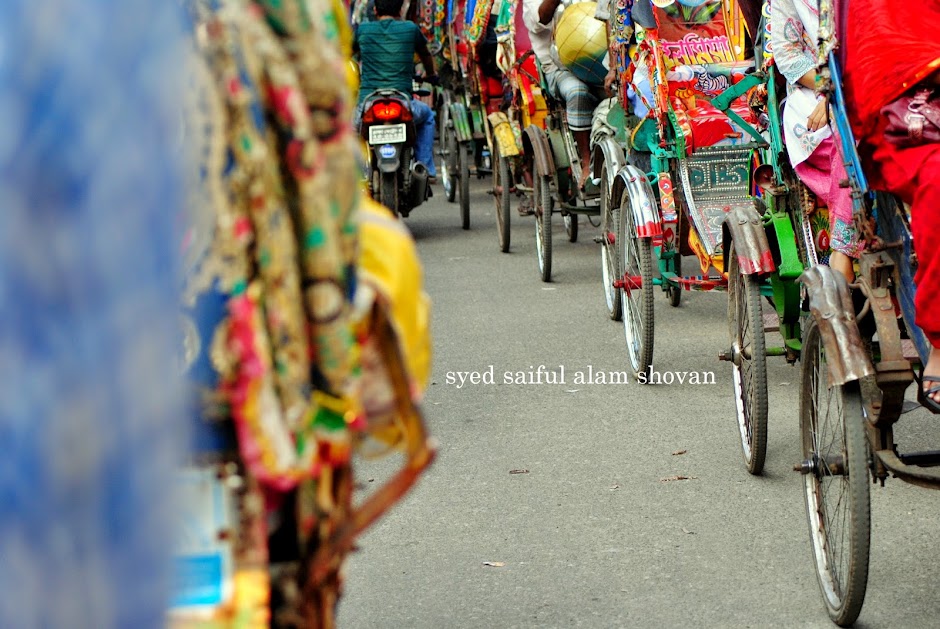
Knowledge-based Transport Planning and More Rickshaw Bans in the Dhaka City
Dr.Mahabubul Bari
For several years, discussion of transport issues and problems in Dhaka has had a singular focus on the supposed contribution of cycle rickshaws to traffic congestion, and the need to facilitate movement of automobiles. In line with this analysis of the transport situation, various projects have been undertaken, focusing on banning rickshaws and rickshaw vans from major roads, and sometimes relegating them to narrow rickshaw lanes. The problem of car parking has been addressed mainly through insistence on provision of separate parking places by offices, shops and restaurants even by enacting law under the building code. It is a matter of deep regret that not a single transport policy decision was undertaken after conducting a proper scientific or knowledge-based analysis of the transport problems of the city. It has become a standard norm to take important policy decisions rather arbitrarily, whether it is rickshaw ban or Strategic Transport Plan (STP) for the city.
The results of these various initiatives have been made clear through government-mandated studies, including the HDRC report on the rickshaw ban on Mirpur Road (HDRC 2004), and the DUTP after-study report (DUTP 2006). The results, almost astonishingly negative, would suggest that the basis for the policy decisions and transport plans are flawed. This would be less than surprising when considering the fact that important transport policy decisions were taken without employing any knowledge-based approach or scientific study.
Moreover, despite the strong evidence of increased travel costs and traffic congestion, transport planning continues to focus on expanding the role of the automobile and reducing that of fuel-free transport. That pattern has been reflected by the further extension of the rickshaw bans on more city roads. In this connection, readers are requested to draw their attention to the following news item:
Paltan-Bijoynagar Road made off-limits to rickshaws
Staff Correspondent
“Traffic Division of the Dhaka Metropolitan Police made Purana Paltan-Bijoynagar Road off-limits to rickshaws from Thursday. The decision was taken at a meeting on Wednesday. All the deputy commissioners of four traffic divisions were present at the meeting. M Sayedur Rahman, deputy commissioner (south) of traffic division, told New Age on Thursday that the authorities banned plying of non-motorised vehicles on the stretch between Purana Paltan and Bijoynagar to ease traffic congestion.” The New Age, Dhaka, Friday, October 19, 2007”.
This arbitrary decision making process as depicted in the news item draws attention to a number of disturbing questions as follows:
Do the police have the authority to ban or restrict rickshaw movements?
If yes, from whom do they get that authority?
Do the police have similar authority to limit the movement of motorised vehicles when there is not sufficient road capacity for them, e.g. narrow lanes, which cannot accommodate cars without causing traffic jams?
Probably not, it is therefore clear that such misguided policy actions are being pursued just to give absolute priority in the transport system of the city for a tiny minority of car owners, i.e. the so called elite section of the society.
Do the police have requisite training to make proper transport decisions?
If so, why dies Dhaka needs organisation like DTCB, when the police can do the job better?
The rickshaw bans are being extended beyond Mirpur Road, but it seems unlikely that those bans were carried out by the police, rather than by a section of the powerful bureaucrats behind the scene. It may be mentioned here that after failure of the rickshaw ban in the demonstration project of the Mirpur Road, the World Bank has set the standard of extending further bans on the condition that: “Any future support from the World Bank would be possible only if it can be demonstrated that aggregate positive impacts of NMT-free conversion on transport users and transport providers outweigh the aggregate negative impact”.
It is matter of deep regret that policies continue to give car owners absolute priority, while ignoring the fundamental principle of any transport project appraisal, that is, that net user benefits of any transport intervention must exceed net loss.
Now, it may be appropriate to concentrate on, possibly, the most important argument in the news item, that is, “the authorities banned plying of non-motorised vehicles on the stretch between Purana Paltan and Bijoynagar to ease traffic congestion.” In the following paragraphs answer to this question and other related aspects of such transport policy interventions, will be analysed in the light of knowledge-based and participatory decision-making approach.
Did the previous rickshaw ban in Dhaka City ease traffic congestion?
The answer lies in the “After Project” report of the government mandated study of the Mirpur Road Demonstration project (DUTP 2006), where fuel free transport was banned.
It might be appropriate to look into the issue considering a number of key congestion indices with respect to before and after scenarios of the Mirpur Road Demonstration project as follows:
Average journey time per vehicle
Average journey time per person
Journey reliability
Throughput (total number of vehicles per time interval that pass a point on the carriageway)
Average Journey time per Vehicle
The Table 1 shows the comparison of travel times of fuel dependent (motorised) vehicles between 2000 and 2005. Considering large variability of the travel time data, it is evident that there is no statistically significant difference of travel times of fuel dependent or motorised vehicles between pre and post rickshaw ban scenarios. This means that no travel time gain for fuel dependent vehicle was achieved due to rickshaw ban.
Table 1: Comparison of 2000/2005 Travel Times (average of two directions) in Mirpur Road Corridor (Source: DUTP 2006)
Year
Average Speed (km/h)
Travel Time (min.)
Delay (sec)
No of Stops
Delay in Stop (sec/stop)
Gabtoli - North South Road (Demonstration Corridor)
2005
19.9
36.1
717
20
36
2000
19.2
38.3
720
17
42
% Difference
3.6%
-5.7%
-0.4%
The Table 2 demonstrates the comparison of travel times of buses between 2000 and 2005. Although there is no statistically significant difference of travel times for fuel dependent vehicles between pre and post FFT ban scenarios, the travel times for buses did undergo significant deterioration with a 26.1% increase of travel times. This means that bus congestion has increased significantly due to imposition of rickshaw ban in the Mirpur Road demonstration corridor.
On balance average vehicle congestion in terms of journey time per vehicle has increased significantly due to the rickshaw ban.
Table 2: Comparison of 2000/2005 Travel Times for Buses in along Mirpur Road Corridor (Source: DUTP 2006)
Bus Line
Year
Speed (km/h)
Travel Time (min)
No of Stops
Line 7: Gabtoli to Gulistan Via Neel Khate
2005
13.2
50.2
45.2
2000
17.0
39.8
45.2
% Change
-22.4%
26.1%
Average journey time per person
Bus travel has worsened following the FFT ban, with a 26.1% increase in travel time; passenger travels by bus has become slower than by rickshaw. Thus all the bus passengers (28.1% of total passengers)—both those who continue to travel by bus in pre- and post-project scenarios, and those who were forced to shift from rickshaws—have experienced significant increase in travel times.
Impacts of the project on car passengers who have been riding a car both pre- and post-project are more or less neutral, as there is no significant difference in travel time.
The passengers of motorised para-transit who continue to travel both in pre- and post-project scenarios are likely to suffer increase in average journey times. While there is no significant difference in travel times between scenarios, the times required to find a driver who would be willing to go for short trips have gone up substantially as per HDRC report (HDRC 2004) thereby increasing average travel times per person.
Despite being subjected to a ban on Mirpur Road, rickshaws remain the most popular means of transport in the corridor, accounting for 30% of all trips. Rickshaw passengers have become net losers, being forced to take long detours using congested side roads, and thereby substantially increase their travel time.
These evidences from the after project studies prove that congestion in terms of average journey time per person have increased significantly after rickshaw ban in the Mirpur Road demonstration corridor.
Journey Reliability
Both DUTP after project study (DUTP 2006) and HDRC studies reported significant deterioration of waiting times for bus passengers. Again, as reported in the HDRC report, baby taxi operators are reluctant to take short trips, causing significant increases in waiting times for passengers. Similarly, finding suitable taxicabs at an affordable cost has become increasingly troublesome and time-consuming for short trips.
It is therefore clearly evident that journey reliability of the Mirpur Road demonstration project deteriorated significantly due to imposition of rickshaw ban. This in turn represents increase of congestion.
Throughput (total number of vehicles per time interval that pass a point on the carriageway)
Although it might not be appropriate to compare throughputs between a FFT free road and a mixed vehicles road, it is obvious from the Table 3 that number of vehicles that pass at North of Dhanmodi R#2 of Mirpur Road, decreased significantly both in terms of absolute number of vehicles and passenger car equivalents due to rickshaw ban. This indicates the congestion in terms of throughput has increased significantly due to rickshaw ban in Mirpur Road.
Table 3: Comparison of 2000/2005 throughputs at North of Dhanmondi Road #2 Section of Mirpur Road (Source: DUTP 2006)
Road section of Mirpur Road
Year
Vehs/hr
PCE/hr
North of Dhanmondi R#2
2000
167235
96112
North of Dhanmondi R#2
2005
55822
55930
Difference %
-66.62%
-41.81%
Again, although passenger carrying capacities of the whole network under investigation were found to increase on average by 30% due to a significant increase of bus services under a private sector-driven initiative, increase in passenger capacity for the demonstration project was only 15%. Again, a careful analysis of data reveals that nearly total elimination of FFT combined with a very high increase in bus service resulted in only a 15% increase in passenger capacity, whereas a small decrease in cars combined with only a modest increase in bus service resulted in a 27% increase in passenger capacity in a VIP road, which has been under FDT-only operation in the base case, indicating that as far as road capacity is concerned the problem is cars, not rickshaws.
Whether car more efficient than rickshaws in terms of road space occupancy?
Despite constant claims of the city officials that rickshaws are the main source of traffic jams, data indicate that rickshaws are far superior to cars as far as road space occupancy is concerned (see Table 4). In the base case i.e. before fuel free transport ban, rickshaws made up 69.8% of vehicles, yet utilised only 43.5% of road space to transport 59.4% of passengers (all trips). Cars made up only 6.4% of vehicles, yet occupied as much as 29.9% of the road space in the base case to transport far fewer passengers (5.5%) than by rickshaw.
Despite being removed from the main roads, rickshaws are still the most popular mode of transport, serving 30% of the passengers, whereas cars serve only 8.5% of all trips (11% of vehicular trips) while requiring the greatest share of road space (54.2%). Although the modal share of cars in overall has gone up only 3.0%, they now claim about 25% more road space than prior to FFT ban. If one considers the additional parking space required for them, total road space required would be much higher. It is clear that a combination of fuel-free transit and public transit would be far superior to a fuel-dependent transport and public transit option.
Table 4: Road Space Occupancy Impacts of DUTP on Mirpur Demonstration Road (Sources: DUTP 2006, STP 2005 and HDRC 2004)
Year
Attribute
Light 4-whl.
Buses
Cycle Rickshaws
2000
% Modal Share of All Trip (HDRC 2004)
5.5%
10.7%
59.4%
2000
% Modal Share of Vehicular Trip (HDRC 2004)
6.4%
12.6%
69.8%
2000
% Space on the Main Road Link
29.9%
5.2%
43.5%
2000
% Passenger on the Main Road Link
13.6%
37.4%
30.6%
2005
% Modal Share of All Trip (HDRC 2004)
8.5%
20.8%
29.5%
2005
% Modal Share of Vehicular Trip (HDRC 2004)
11.0%
26.9%
38.1%
2005
% space on the Main Road Link
54.2%
21.3%
0.1%
2005
% Passengers on the Main Road Link
12.5%
79.9%
0.0%
It may be mentioned here that despite 50% traffic growth of motorised vehicles during 2000 to 2005 period, the traffic in terms of PCE (passenger car equivalent) in Mirpur Road Demonstration corridor was lower in 2005 in comparison to that of 2000. However, despite having less number of traffic in 2005, the performance of the corridor was significantly worse under FFT free condition after the ban.
It is therefore clearly evident from the data analysis of the DUTP after project study that congestion in terms of all major congestion indices has increased significantly due to imposition of fuel free transport ban in the Mirpur Road demonstration corridor.
Whether net economic benefit of previous rickshaw ban in the Mirpur Road Demonstration Corridor was positive?
The economic impact of fuel free transport ban on the demonstration corridor has been quite devastating; even DUTB’s figures indicate an enormous net loss. Revised figures suggest a colossal loss as high as Tk 1.52 billion per year for the demonstration corridor. Not a single item produced any positive benefit.
Although banning rickshaws means that many former rickshaw passengers will now have to travel by foot, including to access buses, absolutely nothing was done to improve the situation of pedestrians. The banning of FFT in the demonstration corridor has deteriorated accessibility of the majority of road users by cutting access to side roads, destroying the continuity of the transport system, and hampering door-to-door mobility of passengers.
The fuel free transport ban has been proved to be highly regressive in economic terms, with 83% of the road users becoming the ultimate losers as against only 1%, those who shifted from rickshaws to cars, emerging victorious.
Figure 1 Impact of Mirpur Road Demonstration Project on Road Users
Can fuel free transport ban ensure social equity and protect the right of the most vulnerable sections of the society?
Any city development initiative should contribute positively to social equity and protect the right of the most vulnerable sections of the society. On the contrary the fuel free transport ban created serious social exclusion problems by depriving the most vulnerable section of the society like women, children, the elderly, the disabled and the infirm of a feasible mode of transport.
Again, the initiative has generated undue advantages to a tiny minority of the urban elite, that is, car owners, by allocating them absolute priority in all spheres of the city transport system at the expense of mobility and convenience for the majority of the road users, i.e. pedestrians and rickshaw passengers. In the demonstration corridor, cars now make up only 8.5% of all trips but they occupy 54% of road space. Moreover, undue privilege to cars has also been manifested in terms of providing them with unlimited space for parking free of cost, giving preferential access along road links, ensuring uninterrupted movement at pedestrian crossings and giving undue long green times at traffic signals, etc.
Above all, the FFT ban project shattered the life of the vulnerable rickshaw pullers and operators by reducing their income by 32-41% despite being forced to adopt longer working hours, caused them to take less food, and above all deprived them from their fundamental right of earning a living by a legal means.
Knowledge-based and participatory decision-making approach for transport planning for Dhaka City
Given the complexity of the enterprise and the fact that transport and urban planning have significant effects on the economic and overall well-being of a city’s residents, it is important not to undertake any important transport policy initiative, such as fuel free transport ban arbitrarily. It is high time to institutionalise a knowledge-based and participatory decision-making process for the Dhaka City. It is a matter of deep regret that important transport policy decisions are being taken without conducting any knowledge-based analysis by involving people who do not have proper training on transport or urban planning process. In this connection lessons can be learnt from the arbitrary decision making process of STP where a top-down planning process was adopted by involving a number of part-timers mainly drawn from the section of the urban elite without wider participation of major stakeholders and socially deprived sections of the city. As is always the case in such scenarios, the tendency to allocate resources rather arbitrarily for car-friendly (pro-rich) and capital-intensive projects becomes evidently clear from the STP approach. The experiences of different cities of Brazil prior to participatory budgeting were more or less similar, when decisions regarding urban developments were the exclusive right only for the elite and the powerful. Participatory budgeting, which has been in operation in Brazil since 1989 (Souza 2001), is emerging as an innovative urban development management theme with enormous potential to support cities in the adoption of socially integrated, inclusive, accessible, transparent, participatory and accountable urban governance and management, with a view to ensuring equitable and sustainable urban development. There is no reason why such approaches could not be institutionalised and integrated with appropriate knowledge-based process ensuring people-oriented transport developments.
In this connection, some of the major recent transport policy decisions is worth discussion. The government has recently undertaken an initiative to build 52 kilometres of subway in Dhaka City on commercial basis using private sector financing. A similar initiative on building of a system of elevated expressway under a commercial venture is probably also in the agenda. Any move to build a mass transit system for Dhaka City is long overdue and welcome. However, there are number of issues which demand especial attention prior to undertaking major policy initiatives as follows:
· It might not be appropriate to build a mass transit system as a commercial enterprise under a profit or loss system. A profit making public transit system would likely to be expensive and beyond the reach of the ordinary people despite some fancy claims from the investor. A profit making enterprise would have an adverse impact on social equity and integration. Such a transport system will definitely deny the most vulnerable section of the society about the right to accessibly and mobility. The very objective of the development of mass transit system, i.e. to provide an affordable public transport system for the majority will be defected if it is run on a commercial basis.
· Despite some over optimistic claims, the underground metro will not be able to solve the transport problem of the Dhaka city on its own. Without a proper integrated demand and supply management approach it is unlikely that only an underground metro will solve the transport problem of Dhaka City.
· It is essential that any mass transit system, such as underground metro, should be integrated appropriately with other transport sustainable transport modes, like pedestrians and FFT to make it effective.
· The bitter experience of STP planning process should not negate the need for implementing a well-integrated mass transit system under a knowledge-based and participatory transport planning process.
· The implementation of car incentive project like elevated expressway system would likely to eat up some of the potential benefits of the proposed mass transit system. Current anti-FFT and pro-car transport initiatives would likely to be counter-productive for the development a sustainable transport system for Dhaka City.
Concluding Remarks
The truism “history repeats itself” applies to those who ignore the lessons of the past and insist on forging ahead, committing the same mistakes, and experiencing the same results. It is hoped that, city authority will learn form the mistakes of the Mirpur Road Demonstration project and try to assign due importance of FFT as it deserves. Given the small modal share of autos and the many problems they cause, there should be no provision for creating more auto-only roads within urban areas, and all existing auto-only roads should be converted into mixed-use roads by properly integrating public transit, FFT and fuel-dependent transport (FDT).
Again, while developing mass transit system for a mega city like Dhaka, efforts should be made to develop an affordable system for the majority under a well-integrated multi-modal system. It would be rather unfortunate to develop a mass transit system mainly as a profit making enterprise.
Given the complexity of the transport planning process and the fact that transport and urban planning have significant effects on the economic and overall well-being of a city’s residents, it is important adopting a knowledge-based and participatory approach involving all segment of the stakeholders. Such participatory planning process should take into account not only technical issues about feasibility and efficiency, but also the likely effects of policies on mobility, accessibility, and quality of life for all those affected, with a particular focus on vulnerable groups, those most likely to be left out of, and highly affected by, the existing planning process.
References:
DUTP (2006), “Impact Assessment of DUTP: After Project”, Final Report submitted to Dhaka Transport Coordination Board, by DHV Consultants BV, the Netherlands, Japan Overseas Co., Ltd., Japan, Finnroad Oy, Finland, Operation Research Group, India, SARM Associates Ltd., Bangladesh, Desh Upodesh Ltd., Bangladesh, DevConsultants Ltd., Bangladesh in Dhaka Urban Transport Project (DUTP), Dhaka, February 2006.
HDRC (2004), “After Study on the Impact of Mirpur Demonstration Corridor Project (Gabtoli-Russell Square)” Report prepared for Dhaka Transportation Coordination Board (DTCB), Human Development Research Centre, August 2004, Dhaka
Souza, C. (2001) “Participatory budgeting in Brazilian cities: limits and possibilities in building democratic institutions.” Environment & Urbanization, Vol. 13 No 1, April 2001.
It is important to have an open discussion to explore the scientific validity of the further extensions of fuel free transport bans and the justification of the building a mass transit mainly as a profit making enterprise under the perspectives of sustainable transport development in the Dhaka City. We, the proponents of sustainable transport development, would be very keen to discuss the issues at lengths at any place in Dhaka in between December 29 2007 to January 21, 2008. Active participation of DTCB, DCC, police, high officials from the Ministry of Communications, academic from universities, representatives from the development partners and members of STP advisory committee would be highly appreciated.
This article also pulished
- The Finacial Express Dhaka needs proper transport planning
- The Daily New Nation Knowledge-based transport planning and rickshaw bans
Syed Saiful Alam Shovan
shovan1209[at]yahoo.com
Dhaka Rickshaw Pro-people Transport Plan All Newspapers on one click