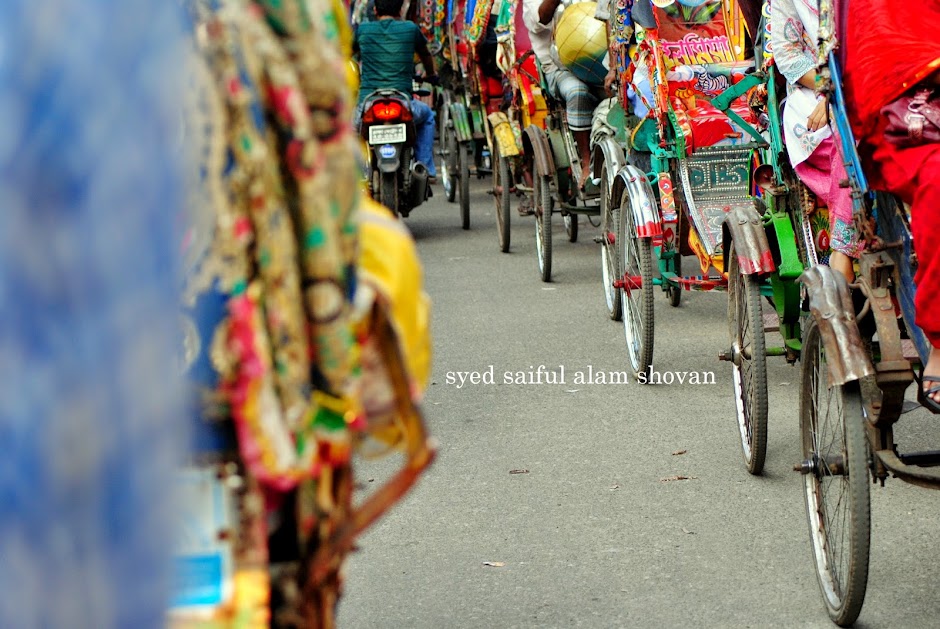
RICKSHAW

Showing posts with label playground. Show all posts

Monday, September 7, 2009

Cycle Training in Dhaka: More than it appears


Syed Saiful Alam

For four hours a week, one section of a residential street in Dhanmondi comes to life with the shouts of playing children. Boys and girls, age five on up, are on bicycles—a few with training wheels, most without. Some are just learning, guided by a helping hand, while others ride confidently on their own, despite the child’s diminutive size. Teenagers join in the ride, and even a few adults come to learn.

One of the trainers leans down and asks a child, “How do you feel about riding a bike?” “I love it!” exclaims the child. “Which would you rather do, play computer games, watch TV, or ride a bike?” “Ride a bike!” “What if Tom and Jerry cartoons were on?” asks the trainer. “Then what would you rather do?”“Ride a bike!” the child repeats.

It is clear from watching the children that this child is not alone in his fascination for cycling. The other kids of all sizes are also happily absorbed.A few official helpers, themselves aged only 12-15, move around the bicycles and clusters of children with authority, ensuring that everyone gets a chance at a bicycle, helping young children learn, and checking that the bikes are in good condition. A sturdy 14-year-old circulates with a pump and tools, fixing the bicycles when they fall into disrepair. Various adults from the neighborhood also gather, mothers to watch their children with anxiety and pride, father and brothers to help with the program, or just to enjoy the evident pleasure of the children.

A CNG baby taxi driver slows to a stop in front of a large sign featuring Einstein and a Bangla slogan, “Cycling is intelligent transport.” Other vehicles slow down as the drivers and passengers stare at this unanticipated sight of children riding in the street, in a lane marked with small signs with messages such as “Let us play” and “Cycle training is going on”.

The program is run by WBB Trust Thursdays and Saturdays from about 3-5 pm (earlier in winter, later in summer) in front of its office on Road 4/A in Dhanmondi. WBB hopes the program will spread, as people see the need to make better use of all the space usually devoted exclusively to traveling and parking.

Ziaur Rahman Litu, who regularly helps with the program, comments, “Rich children have many advantages; they can get basically whatever they want. But for poor children, they may only get one meal a day. They gain no advantages in school, housing, or other areas. We need to do something for them. I can’t help them to eat, but at least when they come to our program, they are enjoying themselves, laughing, forgetting their hunger and other problems. We want to spread this joy throughout the city.”

The mother of a very overweight boy watches with concern as her child struggles to learn, unable to gain his balance due to his unwieldy body. “I know he needs to lose weight, but where can he play? At home he’s always in front of the TV,” she explains. As her son gains confidence and slowly begins to gain balance, she herself gets onto a bicycle, riding for the first time in years. Though she falls several times and rips her salwar, she is laughing with joy. Soon she sails past her son, shouting to him, “Look at your mother!”A 10-year-old girl is riding for the first time, and slowly gains confidence, only to crash into the footpath and fall over. Her mother runs anxiously over, and someone pulls out a bottle of Savlon. The girl grins, waving everyone away, and gets right back onto the bicycle. Some parents may never have seen this aspect of their children, or perhaps only on a visit to the countryside, where their children run eagerly, climb trees, and forget to whimper or complain over minor pains.

Another mother tells us that her daughter is usually silent, and never mixes with others. But when she saw that children are riding on the street, she suddenly became excited and begged her mother to take her to the class. This child, reluctant to talk to others, who has no friends, suddenly is struggling with persistence to learn, and euphoria breaks across her face as she pedals away from her trainer and rides free for the first time.

Advantages for participants include not only the chance to learn to ride a bike, or to practice the skill, or to enjoy outdoor play, but the confidence of the child helpers in carrying out their job, and the opportunity for rich and poor to mix in a safe setting. For guardians and the others who congregate on the footpaths, this is an opportunity for recreation simply in watching others, laughing at the spectacle of grown men stumbling as they learn, and at the pleasure of children.
WBB Trust explains that in a good city, children can safely walk and cycle to school, traffic systems are not all geared towards the convenience of car drivers but allow others to move safely by other means, office workers can transport themselves by bicycle without cost, and parking for cars does not take priority over play space for children.

Children need play spaces, not just in the home but outdoors, where they can move about freely and mix with other children. Relying on playgrounds and fields in the crowded city of Dhaka is no solution. If children are to have any hope of a happy childhood, with full opportunities for development, then we have to consider turning some of our less trafficked streets into playgrounds, at least a few hours a week, so once again our city can ring with the happy shouts of children.

On a Saturday afternoon, as the street again fills with children and bikes, other children are playing in the only space available for them—the roof of their luxury apartment building. As they toss a ball to each other, the ball frequently falls down on the street, amongst the cyclists. The players congregate on the roof and stare down at the children, perhaps wondering when they, too, will be able to make the street their playground.


www.dhaka-rickshaw.blogspot.com/ Dhaka Rickshaw
www.dhaka-transport.blogspot.com/ Pro-people Transport Plan www.dhakanewspapers.blogspot.com/ All Newspapers on one click

syed saiful alam
shovan1209@yahoo.com

Sunday, September 6, 2009

save city parks and playgrounds.


Save the Environment Movement (SEM) and WBB Trust form a human chain in front of Faculty of Fine Art on Dhaka University campus yesterday with a call to save city parks and playgrounds.Staff Correspondent
Environmentalists at a human chain yesterday demanded the parks in the city be saved.
They also demanded more open spaces and playgrounds to ensure sound physical and mental development of the children.

Save the Environment Movement (SEM) and WBB Trust formed the human chain in front of Faculty of Fine Art on Dhaka University campus.
Chairman of SEM Abu Naser Khan said physical exercise and outdoor games are very important for sound mental growth of a man.

The children are being deprived of the opportunity to play outdoor games due to lack of playgrounds and parks, he said.

Project Manager of WBB Trust Syed Mahbubul Alam said people are suffering from different kinds of diseases like diabetes, obesity and cardiac problem due to lack of outdoor games and physical exercise.

The children are the worst sufferers of the process and to address the problem it is necessary to ensure that they get outdoor games facilities since their childhood, he said.

Secretary General of Citizens' Rights Movement Tushar Rehman said amusement facilities should get special attention in urban planning.
Singer Abdul Kuddus Boyati, President of Nirapad Foundation Ibnul Sayed Rana and President of Khilgaon Samajik Unnayan Sangstha Hafizur Rahman Mayna also spoke.


Call to protect parks, open spaces in city
Green activists on Thursday urged the government to take immediate measures for protecting the existing open spaces, parks and playgrounds in the city. They also called on the authorities concerned to set up more parks and playgrounds for city dwellers, including children. They demanded cancellation of leasing system of playgrounds and open spaces, ensuring people’s representation in park management and strict enforcement of water body conservation act 2000.
Environmental activists made the demands at a human chain programme organised by Save the Environment Movement and Work for Better Bangladesh Trust in front of the fine arts faculty at Dhaka University. SEM chairman Abu Naser Khan, WBB Trust project manager Syed Mahbubul Alam, Citizen’s Rights Movement secretary general Tusher Rehman, folk singer Quddus Boyati, Nirapad Development Foundation president Ibnul Sayed Rana and Khilgaon Samajik Unnayan Sangstha president Hafizur Rahman, among others, took part in the programme. ‘There is no alternative but to keep open spaces and playgrounds for sound mental health of children. But the children are being deprived of such facilities,’
Naser Khan said. ‘Both mental and physical growth of the children are being hampered due to the absence of sufficient open spaces and playgrounds,’ he said, calling upon the government to take immediate steps for saving the existing open spaces, parks and playgrounds. Syed
Mahbubul Alam said, ‘City people are exposed to many diseases like diabetes as they don’t get sufficient open spaces for doing physical exercise.’ They also blasted Rajuk for its failure to compel the house owners to keep a portion as open space. Children also lodged their protest against unplanned urbanisation leaving no space for them to play. They queued up inside a makeshift cage.
www.dhaka-rickshaw.blogspot.com/ Dhaka Rickshaw
www.dhaka-transport.blogspot.com/ Pro-people Transport Plan www.dhakanewspapers.blogspot.com/ All Newspapers on one click
Syed Saiful Alam
Save The Environment Movement
shovan1209[at]yahoo.com

Saturday, August 30, 2008

Cycle Training in Dhaka: More than it appears

Cycle Training in Dhaka: More than it appears

Syed Saiful Alam

For four hours a week, one section of a residential street in Dhanmondi comes to life with the shouts of playing children. Boys and girls, age five on up, are on bicycles—a few with training wheels, most without. Some are just learning, guided by a helping hand, while others ride confidently on their own, despite the child’s diminutive size. Teenagers join in the ride, and even a few adults come to learn.

One of the trainers leans down and asks a child, “How do you feel about riding a bike?”
“I love it!” exclaims the child.

“Which would you rather do, play computer games, watch TV, or ride a bike?”
“Ride a bike!”

“What if Tom and Jerry cartoons were on?” asks the trainer. “Then what would you rather do?”
“Ride a bike!” the child repeats. It is clear from watching the children that this child is not alone in his fascination for cycling. The other kids of all sizes are also happily absorbed.

A few official helpers, themselves aged only 12-15, move around the bicycles and clusters of children with authority, ensuring that everyone gets a chance at a bicycle, helping young children learn, and checking that the bikes are in good condition. A sturdy 14-year-old circulates with a pump and tools, fixing the bicycles when they fall into disrepair. Various adults from the neighborhood also gather, mothers to watch their children with anxiety and pride, father and brothers to help with the program, or just to enjoy the evident pleasure of the children.
A CNG baby taxi driver slows to a stop in front of a large sign featuring Einstein and a Bangla slogan, “Cycling is intelligent transport.” Other vehicles slow down as the drivers and passengers stare at this unanticipated sight of children riding in the street, in a lane marked with small signs with messages such as “Let us play” and “Cycle training is going on”.


The program is run by WBB Trust Thursdays and Saturdays from about 3-5 pm (earlier in winter, later in summer) in front of its office on Road 4/A in Dhanmondi. WBB hopes the program will spread, as people see the need to make better use of all the space usually devoted exclusively to traveling and parking.

Ziaur Rahman Litu, who regularly helps with the program, comments, “Rich children have many advantages; they can get basically whatever they want. But for poor children, they may only get one meal a day. They gain no advantages in school, housing, or other areas. We need to do something for them. I can’t help them to eat, but at least when they come to our program, they are enjoying themselves, laughing, forgetting their hunger and other problems. We want to spread this joy throughout the city.”

The mother of a very overweight boy watches with concern as her child struggles to learn, unable to gain his balance due to his unwieldy body. “I know he needs to lose weight, but where can he play? At home he’s always in front of the TV,” she explains. As her son gains confidence and slowly begins to gain balance, she herself gets onto a bicycle, riding for the first time in years. Though she falls several times and rips her salwar, she is laughing with joy. Soon she sails past her son, shouting to him, “Look at your mother!”

A 10-year-old girl is riding for the first time, and slowly gains confidence, only to crash into the footpath and fall over. Her mother runs anxiously over, and someone pulls out a bottle of Savlon. The girl grins, waving everyone away, and gets right back onto the bicycle. Some parents may never have seen this aspect of their children, or perhaps only on a visit to the countryside, where their children run eagerly, climb trees, and forget to whimper or complain over minor pains.
Another mother tells us that her daughter is usually silent, and never mixes with others. But when she saw that children are riding on the street, she suddenly became excited and begged her mother to take her to the class. This child, reluctant to talk to others, who has no friends, suddenly is struggling with persistence to learn, and euphoria breaks across her face as she pedals away from her trainer and rides free for the first time.

Advantages for participants include not only the chance to learn to ride a bike, or to practice the skill, or to enjoy outdoor play, but the confidence of the child helpers in carrying out their job, and the opportunity for rich and poor to mix in a safe setting. For guardians and the others who congregate on the footpaths, this is an opportunity for recreation simply in watching others, laughing at the spectacle of grown men stumbling as they learn, and at the pleasure of children.
Maruf Rahman of WBB Trust explains that in a good city, children can safely walk and cycle to school, traffic systems are not all geared towards the convenience of car drivers but allow others to move safely by other means, office workers can transport themselves by bicycle without cost, and parking for cars does not take priority over play space for children.


Children need play spaces, not just in the home but outdoors, where they can move about freely and mix with other children. Relying on playgrounds and fields in the crowded city of Dhaka is no solution. If children are to have any hope of a happy childhood, with full opportunities for development, then we have to consider turning some of our less trafficked streets into playgrounds, at least a few hours a week, so once again our city can ring with the happy shouts of children.


On a Saturday afternoon, as the street again fills with children and bikes, other children are playing in the only space available for them—the roof of their luxury apartment building. As they toss a ball to each other, the ball frequently falls down on the street, amongst the cyclists. The players congregate on the roof and stare down at the children, perhaps wondering when they, too, will be able to make the street their playground.


www.dhaka-rickshaw.blogspot.com/ Dhaka Rickshaw
www.dhaka-transport.blogspot.com/ Pro-people Transport Plan www.dhakanewspapers.blogspot.com/ All Newspapers on one click

Syed Saiful Alam Save The Environment Movement shovan1209[at]yahoo.com

What If We Loved Our Kids More than Our Cars?

What If We Loved Our Kids More than Our Cars?

For it must be a sick society indeed that can, and does, and continues to, love its cars more than its children.

WITHIN just one generation, the lives of children throughout the world have changed radically, with just one indication among many being that so many children are now driven to school rather than walking. The same change that occurred in the United States has also happened where I now live, in Dhaka, Bangladesh. Even though car owners are very much the minority, children’s freedom has been greatly curtailed by those cars. Those whose parents do have cars are driven everywhere; those whose parents do not, unless they are very poor, are escorted by adults and strictly prohibited from playing outdoors. It sometimes seems the only children in the city who have the opportunity for wholehearted pleasure, and who have confidence and skill in negotiating the streets, are the slum children.


One could, of course, sit back quietly and watch these changes, reflecting that surely it isn’t as bad as it appears or that something else will come along to make things better or that children perhaps don’t need to play outdoors or meet and interact with strangers or get to know those of other social classes or learn how to get around on their own. It is easy to be defeatist and say who am I to fight such changes? And there are those who feel the changes are inevitable, because the only response is to curtail cars – and that is a ‘freedom’ or enjoyment we could never part with. It isn’t that bad, people may argue; in some parts of the world children have access to parks and playgrounds, and while structured sports for children may not deliver all the benefits of street play, it is the best we can do in the modern world and surely nobody wishes to give up the benefits of modernity.


We too, here in Dhaka, watched the changes and despaired. Later, I found inspiration in reading David Engwicht’s Street Reclaiming; we bought sports equipment to give to the children on the street where our office is – a ‘residential’ neighbourhood with homes, NGO offices, a private university, a pharmaceutical company, a car repair centre and a fair amount of traffic – and made signs to put in the streets with such messages as ‘Love us, let us play.’ The kids took the sporting equipment and played on the roof of their apartment building; the signs seemed likely to turn rusty in our office.


Then one day, a few months later, a couple of my colleagues came into my office and announced that on that very afternoon they were starting a cycle training programme. A what? We have been working to promote cycling, and fighting with transport officials on the issue of cycle rickshaw bans in Dhaka; in the process we have collected a good number of small, folding bikes. Out came the bikes. We bought a few more for little kids, and taped paper with the message ‘Cycle training’ over our old signs, and put up a banner, and later made a large sign showing Einstein on a bicycle – an amusing choice, I had to think, in a Muslim country – all to make the car drivers pay attention, slow down, and yield a lane or two to the kids.


The first day we arranged for some friends to come cycle; almost nobody from our street showed up. Curious children and sceptical adults watched from their balconies. Later, a neighbour told us that people believed we couldn’t be offering free cycle training without an underlying motive –which they took to be that we were planning to kidnap their children. How effective the media has proved in frightening parents out of allowing their children freedom of movement or opportunity to play! If only we could compare the likelihood of children being harmed by being kept under lock and key to the likelihood of being kidnapped. But the woman who told us this was brave, or had a better feeling towards humanity, and brought her children, and reported to her neighbours, and the numbers began to increase. We advertised the programme (for free) in newspapers and through handbills, and children and adolescents (and even adults) from different parts of town began to come, and a regular group of children showed up for the inestimable pleasure of riding a bike with other children.


Other organisations have started similar initiatives, though on small fields rather than on streets. Less than a year has passed, and we hope eventually people will realise the good sense of converting quiet streets into temporary children’s playgrounds. In the meantime, other stunning and unanticipated results have occurred. Prior to the programme, no children on the street knew each other, having always being escorted by parents, usually by car; now many friendships have developed.


One of our volunteers, Topon Shikder says: ‘We have created a platform which allows children from different apartment buildings to get to know each other, breaking the isolation which existed, in which everyone lived their separate lives. So now if someone is in trouble – is sick, or there is no male around – they can turn to each other for help. And of course the kids love it, they keep asking me, “give me a bike, give me a bike, when is it my turn?” It’s wonderful to see their excitement.’


We have slum children helping to run the programme and fix the bicycles; like it or not, if you want to ride, you have to interact with these kids, and interact they do. A couple of child servants who have no other opportunity for recreation sneak away to join and revel in being treated the same by our staff as the rich neighbourhood kids. The children who repair the bikes have gained confidence as well as new skills, marching about with great authority; twice a week a few of them eat lunch with our office staff. During school holidays, children from the street come to our office to borrow bikes, usually in groups; it is now perfectly normal to have children moving around as freely as if it were their office.


Another of our volunteers, Muminul Islam says, ‘Street children – those who pick rags or papers, or sell peanuts at the nearby lake, to make a little money – often wander to our street to watch, and stand with their mouths almost hanging open. So I send one of our kids with a bike to ask the child if he wants to ride for a few minutes. I can’t express how happy they are! Sometimes afterwards they get so excited that they come up to me and grab my hand, calling me uncle or brother, and thank me profusely.’


I wish I could say that the adults on our street have also thanked us warmly for the initiative, and that drivers slow down, or avoid entering our dead-end street altogether so as not to disrupt the children. Most adults, including the parents whose kids participate, are delighted; when they see drivers racing on the street, or honking loudly at the kids, they complain about how uncivilised they are. But other adults tell us we should take the programme elsewhere, and one woman – a paediatrician –complained that it’s hard on drivers because ‘we have to slow down;’ others ask why we take so much space (blocking one or two lanes of a three-lane street). Our volunteers shake their heads in wonder – it really seems that people love their cars more than their children, they say.


What we are giving to the children at one level seems so minor – the chance to ride a bike up and down a stretch of road, while passing drivers blare their horns. On the other hand, we are giving them the freedom to leave their homes unescorted, to gain a new skill, to form friendships, to interact with different kinds of people...and to have fun. Perhaps, if things go well, if we are able to continue and expand, we will even succeed in communicating our key message: cars should not be allowed to destroy the joy in children’s lives. Perhaps, people will see that children don’t have to grow up trapped in cars and behind TV, helpless and dependent, growing up in fear of strangers and of the world around them. Perhaps, they will come to see the harm in the mentality that has developed; in which any sacrifice of children’s natural state seems preferable to restrictions on cars. For it must be a sick society indeed that can, and does, and continues to, love its cars more than its children.