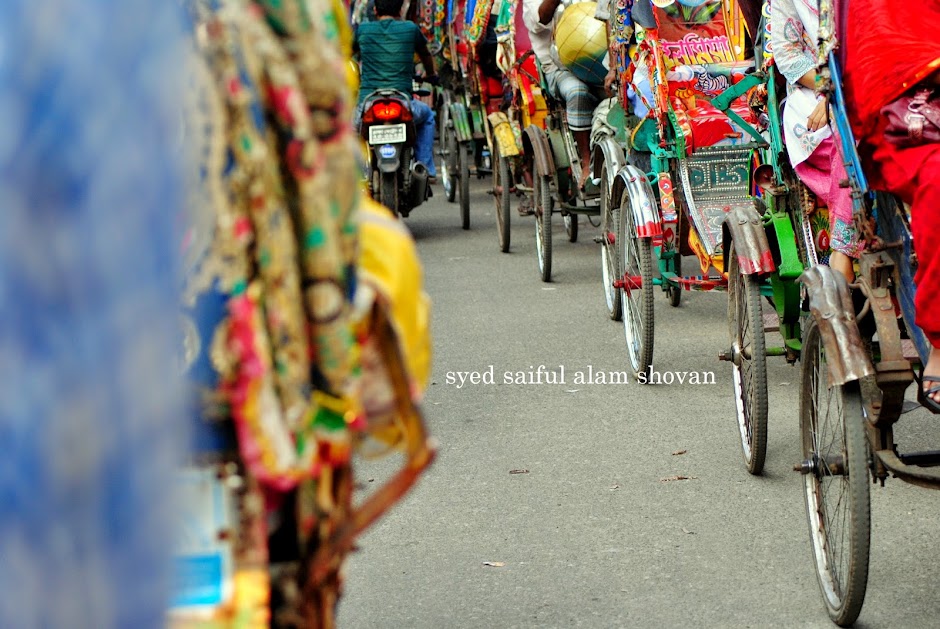
RICKSHAW

Showing posts with label cycle. Show all posts

Monday, September 7, 2009

Cycle Training in Dhaka: More than it appears


Syed Saiful Alam

For four hours a week, one section of a residential street in Dhanmondi comes to life with the shouts of playing children. Boys and girls, age five on up, are on bicycles—a few with training wheels, most without. Some are just learning, guided by a helping hand, while others ride confidently on their own, despite the child’s diminutive size. Teenagers join in the ride, and even a few adults come to learn.

One of the trainers leans down and asks a child, “How do you feel about riding a bike?” “I love it!” exclaims the child. “Which would you rather do, play computer games, watch TV, or ride a bike?” “Ride a bike!” “What if Tom and Jerry cartoons were on?” asks the trainer. “Then what would you rather do?”“Ride a bike!” the child repeats.

It is clear from watching the children that this child is not alone in his fascination for cycling. The other kids of all sizes are also happily absorbed.A few official helpers, themselves aged only 12-15, move around the bicycles and clusters of children with authority, ensuring that everyone gets a chance at a bicycle, helping young children learn, and checking that the bikes are in good condition. A sturdy 14-year-old circulates with a pump and tools, fixing the bicycles when they fall into disrepair. Various adults from the neighborhood also gather, mothers to watch their children with anxiety and pride, father and brothers to help with the program, or just to enjoy the evident pleasure of the children.

A CNG baby taxi driver slows to a stop in front of a large sign featuring Einstein and a Bangla slogan, “Cycling is intelligent transport.” Other vehicles slow down as the drivers and passengers stare at this unanticipated sight of children riding in the street, in a lane marked with small signs with messages such as “Let us play” and “Cycle training is going on”.

The program is run by WBB Trust Thursdays and Saturdays from about 3-5 pm (earlier in winter, later in summer) in front of its office on Road 4/A in Dhanmondi. WBB hopes the program will spread, as people see the need to make better use of all the space usually devoted exclusively to traveling and parking.

Ziaur Rahman Litu, who regularly helps with the program, comments, “Rich children have many advantages; they can get basically whatever they want. But for poor children, they may only get one meal a day. They gain no advantages in school, housing, or other areas. We need to do something for them. I can’t help them to eat, but at least when they come to our program, they are enjoying themselves, laughing, forgetting their hunger and other problems. We want to spread this joy throughout the city.”

The mother of a very overweight boy watches with concern as her child struggles to learn, unable to gain his balance due to his unwieldy body. “I know he needs to lose weight, but where can he play? At home he’s always in front of the TV,” she explains. As her son gains confidence and slowly begins to gain balance, she herself gets onto a bicycle, riding for the first time in years. Though she falls several times and rips her salwar, she is laughing with joy. Soon she sails past her son, shouting to him, “Look at your mother!”A 10-year-old girl is riding for the first time, and slowly gains confidence, only to crash into the footpath and fall over. Her mother runs anxiously over, and someone pulls out a bottle of Savlon. The girl grins, waving everyone away, and gets right back onto the bicycle. Some parents may never have seen this aspect of their children, or perhaps only on a visit to the countryside, where their children run eagerly, climb trees, and forget to whimper or complain over minor pains.

Another mother tells us that her daughter is usually silent, and never mixes with others. But when she saw that children are riding on the street, she suddenly became excited and begged her mother to take her to the class. This child, reluctant to talk to others, who has no friends, suddenly is struggling with persistence to learn, and euphoria breaks across her face as she pedals away from her trainer and rides free for the first time.

Advantages for participants include not only the chance to learn to ride a bike, or to practice the skill, or to enjoy outdoor play, but the confidence of the child helpers in carrying out their job, and the opportunity for rich and poor to mix in a safe setting. For guardians and the others who congregate on the footpaths, this is an opportunity for recreation simply in watching others, laughing at the spectacle of grown men stumbling as they learn, and at the pleasure of children.
WBB Trust explains that in a good city, children can safely walk and cycle to school, traffic systems are not all geared towards the convenience of car drivers but allow others to move safely by other means, office workers can transport themselves by bicycle without cost, and parking for cars does not take priority over play space for children.

Children need play spaces, not just in the home but outdoors, where they can move about freely and mix with other children. Relying on playgrounds and fields in the crowded city of Dhaka is no solution. If children are to have any hope of a happy childhood, with full opportunities for development, then we have to consider turning some of our less trafficked streets into playgrounds, at least a few hours a week, so once again our city can ring with the happy shouts of children.

On a Saturday afternoon, as the street again fills with children and bikes, other children are playing in the only space available for them—the roof of their luxury apartment building. As they toss a ball to each other, the ball frequently falls down on the street, amongst the cyclists. The players congregate on the roof and stare down at the children, perhaps wondering when they, too, will be able to make the street their playground.


www.dhaka-rickshaw.blogspot.com/ Dhaka Rickshaw
www.dhaka-transport.blogspot.com/ Pro-people Transport Plan www.dhakanewspapers.blogspot.com/ All Newspapers on one click

syed saiful alam
shovan1209@yahoo.com

Sunday, September 6, 2009

save city parks and playgrounds.


Save the Environment Movement (SEM) and WBB Trust form a human chain in front of Faculty of Fine Art on Dhaka University campus yesterday with a call to save city parks and playgrounds.Staff Correspondent
Environmentalists at a human chain yesterday demanded the parks in the city be saved.
They also demanded more open spaces and playgrounds to ensure sound physical and mental development of the children.

Save the Environment Movement (SEM) and WBB Trust formed the human chain in front of Faculty of Fine Art on Dhaka University campus.
Chairman of SEM Abu Naser Khan said physical exercise and outdoor games are very important for sound mental growth of a man.

The children are being deprived of the opportunity to play outdoor games due to lack of playgrounds and parks, he said.

Project Manager of WBB Trust Syed Mahbubul Alam said people are suffering from different kinds of diseases like diabetes, obesity and cardiac problem due to lack of outdoor games and physical exercise.

The children are the worst sufferers of the process and to address the problem it is necessary to ensure that they get outdoor games facilities since their childhood, he said.

Secretary General of Citizens' Rights Movement Tushar Rehman said amusement facilities should get special attention in urban planning.
Singer Abdul Kuddus Boyati, President of Nirapad Foundation Ibnul Sayed Rana and President of Khilgaon Samajik Unnayan Sangstha Hafizur Rahman Mayna also spoke.


Call to protect parks, open spaces in city
Green activists on Thursday urged the government to take immediate measures for protecting the existing open spaces, parks and playgrounds in the city. They also called on the authorities concerned to set up more parks and playgrounds for city dwellers, including children. They demanded cancellation of leasing system of playgrounds and open spaces, ensuring people’s representation in park management and strict enforcement of water body conservation act 2000.
Environmental activists made the demands at a human chain programme organised by Save the Environment Movement and Work for Better Bangladesh Trust in front of the fine arts faculty at Dhaka University. SEM chairman Abu Naser Khan, WBB Trust project manager Syed Mahbubul Alam, Citizen’s Rights Movement secretary general Tusher Rehman, folk singer Quddus Boyati, Nirapad Development Foundation president Ibnul Sayed Rana and Khilgaon Samajik Unnayan Sangstha president Hafizur Rahman, among others, took part in the programme. ‘There is no alternative but to keep open spaces and playgrounds for sound mental health of children. But the children are being deprived of such facilities,’
Naser Khan said. ‘Both mental and physical growth of the children are being hampered due to the absence of sufficient open spaces and playgrounds,’ he said, calling upon the government to take immediate steps for saving the existing open spaces, parks and playgrounds. Syed
Mahbubul Alam said, ‘City people are exposed to many diseases like diabetes as they don’t get sufficient open spaces for doing physical exercise.’ They also blasted Rajuk for its failure to compel the house owners to keep a portion as open space. Children also lodged their protest against unplanned urbanisation leaving no space for them to play. They queued up inside a makeshift cage.
www.dhaka-rickshaw.blogspot.com/ Dhaka Rickshaw
www.dhaka-transport.blogspot.com/ Pro-people Transport Plan www.dhakanewspapers.blogspot.com/ All Newspapers on one click
Syed Saiful Alam
Save The Environment Movement
shovan1209[at]yahoo.com

Monday, June 1, 2009

অর্থনীতি, জ্বালানী সঙ্কট ও রিকশা


পরিবেশ বাচাঁও আন্দোলন (পবা)র একদল সেচ্ছাসেবক রিকশা বিষয়ক পেপার তৈরি করেছে। রাজধানী ঢাকার রিকশা চলচলের সুবিধা, সম্ভবনা, চলাচলে প্রতিবন্ধকতা, বৈজ্ঞানিক ভিত্তি, চলাচলের যুক্তিকতা, পরিবহন পরিকল্পনা, অর্থনীতি, পরিবেশ, রাজনীতি, সামাজিকতা, দারিদ্র বিমোচনসহ অনেকগুলো বিষয়ই উঠে এসেছে। তারপরও নেহাতই সময় সল্পতা, পেপারটির আকার নিয়ন্ত্রণ করার বাধ্য বাধ্যকতা থাকায় বেশ কিছু বিষয় বাদ দিতে হয়েছে। কিন্তু কোন অংশেই সেই বিষয়গুলো ছোট করে দেখার কিছু নেই। এই পেপারটি তৈরি পেছনে থাকা সকলের প্রতি আন্তরিক কৃতজ্ঞতা প্রকাশ করছি। পাশাপাশি আশা করি এই ব্লগের অনেকেরই বিভিন্ন সময় মন্তব্য প্রকাশের মাধ্যমে এই লেখাটিকে সমৃদ্ধ করেছেন এবং নানা ভাবে সমর্থন দিয়ে সহয়তা করেছেন তাদের প্রতি কৃতজ্ঞতা প্রকাশ করছি। আমরা বিশ্বাস করি এই লেখাটি যদি বিভিন্ন পযায়ে মানুষের কাছে পৌছে দেওয়া যায় তাহলে ঢাকার আগমীর পরিবহন পরিকল্পনায় বিশেষ ভূমিকা রাখবে।


রিকশা অর্থনীতি
ঢাকা শহরের অধিকাংশ যাতায়াত স্বল্প দূরত্বের। আর স্বল্প দূরত্বে বিরতীহীনভাবে যাতায়াতের জন্য রিকশা হচ্ছে সাশ্রয়ী ও জনপ্রিয় বাহন। রিকশা জ্বালানীমুক্ত, পরিবেশবান্ধব ও নিরাপদ বাহন। এর মাধ্যমে প্রচুর মানুষের কর্মসংস্থানের সুযোগ রয়েছে। সুতরাং রিকশা চলাচলকে কিভাবে সুষ্ঠু ব্যবস্থাপনার আওতায় আনা যায় সেই ধরনের পদক্ষেপ গ্রহণ করা প্রয়োজন। রিকশা দেশের পরিবহণ খাতে প্রতি বছর ৫ হাজার কোটি টাকার জ্বালানী সাশ্রয় করছে। রিকশা পরিবেশের ক্ষতি থেকেও রক্ষা করছে, যার মূল্য বছরে ১০ হাজার কোটি টাকা। হিউম্যান রিসোর্স সেন্টার (এইচডিআরসি) এর সমীক্ষায় দেখা যায় বাংলাদেশ বিমান, রেল, সড়ক ও নৌপরিবহণ খাত থেকে বছরে যত টাকা আয়, রিকশা থেকে এককভাবে তার চেয়ে বেশি অর্থ আয় হয়। ঢাকার রিকশা চালকরা প্রতি মাসে ২শ কোটি টাকা গ্রামে পাঠান। বাংলাদেশ পরিসংখ্যান বু্যরোর তথ্যমতে ২০০৪-০৫ অর্থবছরে রিকশা থেকে সরকার আয় করেছে ১ হাজার ৯শ ৮০ কোটি টাকা। প্রাইভেট কার জিপ ও ট্যাক্সি থেকে ৬৪ কোটি টাকা।


জ্বালানী সঙ্কট ও রিকশা :
বর্তমানে সারা বিশ্বে জ্বালানী অত্যনত্দ আলোচিত একটি বিষয়। দিন দিন জ্বালানী চাহিদা বৃদ্ধির ফলে দেখা দিয়েছে নানাতর সঙ্কট। এছাড়া বিশেষজ্ঞরা বিশ্বে জ্বীবাশ্ম জ্বালানীর মজুদ নিকট ভবিষ্যতে ফুরিয়ে যাবার আশঙ্কা প্রকাশ করেছেন। সেক্ষেত্রে জ্বালানী নিরাপত্তার জন্য এর চাহিদা নিয়ন্ত্রণ করা জরুরী হয়ে পড়েছে। এক্ষেত্রে ঢাকার বিভিন্ন সড়ক থেকে রিকশা নিষিদ্ধ করায় পরিবহণ খাতে জ্বালানীর ব্যবহার বৃদ্ধি পাচ্ছে। পত্রিকার সংবাদের ভিত্তিতে জ্বালানী সমস্যা সম্পর্কে জাতীয় ও আনত্দর্জাতিক পর্যায়ের কিছু বিষয়ে আলোকপাত করা হলো।

১.দি নিউইয়র্ক টাইমস এর ওয়েবসাইট সংস্করণে বিশেষজ্ঞদের মতামত শিল্প কলকারখানার চিত্র তুলে ধরে জানায় জ্বালানী তেল রফতানীকারক কয়েকটি নেতৃস্থানীয় দেশ আগামী দশ বছরের মধ্যে নিজস্ব জ্বালানী চাহিদা মেটাতে তেল আমদানীকারক দেশ হিসেবে পরিণত হতে পারে। ইতোমধ্যেই ইন্দোনেশিয়া এরকম পরিস্থিতির সম্মূখীন হয়েছে, অন্যদিকে মেক্সিকো আগামী পাঁচ বছরের মধ্যেই তেল আমদানীতে যেতে পারে। (আমাদের সময়, ১০ ডিসেম্বর ২০০৭)

২.ইন্টারন্যাশনাল এনার্জি এজেন্সি (আইইএ) জানিয়েছে ২০০৮ সালে গড়ে প্রায় ২.২ মিলিয়ন ব্যারেল তেলের চাহিদা বাড়বে, যা এ বছর রয়েছে ১.৫ মিলিয়ন ব্যরেল। এ ক্রমবর্ধমান চাহিদা সামাল দিতে ওপেক অনত্দর্ভূক্ত দেশগুলোকে তেল উৎপাদন বাড়াতে হবে বলে আইইএ জানিয়েছে। (যায়যায়দিন, ১৪ জুলাই ২০০৭)

৩.পেট্রোবাংলার হিসেবে ২০১১ সাল থেকে গ্যাসের সংকট শুরু হবে। আর ২০১৫ সালের মধ্যে আবিস্কৃত মজুদ শেষ হয়ে যাবে। ফলে ব্যাপক হারে নতুন গ্যাস আবিস্কার ও কয়লা খনি উন্নয়ন করতে না পারলে বাংলাদেশে জ্বালানী সংকট ভয়ঙ্কর রূপ নেবে। (সমকাল, ৮ সেপ্টেম্বর ২০০৭)

৪.পেট্রোল-অকটেনের দাম আকাশচুম্বী হওয়ায় সিএনজি এর চাহিদা বাড়ছে। প্রতিদিনিই অসংখ্য গাড়ি সিএনজিতে কনভার্ট করা হচ্ছে। দেখা যায় রিফুয়েলিং স্টেশনগুলিতে সকাল থেকে রাত্রি পর্যনত্দ দীর্ঘ লাইন পড়ে। ফলে যাত্রীদের শ্রমঘণ্টা নষ্ট হওয়ার পাশাপাশি বাড়ছে নানাবিধ বিড়ম্বনা ও দূর্ভোগ। (যুগানত্দর, ২১ আগস্ট ২০০৬) ৫.২০০৪-০৫ অর্থবছরে জ্বালানী তেল আমদানীতে ব্যয় হয়েছিল ২৫০ কোটি ডলার। আমদানী করা জ্বালানীর মধ্যে পরিবহণ খাতে ৫৫ শতাংশ, কৃষি খাতে ২১ শতাংশ ও বাকী ২৪ শতাংশ ব্যবহার করা হয় ক্ষুদ্র বিদ্যুৎ কেন্দ্র ও জেনারেটরে। (যায়যায়দিন, ২১ আগস্ট ২০০৬) ৬.রিকশার কারণে বাংলাদেশে পরিবহণ খাতে কমপক্ষে ৫ হাজার কোটি টাকার জ্বালানী সাশ্রয় হয়।

এছাড়া বিশ্ব ব্যাংকের হিসাবানুযায়ী আমাদের দেশে প্রতিবছর শুধু রিকশাকে কেন্দ্র করে ১০ হাজার কোটি টাকা আয় হয়ে থাকে। (দৈনিক ইনকিলাব, ২ আগষ্ট ২০০৭) জ্বালানী সঙ্কট উত্তরণের লক্ষ্যে পরিবহণ ব্যবস্থায় রিকশার গুরুত্ব অনুধাবন সাপেক্ষে এর চলাচল আরো সুদৃঢ় ও সুসংহত করা বাঞ্ছনীয়।


www.dhaka-rickshaw.blogspot.com/ Dhaka Ricksha
wwww.dhaka-transport.blogspot.com/ Pro-people Transport Plan www.dhakanewspapers.blogspot.com/ All Newspapers on one click

Syed Saiful Alam
Save The Environment Movement
shovan1209[at]yahoo.com

Thursday, September 4, 2008

London’s congestion charge cuts traffic jams by 30%

London’s congestion charge cuts traffic jams by 30 percent

By James Monaghan
London Mayor Ken Livingstone’s central London congestion charging system celebrated its first anniversary in February 2004 to general acclaim at home and abroad. Despite of the prophets of doom and even some of its supporters back in 2003, the centre of the UK capital has achieved and maintained its figure of 30 per cent fewer traffic delays inside the charging zone compared with the period before charging was introduced.


Transport for London (TfL), the city’s transport authority, told City Mayors: “Estimates of year-on-year changes in traffic levels show a reduction of 18 per cent in traffic entering the zone during charging hours." In the first six months after the introduction of the scheme in February 2003, the reduction had only dropped by 16 per cent. This is a small but gratifying sign that central London’s streets are becoming safer and more congestion- and pollution-free.


Ken Livingstone, who became London’s first ever directly elected Mayor in 2000, had made transport one of the main planks of his campaign. He stressed the need to ease traffic congestion in central London by persuading people to switch from private cars to public transport. He promised to do this by introducing a congestion charge while at the same time dramatically increasing the number of buses on London roads. Under the scheme, private car drivers entering central London pay a daily fee of five pounds (eight dollars) with heavy goods vehicles paying the same.


To a large extent, Mr Livingstone’s claims to City Mayors in July 2003 seem to have been vindicated. He said then, “It has helped to get London moving again after years of choking traffic. London has become the first of the great world cities to set about substantially reducing congestion in the central area.”


The congestion-charging scheme was at the heart of a larger transport strategy designed from the outset to tackle four key transport priorities for London: reducing congestion; improving bus services; improving journey time reliability for car -users; and making the distribution of goods and services more reliable, sustainable and efficient. It has also been designed to raise significant funds to improve London’s transport system.


The London congestion charge was strongly opposed by Conservative members on the London Assembly (London’s municipal council) and 'The Evening Standard', London’s evening newspaper. The paper’s prediction of traffic chaos never materialised. London’s public has always supported the scheme, while opinion in the business community was divided. Office-based businesses were largely in favour of congestion charging because it was likely to ease travel to work for their staff. Some retailers, on the other hand, claim loss of trade. The Labour Party initially adopted a wait-and-see attitude, but now welcome it since Mr Livingstone rejoined the Party.‘Congestion Charging: Update on scheme impacts and operations’, released at the first anniversary by TfL claims among other things that, • Buses continued to experience significant gains in reliability in and around the charging zone with up to 60 per cent reduction in disruption caused by traffic delays.


• There has been a year-on-year increase of 29,000 bus passengers entering the zone during the morning peak period, for which sufficient additional public transport capacity has been provided.


• When over 700 businesses inside and just outside the charging zone were asked if they supported congestion charging zone, as long as there is continued investment in public transport, 60 per cent agreed, around 20 per cent disagreed. Only 12 per cent said the congestion charge affected business performance.


• On the other hand, net revenues from the scheme are less than anticipated. Instead of raising more than £100 million during the scheme’s first year, “congestion charging contributes £50 million of net transport benefits to London’s economy per year, mainly through quicker and more reliable journeys for road and bus users”. This is partly explained by TfL’s claim that 50,000 fewer cars per day were being driven into central London since the introduction of the charging scheme – although they also claimed that the number of people entering the centre of London had only fallen by some 4,000 in 2003.


Some controversies remain. TfL is carrying out a public and stakeholder consultation on behalf of the Mayor, who is proposing to extend the present central London charging scheme westward into Kensington & Chelsea and Westminster. If accepted, the proposals, which are widely accepted by the Liberal Democrats, opposed by the Conservatives and found to be too restricted by the Greens, would not be implemented before 2006.


TfL also released a report in early March 2004 into Transport in London and its national ramifications. The report warns, “Inadequate transport will limit office development, job creation, house-building and the efficiency of the labour market” unless heavy investment in the transport system takes place.


Within a decade there will be the equivalent of 19 more passengers on each carriage of the Tube (the London underground rail system) during rush hour. Some trains currently are already leaving their first station with no seats left.
The dire warnings are partly due to political manoeuvring to increase central Government funding for transport, but in general congestion charging is becoming less of a hot issue and the Mayor is moving into other areas such as energy efficiency.


www.dhaka-rickshaw.blogspot.com/ Dhaka Rickshaw
www.dhaka-transport.blogspot.com/ Pro-people Transport Plan www.dhakanewspapers.blogspot.com/ All Newspapers on one click

Syed Saiful Alam
shovan1209 [at] yahoo.com

Saturday, August 30, 2008

Cycle Training in Dhaka: More than it appears

Cycle Training in Dhaka: More than it appears

Syed Saiful Alam

For four hours a week, one section of a residential street in Dhanmondi comes to life with the shouts of playing children. Boys and girls, age five on up, are on bicycles—a few with training wheels, most without. Some are just learning, guided by a helping hand, while others ride confidently on their own, despite the child’s diminutive size. Teenagers join in the ride, and even a few adults come to learn.

One of the trainers leans down and asks a child, “How do you feel about riding a bike?”
“I love it!” exclaims the child.

“Which would you rather do, play computer games, watch TV, or ride a bike?”
“Ride a bike!”

“What if Tom and Jerry cartoons were on?” asks the trainer. “Then what would you rather do?”
“Ride a bike!” the child repeats. It is clear from watching the children that this child is not alone in his fascination for cycling. The other kids of all sizes are also happily absorbed.

A few official helpers, themselves aged only 12-15, move around the bicycles and clusters of children with authority, ensuring that everyone gets a chance at a bicycle, helping young children learn, and checking that the bikes are in good condition. A sturdy 14-year-old circulates with a pump and tools, fixing the bicycles when they fall into disrepair. Various adults from the neighborhood also gather, mothers to watch their children with anxiety and pride, father and brothers to help with the program, or just to enjoy the evident pleasure of the children.
A CNG baby taxi driver slows to a stop in front of a large sign featuring Einstein and a Bangla slogan, “Cycling is intelligent transport.” Other vehicles slow down as the drivers and passengers stare at this unanticipated sight of children riding in the street, in a lane marked with small signs with messages such as “Let us play” and “Cycle training is going on”.


The program is run by WBB Trust Thursdays and Saturdays from about 3-5 pm (earlier in winter, later in summer) in front of its office on Road 4/A in Dhanmondi. WBB hopes the program will spread, as people see the need to make better use of all the space usually devoted exclusively to traveling and parking.

Ziaur Rahman Litu, who regularly helps with the program, comments, “Rich children have many advantages; they can get basically whatever they want. But for poor children, they may only get one meal a day. They gain no advantages in school, housing, or other areas. We need to do something for them. I can’t help them to eat, but at least when they come to our program, they are enjoying themselves, laughing, forgetting their hunger and other problems. We want to spread this joy throughout the city.”

The mother of a very overweight boy watches with concern as her child struggles to learn, unable to gain his balance due to his unwieldy body. “I know he needs to lose weight, but where can he play? At home he’s always in front of the TV,” she explains. As her son gains confidence and slowly begins to gain balance, she herself gets onto a bicycle, riding for the first time in years. Though she falls several times and rips her salwar, she is laughing with joy. Soon she sails past her son, shouting to him, “Look at your mother!”

A 10-year-old girl is riding for the first time, and slowly gains confidence, only to crash into the footpath and fall over. Her mother runs anxiously over, and someone pulls out a bottle of Savlon. The girl grins, waving everyone away, and gets right back onto the bicycle. Some parents may never have seen this aspect of their children, or perhaps only on a visit to the countryside, where their children run eagerly, climb trees, and forget to whimper or complain over minor pains.
Another mother tells us that her daughter is usually silent, and never mixes with others. But when she saw that children are riding on the street, she suddenly became excited and begged her mother to take her to the class. This child, reluctant to talk to others, who has no friends, suddenly is struggling with persistence to learn, and euphoria breaks across her face as she pedals away from her trainer and rides free for the first time.

Advantages for participants include not only the chance to learn to ride a bike, or to practice the skill, or to enjoy outdoor play, but the confidence of the child helpers in carrying out their job, and the opportunity for rich and poor to mix in a safe setting. For guardians and the others who congregate on the footpaths, this is an opportunity for recreation simply in watching others, laughing at the spectacle of grown men stumbling as they learn, and at the pleasure of children.
Maruf Rahman of WBB Trust explains that in a good city, children can safely walk and cycle to school, traffic systems are not all geared towards the convenience of car drivers but allow others to move safely by other means, office workers can transport themselves by bicycle without cost, and parking for cars does not take priority over play space for children.


Children need play spaces, not just in the home but outdoors, where they can move about freely and mix with other children. Relying on playgrounds and fields in the crowded city of Dhaka is no solution. If children are to have any hope of a happy childhood, with full opportunities for development, then we have to consider turning some of our less trafficked streets into playgrounds, at least a few hours a week, so once again our city can ring with the happy shouts of children.


On a Saturday afternoon, as the street again fills with children and bikes, other children are playing in the only space available for them—the roof of their luxury apartment building. As they toss a ball to each other, the ball frequently falls down on the street, amongst the cyclists. The players congregate on the roof and stare down at the children, perhaps wondering when they, too, will be able to make the street their playground.


www.dhaka-rickshaw.blogspot.com/ Dhaka Rickshaw
www.dhaka-transport.blogspot.com/ Pro-people Transport Plan www.dhakanewspapers.blogspot.com/ All Newspapers on one click

Syed Saiful Alam Save The Environment Movement shovan1209[at]yahoo.com