Why not limit cars instead of banning cycle rickshaws, HC asks NDMC
Terming the approach to ban cycle rickshaws in parts of the city "unrealistic", the Delhi High Court on Wednesday slammed the New Delhi Municipal Corporation for not fixing a limit to the number of cars a person can possess.
A division bench comprising Chief Justice A P Shah noted that the in place of regulation pollution, "the government seems more interested in dumping the eco-friendly mode of transport".
"We find the guidelines are unrealistic. Why are you so enthusiastic in banning cycle rickshaws? Why do not you issue guidelines limiting the number of cars a person can have in the city?" the bench observed while hearing a PIL filed by Manushi, an NGO.
The NGO submitted that the measure to ban rickshaws in some parts of the city has taken away the livelihood of poor people.
"It seems the total number of cars in Delhi are more than the combined number of cars in three metros Mumbai, Chennai and Kolkata," noted the Bench and said that in view of the increasing pollution, people in several countries including China and Holland have adopted bicycles and cycle rickshaws as a mode of transport.
Appearing for the petitioner NGO, senior counsel Prashant Bhushan submitted that the guidelines issued by NDMC were violative of Fundamental Rights under Article 14 (Right to livelihood) of the rickshaw pullers in the city.
Bhushan said a ceiling of 99,000 licences compels most of the six lakh cycle rickshaws to ply illegally.
The government allows plying of rickshaws in parts of the city, the lawyer said and added that they are most eco-friendly among all other vehicles.
The court has fixed February 19 as the date for further hearing of the matter.
www.dhaka-rickshaw.blogspot.com/ Dhaka Rickshaw
www.dhaka-transport.blogspot.com/ Pro-people Transport Plan www.dhakanewspapers.blogspot.com/ All Newspapers on one click
Syed Saiful Alam
Save the Environment Movement
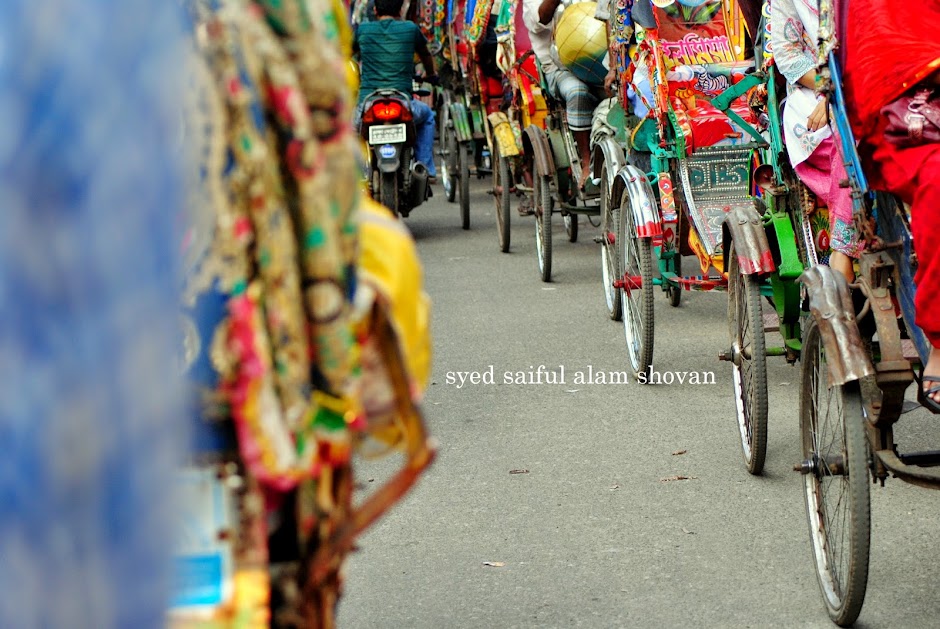
With a few simple steps, we could make Dhaka more livable. The first step is to change our priorities, by emphasizing access, not mobility, short rather than long distance travel, children, not cars, and livable environments, not just transport. “We need a model in which happiness, rather than consumption levels, is the measure of success.”
Showing posts with label save rickshaw. Show all posts
Showing posts with label save rickshaw. Show all posts
Monday, September 14, 2009
Sunday, September 7, 2008
Air Pollution: What is the Main Cause, Cars or Rickshaws?
Air Pollution: What is the Main Cause, Cars or Rickshaws?
Cars pollute as soon as they are turned on, whether they are moving or sitting still in traffic. To blame air pollution on rickshaws because they slow down cars is outrageous. Even when moving smoothly and well-maintained, cars pollute; internationally, cars are the major polluters of our air and the major contributors to climate change. Worldwide, the most air pollution is created by the United States, not because their cars are slowed by rickshaws, or because their cars are poorly maintained, but because Americans drive so much. Cars pollute; lots of cars pollute a lot.
CNG is cleaner than other fuels, but as it is a carbon-based fuel, it still releases carbon dioxide into the air as well as the cancer-causing chemical benzene, for which no safe level of exposure is known. People travelling by foot, bicycle, or rickshaw arrive at their destination without contributing to air pollution; people travelling by a motorized vehicle, even a bus, contribute to air pollution. While the rich are the main sources of air pollution, everyone breathes the air. Meanwhile, if the rich believe they are somehow immune to air pollution because they live with air conditioning, they might wish to remember that they too must breathe the same air that they are polluting; the more cars, the more they too will suffer.
Syed Saiful Alam
shovan1209 (@) yahoo.com
Cars pollute as soon as they are turned on, whether they are moving or sitting still in traffic. To blame air pollution on rickshaws because they slow down cars is outrageous. Even when moving smoothly and well-maintained, cars pollute; internationally, cars are the major polluters of our air and the major contributors to climate change. Worldwide, the most air pollution is created by the United States, not because their cars are slowed by rickshaws, or because their cars are poorly maintained, but because Americans drive so much. Cars pollute; lots of cars pollute a lot.
CNG is cleaner than other fuels, but as it is a carbon-based fuel, it still releases carbon dioxide into the air as well as the cancer-causing chemical benzene, for which no safe level of exposure is known. People travelling by foot, bicycle, or rickshaw arrive at their destination without contributing to air pollution; people travelling by a motorized vehicle, even a bus, contribute to air pollution. While the rich are the main sources of air pollution, everyone breathes the air. Meanwhile, if the rich believe they are somehow immune to air pollution because they live with air conditioning, they might wish to remember that they too must breathe the same air that they are polluting; the more cars, the more they too will suffer.
Syed Saiful Alam
shovan1209 (@) yahoo.com
Wednesday, September 3, 2008
Improving Dhaka's traffic situation: Lessons from Mirpur Road
Improving Dhaka's traffic situation: Lessons from Mirpur Road
On 17 December, rickshaws were banned on Mirpur Road from Russell Square to Azimpur. The reasons given for the ban were that rickshaws cause traffic jams because they take up too much road space and move more slowly than cars and buses. The move to ban rickshaws was pushed by the World Bank, which also pushed the government to ban rickshaws from various other roads in 2005.
Roads for People applauds the efforts of the government of Bangladesh to reduce traffic problems in Dhaka City. We agree that it is wisest to separate non-motorised transport (NMT) from motorised transport (MT) on main roads, and that a reduction in traffic jams would decrease suffering of Dhaka's inhabitants. However, much of the work to date appears ill-advised, leading to negative consequences in terms of traffic flow, travellers expense, livelihood of the most vulnerable, and pollution.Research suggests that women in particular are suffering from the rickshaw bans, finding no adequate replacement transport and often experiencing greater travel costs in terms of both time and money.
The ban on non-motorised transport on Mirpur Road has had the following effects resulted in at least a 10 per cent increase in monetary costs per trip (actual increase seems to be much higher as evident from the experiences of the focus group discussions), induced at least a 50 per cent increase in average journey times per passenger per trip (our estimate using HDRC and DTCB data), caused 32 per cent loss of net income by rickshaw pullers, forced one forth of passengers from rickshaws to walking, left no options but to take shelter in more expensive and unreliable modes, such as baby taxis and taxicabs, even for short trips, for more than one third of people, and caused untold sufferings for the most vulnerable road users like women, children and the disabled.In this paper we set out some thoughts on some of the current directions of transport policy, and our suggestion for improvements.
The ban on NMT on Mirpur Road from Gabtoli to Russell Square meant non-motorised transport was banned on this stretch of road in December 2002 as a pilot project. Several more streets are slated for NMT bans. As of December 17, 2004, NMT was also banned on Mirpur Road from Russell Square to Azimpur. Human Development Research Centre (HDRC) was commissioned by the Dhaka Transport Coordination Board (DTCB) to investigate positive and negative consequences of the ban and make recommendations for further potential bans.
This section summarizes the findings of that report, while also raising a significant question: to what extent is it acceptable to increase poverty among the poorest for the sake of a small perceived benefit in travel time, and also at the cost of higher transport costs and some decreases in mobility? Put another way, how much are the poor and middle class expected to suffer for the convenience of car owners to drive a bit more quickly (except in cases where the jams quickly revert to previous levels, as appears to have happened on the Russell Square-Azimpur corridor) and to park where they wish along the streets and on the footpaths?Economic and other impact of ban on NMT pullersThe HDRC study found various impacts on NMT pullers (rickshaws, vans and hand carts) when comparing their situation before and after the ban. These include:Average monthly net income of rickshaw pullers decreased by 32 per cent, from 3,834 to 2,600 taka (see Table 1 and Figure 1 below). Overall, income for NMT pullers declined by 34 per cent. The amount of money sent back to their villages also declined following the ban. Before the ban, on average rickshaw pullers spent 64 per cent of net income and sent the rest (36 per cent) to his village.
Following the ban, the amount spent in Dhaka decreased by 27 per cent, while the amount sent to the village decreased by 41 per cent.
Similar patterns follow for other NMT pullers (see Table 1 and Figure 2). Pullers compensated for loss of income by reducing food consumption, particularly of fish, meat, and cooking oil: for NMT pullers overall, 85.9 per cent decreased their consumption of fish, 87.5 per cent decreased consumption of meat, 65.1 per cent decreased consumption of cooking oil, and over half (55.3 per cent) decreased consumption of vegetables. There was an increase in the number of income earners in the family from 1.24 to 1.37.
This suggests that some children have been taken out of school to compensate for lost income, or that the burden on wives of the pullers have further increased as they must earn money as well as do all the family and household labour. Average number of working days per month for NMT pullers increased by 1.1 days (from 23.67 to 24.78 days a month), and for rickshaw pullers by 1.3 days (from 23.18 to 24.44 days a month). Average number of working hours per day also increased, from 10.33 to 10.97 hours overall, and from 10.16 to 10.70 for rickshaw pullers.
More rickshaw pullers worked full-day than half-day shifts: 60.5 per cent after the ban, and 56.7 per cent prior to the ban; the figures overall were 65.1 per cent after the ban and 61.5 per cent prior to it. Only about five per cent of pullers reported a second income, and that second income was insufficient to compensate for the loss of income from the ban. Almost all the pullers (81.6 per cent overall) were affected by loss of income; 86.1 per cent of van pullers reported decreased income. Although HDRC recommends training in driving of MT for displaced pullers, only 1.6 per cent of pullers overall suggest that they be provided MT driver training, while 55.9 per cent asked for alternative rehabilitation and 31.6 per cent suggested construction of special lanes for NMT. , while only six per cent wanted an alternative profession in MT, 36 per cent would like to take on petty trading, 27 per cent return to agriculture, and 23 per cent take on day labour. Only four per cent of pullers supported NMT withdrawal on other major arterial roads; fears expressed by them included hardship for the pullers and their families, and concern that the move would lead to further deterioration of the law and order situation in the country in general and Dhaka in particular.
www.dhaka-rickshaw.blogspot.com/ Dhaka Rickshaw
www.dhaka-transport.blogspot.com/ Pro-people Transport Plan www.dhakanewspapers.blogspot.com/ All Newspapers on one click
Syed Saiful Alam shovan1209 [at] yahoo.com
Rickshaws are the main source of vehicular transport for the middle class.
Rickshaws are in many ways the ideal form of transport
They provide door-to-door transport at all hours and in all weather, emit no fumes, create no noise pollution, use no fossil fuels, and employ large numbers of the poorest people.
It is not the rickshaws that are clogging the streets; it's the cars. In 1998, the less than 9% of vehicular transport by car required over 34% of road space, while the 54% travelling by rickshaw took up only 38% of road space. The solution is not to reduce rickshaw transport, but to prevent the growth of car use, by minimising the road space and parking space allocated to cars.
In addition, there are many simple solutions that could benefit both the rickshaw-riding majority and the car-owning minority. Instead of banning rickshaws, the World Bank and local authorities could be (a.) providing dedicated lanes and cycle rickshaw stations that would prevent conflicts between modes, (b.) implementing a programme to help improve the quality of the rickshaws, (c.) supporting cycle rickshaw drivers with training, uniforms, tariff standardisation, etc., (d.) creating cycle lanes throughout the city, and (e.) supporting public transit through bus-only lanes, bus-only turns, etc.
Many rickshaw pullers fled from starvation in the villages. With exceptionally bad floods this year, many villages lack sufficient food and seeds. Cutting back on rickshaw income means directly attacking the ability of the poorest and most vulnerable to survive - not just the rickshaw pullers themselves, but the families and entire villages that they support.
The Mirpur Road is a disastrous choice for a rickshaw ban, as there are no alternate roads for rickshaws, and it is extremely difficult to walk on this road because of the prevalence of street vendors.
Accommodating the automobile over other modes is undemocratic, supporting a wealthy elite while the majority suffers. In the long run, even the rich will not benefit from rickshaw bans, as current policies will lead to more traffic jams, dirtier air and increased noise pollution.
The World Bank figure that the rickshaw ban will cover "only 6% of roads" is highly misleading. Maybe 6% of roads, but those corridors carry well over 50% of all the traffic in the city. Further, the figure of 6% is misleading because Dhaka has only a small number of arterial roads which due to the lack of a secondary road network means must carry all kinds of traffic, including short trips by pedestrians and rickshaws as well as longer trips by motor vehicles. The proposed restrictions cover almost all the main arterials (the widest roads in Dhaka), and almost all of the north-south corridors, where a large percentage of the overall traffic occurs. The rickshaw-ban roads are almost all in the range of 25 metres to 45 metres wide (including walkways), i.e., at least three lanes in each direction. Some are even wider. So the World Bank's claim that traffic cannot be segregated on the arterial roads is simply false.
World Bank policy in Dhaka is inconsistent with the spirit of the World Bank's urban transport strategy, Cities on the Move (2001), which is highly progressive and supportive of non-motorised transport.
Rickshaws are the main source of vehicular transport for the middle class. Since there are often not alternatives within their means, a rickshaw ban is a restriction of their freedom of movement, and therefore a violation of Article 13 of the Universal Declaration of Human Rights.
While proposing for further rickshaw bans between Russell Square and Azimpur, the Dhaka Transport Coordination Board presented data showing an increase in average motor vehicle speeds (15 kmh to 24 kmh) in other parts of the same corridor where a rickshaw ban has already been imposed. But did they analyse how robust and stable the gain in speed reductions would be? Considering experiences of the other rickshaw-free roads, is it not more likely that the gain in speed would be very short lived and the extra space created would soon be filled by more motorised vehicles? And further, wouldn't a ban on motor vehicles on major roads similarly speed up the rickshaws and also allow space for bicycles and pedestrians?
www.dhaka-rickshaw.blogspot.com/ Dhaka Rickshaw
www.dhaka-transport.blogspot.com/ Pro-people Transport Plan www.dhakanewspapers.blogspot.com/ All Newspapers on one click
Syed Saiful Alam
shovan1209 [at] yahoo.com
They provide door-to-door transport at all hours and in all weather, emit no fumes, create no noise pollution, use no fossil fuels, and employ large numbers of the poorest people.
It is not the rickshaws that are clogging the streets; it's the cars. In 1998, the less than 9% of vehicular transport by car required over 34% of road space, while the 54% travelling by rickshaw took up only 38% of road space. The solution is not to reduce rickshaw transport, but to prevent the growth of car use, by minimising the road space and parking space allocated to cars.
In addition, there are many simple solutions that could benefit both the rickshaw-riding majority and the car-owning minority. Instead of banning rickshaws, the World Bank and local authorities could be (a.) providing dedicated lanes and cycle rickshaw stations that would prevent conflicts between modes, (b.) implementing a programme to help improve the quality of the rickshaws, (c.) supporting cycle rickshaw drivers with training, uniforms, tariff standardisation, etc., (d.) creating cycle lanes throughout the city, and (e.) supporting public transit through bus-only lanes, bus-only turns, etc.
Many rickshaw pullers fled from starvation in the villages. With exceptionally bad floods this year, many villages lack sufficient food and seeds. Cutting back on rickshaw income means directly attacking the ability of the poorest and most vulnerable to survive - not just the rickshaw pullers themselves, but the families and entire villages that they support.
The Mirpur Road is a disastrous choice for a rickshaw ban, as there are no alternate roads for rickshaws, and it is extremely difficult to walk on this road because of the prevalence of street vendors.
Accommodating the automobile over other modes is undemocratic, supporting a wealthy elite while the majority suffers. In the long run, even the rich will not benefit from rickshaw bans, as current policies will lead to more traffic jams, dirtier air and increased noise pollution.
The World Bank figure that the rickshaw ban will cover "only 6% of roads" is highly misleading. Maybe 6% of roads, but those corridors carry well over 50% of all the traffic in the city. Further, the figure of 6% is misleading because Dhaka has only a small number of arterial roads which due to the lack of a secondary road network means must carry all kinds of traffic, including short trips by pedestrians and rickshaws as well as longer trips by motor vehicles. The proposed restrictions cover almost all the main arterials (the widest roads in Dhaka), and almost all of the north-south corridors, where a large percentage of the overall traffic occurs. The rickshaw-ban roads are almost all in the range of 25 metres to 45 metres wide (including walkways), i.e., at least three lanes in each direction. Some are even wider. So the World Bank's claim that traffic cannot be segregated on the arterial roads is simply false.
World Bank policy in Dhaka is inconsistent with the spirit of the World Bank's urban transport strategy, Cities on the Move (2001), which is highly progressive and supportive of non-motorised transport.
Rickshaws are the main source of vehicular transport for the middle class. Since there are often not alternatives within their means, a rickshaw ban is a restriction of their freedom of movement, and therefore a violation of Article 13 of the Universal Declaration of Human Rights.
While proposing for further rickshaw bans between Russell Square and Azimpur, the Dhaka Transport Coordination Board presented data showing an increase in average motor vehicle speeds (15 kmh to 24 kmh) in other parts of the same corridor where a rickshaw ban has already been imposed. But did they analyse how robust and stable the gain in speed reductions would be? Considering experiences of the other rickshaw-free roads, is it not more likely that the gain in speed would be very short lived and the extra space created would soon be filled by more motorised vehicles? And further, wouldn't a ban on motor vehicles on major roads similarly speed up the rickshaws and also allow space for bicycles and pedestrians?
www.dhaka-rickshaw.blogspot.com/ Dhaka Rickshaw
www.dhaka-transport.blogspot.com/ Pro-people Transport Plan www.dhakanewspapers.blogspot.com/ All Newspapers on one click
Syed Saiful Alam
shovan1209 [at] yahoo.com

Saturday, August 30, 2008
Specific Recommendations on Dhaka Transport
Specific Recommendations on Dhaka Transport
Despite the fact that the STP model has a number of shortcomings, the study appears to be more or less successful in identifying the preferred mass transit option for long trips, that is, Strategy 1a: Roads+, ALL BRT, NO Metro. Strategy 1a represents a combination of moderate investment in roads and an intensive BRT system as the means for mass transit. The option requires only a fraction (42%) of the total amount of USD 4.52 billion required by the STP-preferred alternative. It also represents the best option considering economics, safety, social development, affordability and sustainability. The surplus resources could be better utilised for the development of a balanced multimodal transport system by providing due consideration to the following vital issues:
1. Adopt integrated demand and supply management for the development of a sustainable transport system for Dhaka City.
2. Adopt a sustainable and “Smart” land use policy, which prefers a concentrated and mixed-use land development and reduces need to travel.
3. Adopt a people-oriented transport policy aiming at maximising door-to-door mobility and accessibility of people and goods, not just movement of vehicles within road links.
4. Assess transport policy by considering key wider policy issues such as economy, environment, accessibility, safety and social equity.
5. Abandon car-friendly and capital-intensive transport policy and explore eco-friendly and sustainable alternatives.
6. Start a fresh study for the development of sound transport policy considering impacts of all transport users and providers, not just FDT.
7. Ensure fair representation of all stakeholders and transport professionals in the decision making and planning process.
8. Properly integrate the proposed BRT system with improved local transport, ensuring adequate and continuous FFT and pedestrian facilities.
9. Provide a continuous bicycle lane throughout Dhaka City.
10. Develop an integrated commuting surface rail services within the Greater Dhaka Metropolitan Area.
11. Reintroduce centrally located stations for bus services (intercity and local).
12. Retain the central railway station at Kamalapur, and revive the old rail stations and service lines at Furbaria and other parts of Dhaka city.
13. Develop an integrated waterway system for Dhaka City.
14. Develop a hierarchical transport model suited to the Greater Dhaka Metropolitan Area for evaluation of different land use and transport development options.
Syed Saiful Alam
Save the Environment Movement
Despite the fact that the STP model has a number of shortcomings, the study appears to be more or less successful in identifying the preferred mass transit option for long trips, that is, Strategy 1a: Roads+, ALL BRT, NO Metro. Strategy 1a represents a combination of moderate investment in roads and an intensive BRT system as the means for mass transit. The option requires only a fraction (42%) of the total amount of USD 4.52 billion required by the STP-preferred alternative. It also represents the best option considering economics, safety, social development, affordability and sustainability. The surplus resources could be better utilised for the development of a balanced multimodal transport system by providing due consideration to the following vital issues:
1. Adopt integrated demand and supply management for the development of a sustainable transport system for Dhaka City.
2. Adopt a sustainable and “Smart” land use policy, which prefers a concentrated and mixed-use land development and reduces need to travel.
3. Adopt a people-oriented transport policy aiming at maximising door-to-door mobility and accessibility of people and goods, not just movement of vehicles within road links.
4. Assess transport policy by considering key wider policy issues such as economy, environment, accessibility, safety and social equity.
5. Abandon car-friendly and capital-intensive transport policy and explore eco-friendly and sustainable alternatives.
6. Start a fresh study for the development of sound transport policy considering impacts of all transport users and providers, not just FDT.
7. Ensure fair representation of all stakeholders and transport professionals in the decision making and planning process.
8. Properly integrate the proposed BRT system with improved local transport, ensuring adequate and continuous FFT and pedestrian facilities.
9. Provide a continuous bicycle lane throughout Dhaka City.
10. Develop an integrated commuting surface rail services within the Greater Dhaka Metropolitan Area.
11. Reintroduce centrally located stations for bus services (intercity and local).
12. Retain the central railway station at Kamalapur, and revive the old rail stations and service lines at Furbaria and other parts of Dhaka city.
13. Develop an integrated waterway system for Dhaka City.
14. Develop a hierarchical transport model suited to the Greater Dhaka Metropolitan Area for evaluation of different land use and transport development options.
Syed Saiful Alam
Save the Environment Movement
No Traffic on a Saturday? Well, No Cars, Anyway
Jason Grant
No Traffic on a Saturday? Well, No Cars, Anyway
Bicycles and pedestrians filled Lafayette Street at Canal Street on Saturday, the first day of the Summer Streets program.
By JAVIER C. HERNANDEZPublished: August 9, 2008
At Grand Central Terminal, the trains ran as usual on Saturday. Tourists studied maps, vendors hawked water and magazines but outside, something was off. On one side of the station there were no cars, taxis or delivery trucks. Instead, the street was filled with pedestrians and bicycles.Skip to next paragraphSuzanne DeChillo/The New York Times
Jason Phelps, 34, stepped off the curb, tilted his sunglasses and froze. “I’ve just walked into a swarm of bicyclists,” he told someone on his cellphone. “I don’t know what they want,” he joked, “but I’m going to close my eyes and pray.”
The ding of bicycle bells and the chatter of people on foot replaced the usual automobile noises along 6.9 miles of Manhattan for six hours on Saturday. It was the first day of Summer Streets, the city’s experiment in car-free recreation modeled on similar efforts in Guadalajara, Mexico; Bogotá, Colombia; Paris; and several American cities.
On a path that extended from the Brooklyn Bridge north to Park Avenue and the Upper East Side, thousands of people filled the streets, taking part in activities like street-side tai chi or salsa dancing. Others simply enjoyed the chance to stroll in normally car-clogged streets. In a city where walkers, cyclists and motorists must share limited space, having a major thoroughfare through Manhattan free of cars created a giddy sort of excitement.
Deborah Fried, 48, a tourist from California, rented a bicycle outside the Loews Regency Hotel on Park Avenue. Ms. Fried said she regularly rode her bicycle at the beach near her hometown of Pacific Palisades, but she had never bicycled on her visits to Manhattan .
She said the Summer Streets path felt safe.
“You don’t have to worry and be killed by a taxi,” she said. “To me, this beats bicycling on the beach because you get the flavor of the city.” The route was broken up by three rest stops, where water, maps and first aid were available. The stops also featured music and dance performances, and yoga and other exercise classes. Police officers directed traffic at 24 streets crossing the route.
Rabbi Jonathan Feldman, 47, took advantage of the break in traffic for a walk with his children before morning services. He said he appreciated the early morning quiet on Park Avenue.
“It gives the city a certain calmness that it doesn’t have otherwise,” Rabbi Feldman said.
The city may make Summer Streets, which continues the next two Saturdays from 7 a.m. to 1 p.m., a regular event if it proves to be a success (city officials have said that this would be a subjective measure).
Although Department of Transportation officials said they did not yet have an estimate of how many people turned out on Saturday, Janette Sadik-Khan, the transportation commissioner, praised the debut. “Summer Streets really struck a chord this morning,” she said in a statement.
The plan to close off streets had drawn criticism from shop owners, who feared it would hurt business. But the city assured skeptics that Summer Streets might bring more customers to their stores.
On Saturday, the economic impact remained unclear. Martha Barzola, 37, manager of a Papyrus stationery store on Park Avenue, said that the area around the store during summer weekends can sometimes resemble a ghost town. Because of the increased foot traffic, however, her store achieved its sales goal of $600 for the day within two hours, she said. But Ibrahim Hamzah, an assistant manager for an Edison ParkFast lot on the corner of Lafayette and Great Jones Streets, said he had not had a single customer, in contrast to the 30 or 40 cars that is typical for a Saturday in summer. “The number of times this is going to happen should be minimal,” Mr. Hamzah said. “We’re losing money, and it makes the job boring.”
There were other complaints. One woman, who declined to give her name because she was in a rush, said she had to park several blocks away to get to a medical appointment. Other pedestrians said that some novice riders, still learning to control their bicycles, were a danger to those on foot. Delivery of food to restaurants was disrupted because trucks could not get in.
Taxi drivers had also worried that Summer Streets would reduce the number of people hailing cabs. But Ali Sada, parking his cab for a few minutes at Park Avenue and 57th Street, praised the event.
“All these people are going to be tired when they put their bikes away,” he said. “We’re going to make a lot more money.”
Jason Grant contributed reporting.
J.H. Crawford Carfree
Citiesmailbox@carfree. com
www.carfree.com
www.dhaka-rickshaw.blogspot.com/ Dhaka Rickshaw
www.dhaka-transport.blogspot.com/ Pro-people Transport Plan www.dhakanewspapers.blogspot.com/ All Newspapers on one click
No Traffic on a Saturday? Well, No Cars, Anyway
Bicycles and pedestrians filled Lafayette Street at Canal Street on Saturday, the first day of the Summer Streets program.
By JAVIER C. HERNANDEZPublished: August 9, 2008
At Grand Central Terminal, the trains ran as usual on Saturday. Tourists studied maps, vendors hawked water and magazines but outside, something was off. On one side of the station there were no cars, taxis or delivery trucks. Instead, the street was filled with pedestrians and bicycles.Skip to next paragraphSuzanne DeChillo/The New York Times
Jason Phelps, 34, stepped off the curb, tilted his sunglasses and froze. “I’ve just walked into a swarm of bicyclists,” he told someone on his cellphone. “I don’t know what they want,” he joked, “but I’m going to close my eyes and pray.”
The ding of bicycle bells and the chatter of people on foot replaced the usual automobile noises along 6.9 miles of Manhattan for six hours on Saturday. It was the first day of Summer Streets, the city’s experiment in car-free recreation modeled on similar efforts in Guadalajara, Mexico; Bogotá, Colombia; Paris; and several American cities.
On a path that extended from the Brooklyn Bridge north to Park Avenue and the Upper East Side, thousands of people filled the streets, taking part in activities like street-side tai chi or salsa dancing. Others simply enjoyed the chance to stroll in normally car-clogged streets. In a city where walkers, cyclists and motorists must share limited space, having a major thoroughfare through Manhattan free of cars created a giddy sort of excitement.
Deborah Fried, 48, a tourist from California, rented a bicycle outside the Loews Regency Hotel on Park Avenue. Ms. Fried said she regularly rode her bicycle at the beach near her hometown of Pacific Palisades, but she had never bicycled on her visits to Manhattan .
She said the Summer Streets path felt safe.
“You don’t have to worry and be killed by a taxi,” she said. “To me, this beats bicycling on the beach because you get the flavor of the city.” The route was broken up by three rest stops, where water, maps and first aid were available. The stops also featured music and dance performances, and yoga and other exercise classes. Police officers directed traffic at 24 streets crossing the route.
Rabbi Jonathan Feldman, 47, took advantage of the break in traffic for a walk with his children before morning services. He said he appreciated the early morning quiet on Park Avenue.
“It gives the city a certain calmness that it doesn’t have otherwise,” Rabbi Feldman said.
The city may make Summer Streets, which continues the next two Saturdays from 7 a.m. to 1 p.m., a regular event if it proves to be a success (city officials have said that this would be a subjective measure).
Although Department of Transportation officials said they did not yet have an estimate of how many people turned out on Saturday, Janette Sadik-Khan, the transportation commissioner, praised the debut. “Summer Streets really struck a chord this morning,” she said in a statement.
The plan to close off streets had drawn criticism from shop owners, who feared it would hurt business. But the city assured skeptics that Summer Streets might bring more customers to their stores.
On Saturday, the economic impact remained unclear. Martha Barzola, 37, manager of a Papyrus stationery store on Park Avenue, said that the area around the store during summer weekends can sometimes resemble a ghost town. Because of the increased foot traffic, however, her store achieved its sales goal of $600 for the day within two hours, she said. But Ibrahim Hamzah, an assistant manager for an Edison ParkFast lot on the corner of Lafayette and Great Jones Streets, said he had not had a single customer, in contrast to the 30 or 40 cars that is typical for a Saturday in summer. “The number of times this is going to happen should be minimal,” Mr. Hamzah said. “We’re losing money, and it makes the job boring.”
There were other complaints. One woman, who declined to give her name because she was in a rush, said she had to park several blocks away to get to a medical appointment. Other pedestrians said that some novice riders, still learning to control their bicycles, were a danger to those on foot. Delivery of food to restaurants was disrupted because trucks could not get in.
Taxi drivers had also worried that Summer Streets would reduce the number of people hailing cabs. But Ali Sada, parking his cab for a few minutes at Park Avenue and 57th Street, praised the event.
“All these people are going to be tired when they put their bikes away,” he said. “We’re going to make a lot more money.”
Jason Grant contributed reporting.
J.H. Crawford Carfree
Citiesmailbox@carfree. com
www.carfree.com
www.dhaka-rickshaw.blogspot.com/ Dhaka Rickshaw
www.dhaka-transport.blogspot.com/ Pro-people Transport Plan www.dhakanewspapers.blogspot.com/ All Newspapers on one click
Transport, Environment, Economics and Health: Promoting an All-Win Situation
Transport, Environment, Economics and Health:Promoting an All-Win Situation
Syed Shamsul Alam
While economic gains may be sufficient in themselves—assuming a reasonably fair distribution of those gains—to improve conditions in health and education, the opposite tends to happen with transport. Market economies support transport investments and infrastructure that actually lead to worsening traffic conditions, and richer cities tend to suffer from worse transport problems—including more traffic congestion, more pollution, and more injuries and deaths from road crashes—than poorer cities.
As i**es increase, if the government does not intervene, then car use will increase. In the case of Hong Kong and Singapore, the governments quickly realized that a drastic increase in car use in proportion to rising i**es would lead to an impossible situation on the streets, and thus instituted strict measures for car control, such as mandating that car owners first buy parking spaces, or charging very high fees for licenses. Where governments have not taken such proactive steps—or where such steps are taken and then loosened under pressure of car manufacturers and others—the traffic situation will invariably decline as i**es rise.
While we often hear of the subsidies given by government for mass transport, few talk of the subsidies governments give for cars. Yet such subsidies play an important role in increasing car ownership, and can represent vast sums of money being spent providing free parking, road space, and other infrastructure (such as elevated expressways) for cars, or on fuel subsidies largely used by car owners. Meanwhile, the increase in cars and government moves to increase road space for them—often by limiting or banning other transport—result in a decrease in fuel‐free transport (mostly walking, cycling, and cycle rickshaws), due to danger, lack of road space, and the unpleasantness of trying to use such modes adjacent to noisy and polluting motorized vehicles.
The “free” market thus fails us by resulting in more fuel-dependent transport (FDT), with serious consequences for the environment and health. (Of course if the market were really “free”, there would not be huge subsidies for cars, and car owners would be expected to pay in real terms for the damage they cause, so that a very different picture would likely result.) Damage to the environment of fuel-dependent (motorized) transport includes air and noise pollution, space used for roads and parking that could have been green space (for agriculture, parks, and nature), and contribution to climate change. Damage to health includes rising rates of respiratory and other disease from pollution; injuries and deaths from road crashes; lack of physical activity caused both by more time spent in cars, and the inability to walk or cycle due to the presence of so many cars; increases in obesity due to lack of physical activity; and the reduced possibility of interacting with neighbors, or of children and youth enjoying outdoor recreation, due to the conversion of open spaces to parking and the danger from so many fuel-dependent vehicles.
Other problems caused by fuel-dependent transport include economics, poverty, and insecurity. For example, the average American spends $6,000/year for car costs, or 20% of gross earnings for the ʺprivilegeʺ of owning a car. Given that one main reason to own a car is to drive to work—so that one can then pay for one’s car—the futility and wastefulness of the current system is obvious. People b**e further impoverished due to high expenses on transport, which can represent a significant portion of monthly i**e. For instance, traveling by bicycle is essentially free, whereas bus fares can prove very costly to the low‐i**e. Those whose i**e is dependent on fuel‐free transport are also affected by bans on their livelihood, including rickshaw and van pullers and handcart peddlers. Finally, global insecurity is increased due to dependence on foreign oil and the wars that result as countries fight for control over existing oil supplies.
Shifting from the “free” market focus, with its emphasis on further enriching wealthy corporations, to a focus on transport for development, would lead to significant changes and gains—not only for the poor, but for everyone. Namely, such a focus would emphasize the need for more fuel-free transport (FFT). FFT has many benefits, including the facts that it is inexpensive, does not cause air or noise pollution, generates employment, provides convenient exercise (allowing people to incorporate physical activity into their daily routine, rather than having to make extra time and spend extra money on it), and increases equity by giving people of different i**e equal rights on the street (or prioritizing the poor over the rich, which would make a small contribution towards balancing the great inequalities favoring the rich).
In working to achieve change in the transport‐health‐environment‐economics equation, our overall goal is to create people‐friendly cities. Given the significant role transport can play in increasing or decreasing quality of life in a city, transport must play a significant role in making cities more livable. Needed changes include an increase in fuel‐free transport (walking, cycling, cycle rickshaws), an increase in public transport, a decrease in car use (brought about by high parking fees reflecting actual land values, license controls, and car‐free areas), and encouragement of high-density, mixed‐use areas, which in turn would lead to a reduction in traffic demand as access is emphasized over mobility.Of course bringing about changes in transport, affected as such changes are by economics and politics, is by no means easy. Significant opposition arises from a number of sources, for rather obvious reasons; such opponents include those manufacturing and selling cars, road and highway construction**panies, media (consider the role of car advertisement in electronic and print media), much of government, and some international agencies.
While there is no one set of working methods guaranteed to bring success, a mix of approaches modified for one’s own political environment is likely to include at least some of the following: signature campaigns, letter writing (to newspapers and policymakers), meetings with journalists and other ways of giving journalists information, research and publications, meetings and other**munication with government officials, seminars, press conferences, and demonstrations.Local, regional, and international alliances can also help support the work. Such alliances can include local NGOs working on the issues of environment, rights of the poor, and public health; a regional network with HealthBridge partners; and international support from such networks or groups as the World Carfree Network (WCN) and possibly the Institute for Transportation & Development Policies (ITDP).
While success is difficult in this area, it is by no means impossible. For instance, successes in Bangladesh included a major slowing of rickshaw bans, and an expressed reversal of World Bank policy in Dhaka regarding those bans. In the words of World Bank Country Director, Christine Wallich: “Any future support from the World Bank would be possible only if it can be demonstrated that aggregate positive impacts of NMT‐free conversion on transport users and transport providers outweigh the aggregate negative impact.” Other countries within theHealthBridge network and beyond have also experienced significant successes.
There is much to learn from the work, and while the difficulty is great, there is still much cause for optimism. Significant lessons include the obvious—that accepting that defeat is inevitable guarantees defeat. That is, if we believe before we start that we will fail, and thus don’t even try, we will indeed fail. Only by trying do we at least have the possibility of success—a possibility that can, surprisingly, materialize at times! After all, as we have also learned, policies serving only a powerful elite will, necessarily, have limited appeal among the masses. While the rich have access to resources that may seem overwhelming, there is tremendous power in public opinion. Therefore, supporting the masses can succeed—if, of course, the work is done wisely.
In sum, we need to work together to guarantee a major role for fuel‐free transport (and to reduce transport needs overall by emphasizing proximity over mobility), and to reduce fuel‐dependent transport. By reducing car use, we can create an all‐win situation, in which even car users benefit. How? By supporting jobs and inexpensive transport for the poor; by decreasing pollution, congestion, and noise; by increasing levels of physical activity and thus improving health; by increasing access to convenient transport for all groups, and by increasing availability of and access to safe outdoor play spaces for children. The result of all these measures is friendlier, people‐focused cities—cities in which all inhabitants will gain.
Syed Saiful Alam
Save the Environment Movement
Syed Shamsul Alam
While economic gains may be sufficient in themselves—assuming a reasonably fair distribution of those gains—to improve conditions in health and education, the opposite tends to happen with transport. Market economies support transport investments and infrastructure that actually lead to worsening traffic conditions, and richer cities tend to suffer from worse transport problems—including more traffic congestion, more pollution, and more injuries and deaths from road crashes—than poorer cities.
As i**es increase, if the government does not intervene, then car use will increase. In the case of Hong Kong and Singapore, the governments quickly realized that a drastic increase in car use in proportion to rising i**es would lead to an impossible situation on the streets, and thus instituted strict measures for car control, such as mandating that car owners first buy parking spaces, or charging very high fees for licenses. Where governments have not taken such proactive steps—or where such steps are taken and then loosened under pressure of car manufacturers and others—the traffic situation will invariably decline as i**es rise.
While we often hear of the subsidies given by government for mass transport, few talk of the subsidies governments give for cars. Yet such subsidies play an important role in increasing car ownership, and can represent vast sums of money being spent providing free parking, road space, and other infrastructure (such as elevated expressways) for cars, or on fuel subsidies largely used by car owners. Meanwhile, the increase in cars and government moves to increase road space for them—often by limiting or banning other transport—result in a decrease in fuel‐free transport (mostly walking, cycling, and cycle rickshaws), due to danger, lack of road space, and the unpleasantness of trying to use such modes adjacent to noisy and polluting motorized vehicles.
The “free” market thus fails us by resulting in more fuel-dependent transport (FDT), with serious consequences for the environment and health. (Of course if the market were really “free”, there would not be huge subsidies for cars, and car owners would be expected to pay in real terms for the damage they cause, so that a very different picture would likely result.) Damage to the environment of fuel-dependent (motorized) transport includes air and noise pollution, space used for roads and parking that could have been green space (for agriculture, parks, and nature), and contribution to climate change. Damage to health includes rising rates of respiratory and other disease from pollution; injuries and deaths from road crashes; lack of physical activity caused both by more time spent in cars, and the inability to walk or cycle due to the presence of so many cars; increases in obesity due to lack of physical activity; and the reduced possibility of interacting with neighbors, or of children and youth enjoying outdoor recreation, due to the conversion of open spaces to parking and the danger from so many fuel-dependent vehicles.
Other problems caused by fuel-dependent transport include economics, poverty, and insecurity. For example, the average American spends $6,000/year for car costs, or 20% of gross earnings for the ʺprivilegeʺ of owning a car. Given that one main reason to own a car is to drive to work—so that one can then pay for one’s car—the futility and wastefulness of the current system is obvious. People b**e further impoverished due to high expenses on transport, which can represent a significant portion of monthly i**e. For instance, traveling by bicycle is essentially free, whereas bus fares can prove very costly to the low‐i**e. Those whose i**e is dependent on fuel‐free transport are also affected by bans on their livelihood, including rickshaw and van pullers and handcart peddlers. Finally, global insecurity is increased due to dependence on foreign oil and the wars that result as countries fight for control over existing oil supplies.
Shifting from the “free” market focus, with its emphasis on further enriching wealthy corporations, to a focus on transport for development, would lead to significant changes and gains—not only for the poor, but for everyone. Namely, such a focus would emphasize the need for more fuel-free transport (FFT). FFT has many benefits, including the facts that it is inexpensive, does not cause air or noise pollution, generates employment, provides convenient exercise (allowing people to incorporate physical activity into their daily routine, rather than having to make extra time and spend extra money on it), and increases equity by giving people of different i**e equal rights on the street (or prioritizing the poor over the rich, which would make a small contribution towards balancing the great inequalities favoring the rich).
In working to achieve change in the transport‐health‐environment‐economics equation, our overall goal is to create people‐friendly cities. Given the significant role transport can play in increasing or decreasing quality of life in a city, transport must play a significant role in making cities more livable. Needed changes include an increase in fuel‐free transport (walking, cycling, cycle rickshaws), an increase in public transport, a decrease in car use (brought about by high parking fees reflecting actual land values, license controls, and car‐free areas), and encouragement of high-density, mixed‐use areas, which in turn would lead to a reduction in traffic demand as access is emphasized over mobility.Of course bringing about changes in transport, affected as such changes are by economics and politics, is by no means easy. Significant opposition arises from a number of sources, for rather obvious reasons; such opponents include those manufacturing and selling cars, road and highway construction**panies, media (consider the role of car advertisement in electronic and print media), much of government, and some international agencies.
While there is no one set of working methods guaranteed to bring success, a mix of approaches modified for one’s own political environment is likely to include at least some of the following: signature campaigns, letter writing (to newspapers and policymakers), meetings with journalists and other ways of giving journalists information, research and publications, meetings and other**munication with government officials, seminars, press conferences, and demonstrations.Local, regional, and international alliances can also help support the work. Such alliances can include local NGOs working on the issues of environment, rights of the poor, and public health; a regional network with HealthBridge partners; and international support from such networks or groups as the World Carfree Network (WCN) and possibly the Institute for Transportation & Development Policies (ITDP).
While success is difficult in this area, it is by no means impossible. For instance, successes in Bangladesh included a major slowing of rickshaw bans, and an expressed reversal of World Bank policy in Dhaka regarding those bans. In the words of World Bank Country Director, Christine Wallich: “Any future support from the World Bank would be possible only if it can be demonstrated that aggregate positive impacts of NMT‐free conversion on transport users and transport providers outweigh the aggregate negative impact.” Other countries within theHealthBridge network and beyond have also experienced significant successes.
There is much to learn from the work, and while the difficulty is great, there is still much cause for optimism. Significant lessons include the obvious—that accepting that defeat is inevitable guarantees defeat. That is, if we believe before we start that we will fail, and thus don’t even try, we will indeed fail. Only by trying do we at least have the possibility of success—a possibility that can, surprisingly, materialize at times! After all, as we have also learned, policies serving only a powerful elite will, necessarily, have limited appeal among the masses. While the rich have access to resources that may seem overwhelming, there is tremendous power in public opinion. Therefore, supporting the masses can succeed—if, of course, the work is done wisely.
In sum, we need to work together to guarantee a major role for fuel‐free transport (and to reduce transport needs overall by emphasizing proximity over mobility), and to reduce fuel‐dependent transport. By reducing car use, we can create an all‐win situation, in which even car users benefit. How? By supporting jobs and inexpensive transport for the poor; by decreasing pollution, congestion, and noise; by increasing levels of physical activity and thus improving health; by increasing access to convenient transport for all groups, and by increasing availability of and access to safe outdoor play spaces for children. The result of all these measures is friendlier, people‐focused cities—cities in which all inhabitants will gain.
Syed Saiful Alam
Save the Environment Movement
Friday, August 15, 2008
Economic and other impact of ban on NMT pullers
Economic and other impact of ban on NMT pullers
Syed Saiful Alam
The HDRC study found various impacts on NMT pullers (rickshaws, vans and handcarts)
when comparing their situation before and after the ban. These include:1. Average monthly net income of rickshaw pullers decreased by 32%, from3,834 to 2,600 taka (see Table 1 and Figure 1 below). Overall, income forNMT pullers declined by 34%.2. The amount of money sent back to their villages also declined following theban. Before the ban, on average rickshaw pullers spent 64% of net incomeand sent the rest (36%) to his village.
Following the ban, the amount spent inDhaka decreased by 27%, while the amount sent to the village decreased by41%. Similar patterns follow for other NMT pullers (see Table 1 and Figure2).
Pullers compensated for loss of income by reducing food consumption,particularly of fish, meat, and cooking oil: for NMT pullers overall, 85.9%decreased their consumption of fish, 87.5% decreased consumption of meat,65.1% decreased consumption of cooking oil, and over half (55.3%) decreasedconsumption of vegetables.
There was an increase in the number of income earners in the family from 1.24to 1.37. This suggests that some children have been taken out of school tocompensate for lost income, or that the burden on wives of the pullers havefurther increased as they must earn money as well as do all the family andhousehold labor
Average number of working days per month for NMT pullers increased by1.1 days (from 23.67 to 24.78 days a month), and for rickshaw pullers by 1.3days (from 23.18 to 24.44 days a month).
Average number of working hours per day also increased, from 10.33 to 10.97hours overall, and from 10.16 to 10.70 for rickshaw pullers.
More rickshaw pullers worked full-day than half-day shifts: 60.5% after theban, and 56.7% prior to the ban; the figures overall were 65.1% after the banand 61.5% prior to it.
Only about 5% of pullers reported a second income, and that second incomewas insufficient to compensate for the loss of income from the ban.
Almost all the pullers (81.6% overall) were affected by loss of income; 86.1%of van pullers reported decreased income.
Although HDRC recommends training in driving of MT for displaced pullers,only 1.6% of pullers overall suggest that they be provided MT driver training,while 55.9% asked for alternative rehabilitation and 31.6% suggestedconstruction of special lanes for NMT. Similarly, while only 6% wanted analternative profession in MT, 36% would like to take on petty trading, 27%return to agriculture, and 23% take on day labour.
Only 4% of pullers supported NMT withdrawal on other major arterial roads;fears expressed by them included hardship for the pullers and their families,and concern that the move would lead to further deterioration of the law andorder situation in the country in general and Dhaka in particular.
source: Improving Dhaka’s Traffic Situation:Lessons from Mirpur Road
Syed Saiful Alam
Save the Environment movement
Syed Saiful Alam
The HDRC study found various impacts on NMT pullers (rickshaws, vans and handcarts)
when comparing their situation before and after the ban. These include:1. Average monthly net income of rickshaw pullers decreased by 32%, from3,834 to 2,600 taka (see Table 1 and Figure 1 below). Overall, income forNMT pullers declined by 34%.2. The amount of money sent back to their villages also declined following theban. Before the ban, on average rickshaw pullers spent 64% of net incomeand sent the rest (36%) to his village.
Following the ban, the amount spent inDhaka decreased by 27%, while the amount sent to the village decreased by41%. Similar patterns follow for other NMT pullers (see Table 1 and Figure2).
Pullers compensated for loss of income by reducing food consumption,particularly of fish, meat, and cooking oil: for NMT pullers overall, 85.9%decreased their consumption of fish, 87.5% decreased consumption of meat,65.1% decreased consumption of cooking oil, and over half (55.3%) decreasedconsumption of vegetables.
There was an increase in the number of income earners in the family from 1.24to 1.37. This suggests that some children have been taken out of school tocompensate for lost income, or that the burden on wives of the pullers havefurther increased as they must earn money as well as do all the family andhousehold labor
Average number of working days per month for NMT pullers increased by1.1 days (from 23.67 to 24.78 days a month), and for rickshaw pullers by 1.3days (from 23.18 to 24.44 days a month).
Average number of working hours per day also increased, from 10.33 to 10.97hours overall, and from 10.16 to 10.70 for rickshaw pullers.
More rickshaw pullers worked full-day than half-day shifts: 60.5% after theban, and 56.7% prior to the ban; the figures overall were 65.1% after the banand 61.5% prior to it.
Only about 5% of pullers reported a second income, and that second incomewas insufficient to compensate for the loss of income from the ban.
Almost all the pullers (81.6% overall) were affected by loss of income; 86.1%of van pullers reported decreased income.
Although HDRC recommends training in driving of MT for displaced pullers,only 1.6% of pullers overall suggest that they be provided MT driver training,while 55.9% asked for alternative rehabilitation and 31.6% suggestedconstruction of special lanes for NMT. Similarly, while only 6% wanted analternative profession in MT, 36% would like to take on petty trading, 27%return to agriculture, and 23% take on day labour.
Only 4% of pullers supported NMT withdrawal on other major arterial roads;fears expressed by them included hardship for the pullers and their families,and concern that the move would lead to further deterioration of the law andorder situation in the country in general and Dhaka in particular.
source: Improving Dhaka’s Traffic Situation:Lessons from Mirpur Road
Syed Saiful Alam
Save the Environment movement
Knowledge-based Transport Planning and More Rickshaw Bans in the Dhaka City
Knowledge-based Transport Planning and More Rickshaw Bans in the Dhaka City
Dr.Mahabubul Bari
For several years, discussion of transport issues and problems in Dhaka has had a singular focus on the supposed contribution of cycle rickshaws to traffic congestion, and the need to facilitate movement of automobiles. In line with this analysis of the transport situation, various projects have been undertaken, focusing on banning rickshaws and rickshaw vans from major roads, and sometimes relegating them to narrow rickshaw lanes. The problem of car parking has been addressed mainly through insistence on provision of separate parking places by offices, shops and restaurants even by enacting law under the building code. It is a matter of deep regret that not a single transport policy decision was undertaken after conducting a proper scientific or knowledge-based analysis of the transport problems of the city. It has become a standard norm to take important policy decisions rather arbitrarily, whether it is rickshaw ban or Strategic Transport Plan (STP) for the city.
The results of these various initiatives have been made clear through government-mandated studies, including the HDRC report on the rickshaw ban on Mirpur Road (HDRC 2004), and the DUTP after-study report (DUTP 2006). The results, almost astonishingly negative, would suggest that the basis for the policy decisions and transport plans are flawed. This would be less than surprising when considering the fact that important transport policy decisions were taken without employing any knowledge-based approach or scientific study.
Moreover, despite the strong evidence of increased travel costs and traffic congestion, transport planning continues to focus on expanding the role of the automobile and reducing that of fuel-free transport. That pattern has been reflected by the further extension of the rickshaw bans on more city roads. In this connection, readers are requested to draw their attention to the following news item:
Paltan-Bijoynagar Road made off-limits to rickshaws
Staff Correspondent
“Traffic Division of the Dhaka Metropolitan Police made Purana Paltan-Bijoynagar Road off-limits to rickshaws from Thursday. The decision was taken at a meeting on Wednesday. All the deputy commissioners of four traffic divisions were present at the meeting. M Sayedur Rahman, deputy commissioner (south) of traffic division, told New Age on Thursday that the authorities banned plying of non-motorised vehicles on the stretch between Purana Paltan and Bijoynagar to ease traffic congestion.” The New Age, Dhaka, Friday, October 19, 2007”.
This arbitrary decision making process as depicted in the news item draws attention to a number of disturbing questions as follows:
Do the police have the authority to ban or restrict rickshaw movements?
If yes, from whom do they get that authority?
Do the police have similar authority to limit the movement of motorised vehicles when there is not sufficient road capacity for them, e.g. narrow lanes, which cannot accommodate cars without causing traffic jams?
Probably not, it is therefore clear that such misguided policy actions are being pursued just to give absolute priority in the transport system of the city for a tiny minority of car owners, i.e. the so called elite section of the society.
Do the police have requisite training to make proper transport decisions?
If so, why dies Dhaka needs organisation like DTCB, when the police can do the job better?
The rickshaw bans are being extended beyond Mirpur Road, but it seems unlikely that those bans were carried out by the police, rather than by a section of the powerful bureaucrats behind the scene. It may be mentioned here that after failure of the rickshaw ban in the demonstration project of the Mirpur Road, the World Bank has set the standard of extending further bans on the condition that: “Any future support from the World Bank would be possible only if it can be demonstrated that aggregate positive impacts of NMT-free conversion on transport users and transport providers outweigh the aggregate negative impact”.
It is matter of deep regret that policies continue to give car owners absolute priority, while ignoring the fundamental principle of any transport project appraisal, that is, that net user benefits of any transport intervention must exceed net loss.
Now, it may be appropriate to concentrate on, possibly, the most important argument in the news item, that is, “the authorities banned plying of non-motorised vehicles on the stretch between Purana Paltan and Bijoynagar to ease traffic congestion.” In the following paragraphs answer to this question and other related aspects of such transport policy interventions, will be analysed in the light of knowledge-based and participatory decision-making approach.
Did the previous rickshaw ban in Dhaka City ease traffic congestion?
The answer lies in the “After Project” report of the government mandated study of the Mirpur Road Demonstration project (DUTP 2006), where fuel free transport was banned.
It might be appropriate to look into the issue considering a number of key congestion indices with respect to before and after scenarios of the Mirpur Road Demonstration project as follows:
Average journey time per vehicle
Average journey time per person
Journey reliability
Throughput (total number of vehicles per time interval that pass a point on the carriageway)
Average Journey time per Vehicle
The Table 1 shows the comparison of travel times of fuel dependent (motorised) vehicles between 2000 and 2005. Considering large variability of the travel time data, it is evident that there is no statistically significant difference of travel times of fuel dependent or motorised vehicles between pre and post rickshaw ban scenarios. This means that no travel time gain for fuel dependent vehicle was achieved due to rickshaw ban.
Table 1: Comparison of 2000/2005 Travel Times (average of two directions) in Mirpur Road Corridor (Source: DUTP 2006)
Year
Average Speed (km/h)
Travel Time (min.)
Delay (sec)
No of Stops
Delay in Stop (sec/stop)
Gabtoli - North South Road (Demonstration Corridor)
2005
19.9
36.1
717
20
36
2000
19.2
38.3
720
17
42
% Difference
3.6%
-5.7%
-0.4%
The Table 2 demonstrates the comparison of travel times of buses between 2000 and 2005. Although there is no statistically significant difference of travel times for fuel dependent vehicles between pre and post FFT ban scenarios, the travel times for buses did undergo significant deterioration with a 26.1% increase of travel times. This means that bus congestion has increased significantly due to imposition of rickshaw ban in the Mirpur Road demonstration corridor.
On balance average vehicle congestion in terms of journey time per vehicle has increased significantly due to the rickshaw ban.
Table 2: Comparison of 2000/2005 Travel Times for Buses in along Mirpur Road Corridor (Source: DUTP 2006)
Bus Line
Year
Speed (km/h)
Travel Time (min)
No of Stops
Line 7: Gabtoli to Gulistan Via Neel Khate
2005
13.2
50.2
45.2
2000
17.0
39.8
45.2
% Change
-22.4%
26.1%
Average journey time per person
Bus travel has worsened following the FFT ban, with a 26.1% increase in travel time; passenger travels by bus has become slower than by rickshaw. Thus all the bus passengers (28.1% of total passengers)—both those who continue to travel by bus in pre- and post-project scenarios, and those who were forced to shift from rickshaws—have experienced significant increase in travel times.
Impacts of the project on car passengers who have been riding a car both pre- and post-project are more or less neutral, as there is no significant difference in travel time.
The passengers of motorised para-transit who continue to travel both in pre- and post-project scenarios are likely to suffer increase in average journey times. While there is no significant difference in travel times between scenarios, the times required to find a driver who would be willing to go for short trips have gone up substantially as per HDRC report (HDRC 2004) thereby increasing average travel times per person.
Despite being subjected to a ban on Mirpur Road, rickshaws remain the most popular means of transport in the corridor, accounting for 30% of all trips. Rickshaw passengers have become net losers, being forced to take long detours using congested side roads, and thereby substantially increase their travel time.
These evidences from the after project studies prove that congestion in terms of average journey time per person have increased significantly after rickshaw ban in the Mirpur Road demonstration corridor.
Journey Reliability
Both DUTP after project study (DUTP 2006) and HDRC studies reported significant deterioration of waiting times for bus passengers. Again, as reported in the HDRC report, baby taxi operators are reluctant to take short trips, causing significant increases in waiting times for passengers. Similarly, finding suitable taxicabs at an affordable cost has become increasingly troublesome and time-consuming for short trips.
It is therefore clearly evident that journey reliability of the Mirpur Road demonstration project deteriorated significantly due to imposition of rickshaw ban. This in turn represents increase of congestion.
Throughput (total number of vehicles per time interval that pass a point on the carriageway)
Although it might not be appropriate to compare throughputs between a FFT free road and a mixed vehicles road, it is obvious from the Table 3 that number of vehicles that pass at North of Dhanmodi R#2 of Mirpur Road, decreased significantly both in terms of absolute number of vehicles and passenger car equivalents due to rickshaw ban. This indicates the congestion in terms of throughput has increased significantly due to rickshaw ban in Mirpur Road.
Table 3: Comparison of 2000/2005 throughputs at North of Dhanmondi Road #2 Section of Mirpur Road (Source: DUTP 2006)
Road section of Mirpur Road
Year
Vehs/hr
PCE/hr
North of Dhanmondi R#2
2000
167235
96112
North of Dhanmondi R#2
2005
55822
55930
Difference %
-66.62%
-41.81%
Again, although passenger carrying capacities of the whole network under investigation were found to increase on average by 30% due to a significant increase of bus services under a private sector-driven initiative, increase in passenger capacity for the demonstration project was only 15%. Again, a careful analysis of data reveals that nearly total elimination of FFT combined with a very high increase in bus service resulted in only a 15% increase in passenger capacity, whereas a small decrease in cars combined with only a modest increase in bus service resulted in a 27% increase in passenger capacity in a VIP road, which has been under FDT-only operation in the base case, indicating that as far as road capacity is concerned the problem is cars, not rickshaws.
Whether car more efficient than rickshaws in terms of road space occupancy?
Despite constant claims of the city officials that rickshaws are the main source of traffic jams, data indicate that rickshaws are far superior to cars as far as road space occupancy is concerned (see Table 4). In the base case i.e. before fuel free transport ban, rickshaws made up 69.8% of vehicles, yet utilised only 43.5% of road space to transport 59.4% of passengers (all trips). Cars made up only 6.4% of vehicles, yet occupied as much as 29.9% of the road space in the base case to transport far fewer passengers (5.5%) than by rickshaw.
Despite being removed from the main roads, rickshaws are still the most popular mode of transport, serving 30% of the passengers, whereas cars serve only 8.5% of all trips (11% of vehicular trips) while requiring the greatest share of road space (54.2%). Although the modal share of cars in overall has gone up only 3.0%, they now claim about 25% more road space than prior to FFT ban. If one considers the additional parking space required for them, total road space required would be much higher. It is clear that a combination of fuel-free transit and public transit would be far superior to a fuel-dependent transport and public transit option.
Table 4: Road Space Occupancy Impacts of DUTP on Mirpur Demonstration Road (Sources: DUTP 2006, STP 2005 and HDRC 2004)
Year
Attribute
Light 4-whl.
Buses
Cycle Rickshaws
2000
% Modal Share of All Trip (HDRC 2004)
5.5%
10.7%
59.4%
2000
% Modal Share of Vehicular Trip (HDRC 2004)
6.4%
12.6%
69.8%
2000
% Space on the Main Road Link
29.9%
5.2%
43.5%
2000
% Passenger on the Main Road Link
13.6%
37.4%
30.6%
2005
% Modal Share of All Trip (HDRC 2004)
8.5%
20.8%
29.5%
2005
% Modal Share of Vehicular Trip (HDRC 2004)
11.0%
26.9%
38.1%
2005
% space on the Main Road Link
54.2%
21.3%
0.1%
2005
% Passengers on the Main Road Link
12.5%
79.9%
0.0%
It may be mentioned here that despite 50% traffic growth of motorised vehicles during 2000 to 2005 period, the traffic in terms of PCE (passenger car equivalent) in Mirpur Road Demonstration corridor was lower in 2005 in comparison to that of 2000. However, despite having less number of traffic in 2005, the performance of the corridor was significantly worse under FFT free condition after the ban.
It is therefore clearly evident from the data analysis of the DUTP after project study that congestion in terms of all major congestion indices has increased significantly due to imposition of fuel free transport ban in the Mirpur Road demonstration corridor.
Whether net economic benefit of previous rickshaw ban in the Mirpur Road Demonstration Corridor was positive?
The economic impact of fuel free transport ban on the demonstration corridor has been quite devastating; even DUTB’s figures indicate an enormous net loss. Revised figures suggest a colossal loss as high as Tk 1.52 billion per year for the demonstration corridor. Not a single item produced any positive benefit.
Although banning rickshaws means that many former rickshaw passengers will now have to travel by foot, including to access buses, absolutely nothing was done to improve the situation of pedestrians. The banning of FFT in the demonstration corridor has deteriorated accessibility of the majority of road users by cutting access to side roads, destroying the continuity of the transport system, and hampering door-to-door mobility of passengers.
The fuel free transport ban has been proved to be highly regressive in economic terms, with 83% of the road users becoming the ultimate losers as against only 1%, those who shifted from rickshaws to cars, emerging victorious.
Figure 1 Impact of Mirpur Road Demonstration Project on Road Users
Can fuel free transport ban ensure social equity and protect the right of the most vulnerable sections of the society?
Any city development initiative should contribute positively to social equity and protect the right of the most vulnerable sections of the society. On the contrary the fuel free transport ban created serious social exclusion problems by depriving the most vulnerable section of the society like women, children, the elderly, the disabled and the infirm of a feasible mode of transport.
Again, the initiative has generated undue advantages to a tiny minority of the urban elite, that is, car owners, by allocating them absolute priority in all spheres of the city transport system at the expense of mobility and convenience for the majority of the road users, i.e. pedestrians and rickshaw passengers. In the demonstration corridor, cars now make up only 8.5% of all trips but they occupy 54% of road space. Moreover, undue privilege to cars has also been manifested in terms of providing them with unlimited space for parking free of cost, giving preferential access along road links, ensuring uninterrupted movement at pedestrian crossings and giving undue long green times at traffic signals, etc.
Above all, the FFT ban project shattered the life of the vulnerable rickshaw pullers and operators by reducing their income by 32-41% despite being forced to adopt longer working hours, caused them to take less food, and above all deprived them from their fundamental right of earning a living by a legal means.
Knowledge-based and participatory decision-making approach for transport planning for Dhaka City
Given the complexity of the enterprise and the fact that transport and urban planning have significant effects on the economic and overall well-being of a city’s residents, it is important not to undertake any important transport policy initiative, such as fuel free transport ban arbitrarily. It is high time to institutionalise a knowledge-based and participatory decision-making process for the Dhaka City. It is a matter of deep regret that important transport policy decisions are being taken without conducting any knowledge-based analysis by involving people who do not have proper training on transport or urban planning process. In this connection lessons can be learnt from the arbitrary decision making process of STP where a top-down planning process was adopted by involving a number of part-timers mainly drawn from the section of the urban elite without wider participation of major stakeholders and socially deprived sections of the city. As is always the case in such scenarios, the tendency to allocate resources rather arbitrarily for car-friendly (pro-rich) and capital-intensive projects becomes evidently clear from the STP approach. The experiences of different cities of Brazil prior to participatory budgeting were more or less similar, when decisions regarding urban developments were the exclusive right only for the elite and the powerful. Participatory budgeting, which has been in operation in Brazil since 1989 (Souza 2001), is emerging as an innovative urban development management theme with enormous potential to support cities in the adoption of socially integrated, inclusive, accessible, transparent, participatory and accountable urban governance and management, with a view to ensuring equitable and sustainable urban development. There is no reason why such approaches could not be institutionalised and integrated with appropriate knowledge-based process ensuring people-oriented transport developments.
In this connection, some of the major recent transport policy decisions is worth discussion. The government has recently undertaken an initiative to build 52 kilometres of subway in Dhaka City on commercial basis using private sector financing. A similar initiative on building of a system of elevated expressway under a commercial venture is probably also in the agenda. Any move to build a mass transit system for Dhaka City is long overdue and welcome. However, there are number of issues which demand especial attention prior to undertaking major policy initiatives as follows:
· It might not be appropriate to build a mass transit system as a commercial enterprise under a profit or loss system. A profit making public transit system would likely to be expensive and beyond the reach of the ordinary people despite some fancy claims from the investor. A profit making enterprise would have an adverse impact on social equity and integration. Such a transport system will definitely deny the most vulnerable section of the society about the right to accessibly and mobility. The very objective of the development of mass transit system, i.e. to provide an affordable public transport system for the majority will be defected if it is run on a commercial basis.
· Despite some over optimistic claims, the underground metro will not be able to solve the transport problem of the Dhaka city on its own. Without a proper integrated demand and supply management approach it is unlikely that only an underground metro will solve the transport problem of Dhaka City.
· It is essential that any mass transit system, such as underground metro, should be integrated appropriately with other transport sustainable transport modes, like pedestrians and FFT to make it effective.
· The bitter experience of STP planning process should not negate the need for implementing a well-integrated mass transit system under a knowledge-based and participatory transport planning process.
· The implementation of car incentive project like elevated expressway system would likely to eat up some of the potential benefits of the proposed mass transit system. Current anti-FFT and pro-car transport initiatives would likely to be counter-productive for the development a sustainable transport system for Dhaka City.
Concluding Remarks
The truism “history repeats itself” applies to those who ignore the lessons of the past and insist on forging ahead, committing the same mistakes, and experiencing the same results. It is hoped that, city authority will learn form the mistakes of the Mirpur Road Demonstration project and try to assign due importance of FFT as it deserves. Given the small modal share of autos and the many problems they cause, there should be no provision for creating more auto-only roads within urban areas, and all existing auto-only roads should be converted into mixed-use roads by properly integrating public transit, FFT and fuel-dependent transport (FDT).
Again, while developing mass transit system for a mega city like Dhaka, efforts should be made to develop an affordable system for the majority under a well-integrated multi-modal system. It would be rather unfortunate to develop a mass transit system mainly as a profit making enterprise.
Given the complexity of the transport planning process and the fact that transport and urban planning have significant effects on the economic and overall well-being of a city’s residents, it is important adopting a knowledge-based and participatory approach involving all segment of the stakeholders. Such participatory planning process should take into account not only technical issues about feasibility and efficiency, but also the likely effects of policies on mobility, accessibility, and quality of life for all those affected, with a particular focus on vulnerable groups, those most likely to be left out of, and highly affected by, the existing planning process.
References:
DUTP (2006), “Impact Assessment of DUTP: After Project”, Final Report submitted to Dhaka Transport Coordination Board, by DHV Consultants BV, the Netherlands, Japan Overseas Co., Ltd., Japan, Finnroad Oy, Finland, Operation Research Group, India, SARM Associates Ltd., Bangladesh, Desh Upodesh Ltd., Bangladesh, DevConsultants Ltd., Bangladesh in Dhaka Urban Transport Project (DUTP), Dhaka, February 2006.
HDRC (2004), “After Study on the Impact of Mirpur Demonstration Corridor Project (Gabtoli-Russell Square)” Report prepared for Dhaka Transportation Coordination Board (DTCB), Human Development Research Centre, August 2004, Dhaka
Souza, C. (2001) “Participatory budgeting in Brazilian cities: limits and possibilities in building democratic institutions.” Environment & Urbanization, Vol. 13 No 1, April 2001.
It is important to have an open discussion to explore the scientific validity of the further extensions of fuel free transport bans and the justification of the building a mass transit mainly as a profit making enterprise under the perspectives of sustainable transport development in the Dhaka City. We, the proponents of sustainable transport development, would be very keen to discuss the issues at lengths at any place in Dhaka in between December 29 2007 to January 21, 2008. Active participation of DTCB, DCC, police, high officials from the Ministry of Communications, academic from universities, representatives from the development partners and members of STP advisory committee would be highly appreciated.
This article also pulished
Dr.Mahabubul Bari
For several years, discussion of transport issues and problems in Dhaka has had a singular focus on the supposed contribution of cycle rickshaws to traffic congestion, and the need to facilitate movement of automobiles. In line with this analysis of the transport situation, various projects have been undertaken, focusing on banning rickshaws and rickshaw vans from major roads, and sometimes relegating them to narrow rickshaw lanes. The problem of car parking has been addressed mainly through insistence on provision of separate parking places by offices, shops and restaurants even by enacting law under the building code. It is a matter of deep regret that not a single transport policy decision was undertaken after conducting a proper scientific or knowledge-based analysis of the transport problems of the city. It has become a standard norm to take important policy decisions rather arbitrarily, whether it is rickshaw ban or Strategic Transport Plan (STP) for the city.
The results of these various initiatives have been made clear through government-mandated studies, including the HDRC report on the rickshaw ban on Mirpur Road (HDRC 2004), and the DUTP after-study report (DUTP 2006). The results, almost astonishingly negative, would suggest that the basis for the policy decisions and transport plans are flawed. This would be less than surprising when considering the fact that important transport policy decisions were taken without employing any knowledge-based approach or scientific study.
Moreover, despite the strong evidence of increased travel costs and traffic congestion, transport planning continues to focus on expanding the role of the automobile and reducing that of fuel-free transport. That pattern has been reflected by the further extension of the rickshaw bans on more city roads. In this connection, readers are requested to draw their attention to the following news item:
Paltan-Bijoynagar Road made off-limits to rickshaws
Staff Correspondent
“Traffic Division of the Dhaka Metropolitan Police made Purana Paltan-Bijoynagar Road off-limits to rickshaws from Thursday. The decision was taken at a meeting on Wednesday. All the deputy commissioners of four traffic divisions were present at the meeting. M Sayedur Rahman, deputy commissioner (south) of traffic division, told New Age on Thursday that the authorities banned plying of non-motorised vehicles on the stretch between Purana Paltan and Bijoynagar to ease traffic congestion.” The New Age, Dhaka, Friday, October 19, 2007”.
This arbitrary decision making process as depicted in the news item draws attention to a number of disturbing questions as follows:
Do the police have the authority to ban or restrict rickshaw movements?
If yes, from whom do they get that authority?
Do the police have similar authority to limit the movement of motorised vehicles when there is not sufficient road capacity for them, e.g. narrow lanes, which cannot accommodate cars without causing traffic jams?
Probably not, it is therefore clear that such misguided policy actions are being pursued just to give absolute priority in the transport system of the city for a tiny minority of car owners, i.e. the so called elite section of the society.
Do the police have requisite training to make proper transport decisions?
If so, why dies Dhaka needs organisation like DTCB, when the police can do the job better?
The rickshaw bans are being extended beyond Mirpur Road, but it seems unlikely that those bans were carried out by the police, rather than by a section of the powerful bureaucrats behind the scene. It may be mentioned here that after failure of the rickshaw ban in the demonstration project of the Mirpur Road, the World Bank has set the standard of extending further bans on the condition that: “Any future support from the World Bank would be possible only if it can be demonstrated that aggregate positive impacts of NMT-free conversion on transport users and transport providers outweigh the aggregate negative impact”.
It is matter of deep regret that policies continue to give car owners absolute priority, while ignoring the fundamental principle of any transport project appraisal, that is, that net user benefits of any transport intervention must exceed net loss.
Now, it may be appropriate to concentrate on, possibly, the most important argument in the news item, that is, “the authorities banned plying of non-motorised vehicles on the stretch between Purana Paltan and Bijoynagar to ease traffic congestion.” In the following paragraphs answer to this question and other related aspects of such transport policy interventions, will be analysed in the light of knowledge-based and participatory decision-making approach.
Did the previous rickshaw ban in Dhaka City ease traffic congestion?
The answer lies in the “After Project” report of the government mandated study of the Mirpur Road Demonstration project (DUTP 2006), where fuel free transport was banned.
It might be appropriate to look into the issue considering a number of key congestion indices with respect to before and after scenarios of the Mirpur Road Demonstration project as follows:
Average journey time per vehicle
Average journey time per person
Journey reliability
Throughput (total number of vehicles per time interval that pass a point on the carriageway)
Average Journey time per Vehicle
The Table 1 shows the comparison of travel times of fuel dependent (motorised) vehicles between 2000 and 2005. Considering large variability of the travel time data, it is evident that there is no statistically significant difference of travel times of fuel dependent or motorised vehicles between pre and post rickshaw ban scenarios. This means that no travel time gain for fuel dependent vehicle was achieved due to rickshaw ban.
Table 1: Comparison of 2000/2005 Travel Times (average of two directions) in Mirpur Road Corridor (Source: DUTP 2006)
Year
Average Speed (km/h)
Travel Time (min.)
Delay (sec)
No of Stops
Delay in Stop (sec/stop)
Gabtoli - North South Road (Demonstration Corridor)
2005
19.9
36.1
717
20
36
2000
19.2
38.3
720
17
42
% Difference
3.6%
-5.7%
-0.4%
The Table 2 demonstrates the comparison of travel times of buses between 2000 and 2005. Although there is no statistically significant difference of travel times for fuel dependent vehicles between pre and post FFT ban scenarios, the travel times for buses did undergo significant deterioration with a 26.1% increase of travel times. This means that bus congestion has increased significantly due to imposition of rickshaw ban in the Mirpur Road demonstration corridor.
On balance average vehicle congestion in terms of journey time per vehicle has increased significantly due to the rickshaw ban.
Table 2: Comparison of 2000/2005 Travel Times for Buses in along Mirpur Road Corridor (Source: DUTP 2006)
Bus Line
Year
Speed (km/h)
Travel Time (min)
No of Stops
Line 7: Gabtoli to Gulistan Via Neel Khate
2005
13.2
50.2
45.2
2000
17.0
39.8
45.2
% Change
-22.4%
26.1%
Average journey time per person
Bus travel has worsened following the FFT ban, with a 26.1% increase in travel time; passenger travels by bus has become slower than by rickshaw. Thus all the bus passengers (28.1% of total passengers)—both those who continue to travel by bus in pre- and post-project scenarios, and those who were forced to shift from rickshaws—have experienced significant increase in travel times.
Impacts of the project on car passengers who have been riding a car both pre- and post-project are more or less neutral, as there is no significant difference in travel time.
The passengers of motorised para-transit who continue to travel both in pre- and post-project scenarios are likely to suffer increase in average journey times. While there is no significant difference in travel times between scenarios, the times required to find a driver who would be willing to go for short trips have gone up substantially as per HDRC report (HDRC 2004) thereby increasing average travel times per person.
Despite being subjected to a ban on Mirpur Road, rickshaws remain the most popular means of transport in the corridor, accounting for 30% of all trips. Rickshaw passengers have become net losers, being forced to take long detours using congested side roads, and thereby substantially increase their travel time.
These evidences from the after project studies prove that congestion in terms of average journey time per person have increased significantly after rickshaw ban in the Mirpur Road demonstration corridor.
Journey Reliability
Both DUTP after project study (DUTP 2006) and HDRC studies reported significant deterioration of waiting times for bus passengers. Again, as reported in the HDRC report, baby taxi operators are reluctant to take short trips, causing significant increases in waiting times for passengers. Similarly, finding suitable taxicabs at an affordable cost has become increasingly troublesome and time-consuming for short trips.
It is therefore clearly evident that journey reliability of the Mirpur Road demonstration project deteriorated significantly due to imposition of rickshaw ban. This in turn represents increase of congestion.
Throughput (total number of vehicles per time interval that pass a point on the carriageway)
Although it might not be appropriate to compare throughputs between a FFT free road and a mixed vehicles road, it is obvious from the Table 3 that number of vehicles that pass at North of Dhanmodi R#2 of Mirpur Road, decreased significantly both in terms of absolute number of vehicles and passenger car equivalents due to rickshaw ban. This indicates the congestion in terms of throughput has increased significantly due to rickshaw ban in Mirpur Road.
Table 3: Comparison of 2000/2005 throughputs at North of Dhanmondi Road #2 Section of Mirpur Road (Source: DUTP 2006)
Road section of Mirpur Road
Year
Vehs/hr
PCE/hr
North of Dhanmondi R#2
2000
167235
96112
North of Dhanmondi R#2
2005
55822
55930
Difference %
-66.62%
-41.81%
Again, although passenger carrying capacities of the whole network under investigation were found to increase on average by 30% due to a significant increase of bus services under a private sector-driven initiative, increase in passenger capacity for the demonstration project was only 15%. Again, a careful analysis of data reveals that nearly total elimination of FFT combined with a very high increase in bus service resulted in only a 15% increase in passenger capacity, whereas a small decrease in cars combined with only a modest increase in bus service resulted in a 27% increase in passenger capacity in a VIP road, which has been under FDT-only operation in the base case, indicating that as far as road capacity is concerned the problem is cars, not rickshaws.
Whether car more efficient than rickshaws in terms of road space occupancy?
Despite constant claims of the city officials that rickshaws are the main source of traffic jams, data indicate that rickshaws are far superior to cars as far as road space occupancy is concerned (see Table 4). In the base case i.e. before fuel free transport ban, rickshaws made up 69.8% of vehicles, yet utilised only 43.5% of road space to transport 59.4% of passengers (all trips). Cars made up only 6.4% of vehicles, yet occupied as much as 29.9% of the road space in the base case to transport far fewer passengers (5.5%) than by rickshaw.
Despite being removed from the main roads, rickshaws are still the most popular mode of transport, serving 30% of the passengers, whereas cars serve only 8.5% of all trips (11% of vehicular trips) while requiring the greatest share of road space (54.2%). Although the modal share of cars in overall has gone up only 3.0%, they now claim about 25% more road space than prior to FFT ban. If one considers the additional parking space required for them, total road space required would be much higher. It is clear that a combination of fuel-free transit and public transit would be far superior to a fuel-dependent transport and public transit option.
Table 4: Road Space Occupancy Impacts of DUTP on Mirpur Demonstration Road (Sources: DUTP 2006, STP 2005 and HDRC 2004)
Year
Attribute
Light 4-whl.
Buses
Cycle Rickshaws
2000
% Modal Share of All Trip (HDRC 2004)
5.5%
10.7%
59.4%
2000
% Modal Share of Vehicular Trip (HDRC 2004)
6.4%
12.6%
69.8%
2000
% Space on the Main Road Link
29.9%
5.2%
43.5%
2000
% Passenger on the Main Road Link
13.6%
37.4%
30.6%
2005
% Modal Share of All Trip (HDRC 2004)
8.5%
20.8%
29.5%
2005
% Modal Share of Vehicular Trip (HDRC 2004)
11.0%
26.9%
38.1%
2005
% space on the Main Road Link
54.2%
21.3%
0.1%
2005
% Passengers on the Main Road Link
12.5%
79.9%
0.0%
It may be mentioned here that despite 50% traffic growth of motorised vehicles during 2000 to 2005 period, the traffic in terms of PCE (passenger car equivalent) in Mirpur Road Demonstration corridor was lower in 2005 in comparison to that of 2000. However, despite having less number of traffic in 2005, the performance of the corridor was significantly worse under FFT free condition after the ban.
It is therefore clearly evident from the data analysis of the DUTP after project study that congestion in terms of all major congestion indices has increased significantly due to imposition of fuel free transport ban in the Mirpur Road demonstration corridor.
Whether net economic benefit of previous rickshaw ban in the Mirpur Road Demonstration Corridor was positive?
The economic impact of fuel free transport ban on the demonstration corridor has been quite devastating; even DUTB’s figures indicate an enormous net loss. Revised figures suggest a colossal loss as high as Tk 1.52 billion per year for the demonstration corridor. Not a single item produced any positive benefit.
Although banning rickshaws means that many former rickshaw passengers will now have to travel by foot, including to access buses, absolutely nothing was done to improve the situation of pedestrians. The banning of FFT in the demonstration corridor has deteriorated accessibility of the majority of road users by cutting access to side roads, destroying the continuity of the transport system, and hampering door-to-door mobility of passengers.
The fuel free transport ban has been proved to be highly regressive in economic terms, with 83% of the road users becoming the ultimate losers as against only 1%, those who shifted from rickshaws to cars, emerging victorious.
Figure 1 Impact of Mirpur Road Demonstration Project on Road Users
Can fuel free transport ban ensure social equity and protect the right of the most vulnerable sections of the society?
Any city development initiative should contribute positively to social equity and protect the right of the most vulnerable sections of the society. On the contrary the fuel free transport ban created serious social exclusion problems by depriving the most vulnerable section of the society like women, children, the elderly, the disabled and the infirm of a feasible mode of transport.
Again, the initiative has generated undue advantages to a tiny minority of the urban elite, that is, car owners, by allocating them absolute priority in all spheres of the city transport system at the expense of mobility and convenience for the majority of the road users, i.e. pedestrians and rickshaw passengers. In the demonstration corridor, cars now make up only 8.5% of all trips but they occupy 54% of road space. Moreover, undue privilege to cars has also been manifested in terms of providing them with unlimited space for parking free of cost, giving preferential access along road links, ensuring uninterrupted movement at pedestrian crossings and giving undue long green times at traffic signals, etc.
Above all, the FFT ban project shattered the life of the vulnerable rickshaw pullers and operators by reducing their income by 32-41% despite being forced to adopt longer working hours, caused them to take less food, and above all deprived them from their fundamental right of earning a living by a legal means.
Knowledge-based and participatory decision-making approach for transport planning for Dhaka City
Given the complexity of the enterprise and the fact that transport and urban planning have significant effects on the economic and overall well-being of a city’s residents, it is important not to undertake any important transport policy initiative, such as fuel free transport ban arbitrarily. It is high time to institutionalise a knowledge-based and participatory decision-making process for the Dhaka City. It is a matter of deep regret that important transport policy decisions are being taken without conducting any knowledge-based analysis by involving people who do not have proper training on transport or urban planning process. In this connection lessons can be learnt from the arbitrary decision making process of STP where a top-down planning process was adopted by involving a number of part-timers mainly drawn from the section of the urban elite without wider participation of major stakeholders and socially deprived sections of the city. As is always the case in such scenarios, the tendency to allocate resources rather arbitrarily for car-friendly (pro-rich) and capital-intensive projects becomes evidently clear from the STP approach. The experiences of different cities of Brazil prior to participatory budgeting were more or less similar, when decisions regarding urban developments were the exclusive right only for the elite and the powerful. Participatory budgeting, which has been in operation in Brazil since 1989 (Souza 2001), is emerging as an innovative urban development management theme with enormous potential to support cities in the adoption of socially integrated, inclusive, accessible, transparent, participatory and accountable urban governance and management, with a view to ensuring equitable and sustainable urban development. There is no reason why such approaches could not be institutionalised and integrated with appropriate knowledge-based process ensuring people-oriented transport developments.
In this connection, some of the major recent transport policy decisions is worth discussion. The government has recently undertaken an initiative to build 52 kilometres of subway in Dhaka City on commercial basis using private sector financing. A similar initiative on building of a system of elevated expressway under a commercial venture is probably also in the agenda. Any move to build a mass transit system for Dhaka City is long overdue and welcome. However, there are number of issues which demand especial attention prior to undertaking major policy initiatives as follows:
· It might not be appropriate to build a mass transit system as a commercial enterprise under a profit or loss system. A profit making public transit system would likely to be expensive and beyond the reach of the ordinary people despite some fancy claims from the investor. A profit making enterprise would have an adverse impact on social equity and integration. Such a transport system will definitely deny the most vulnerable section of the society about the right to accessibly and mobility. The very objective of the development of mass transit system, i.e. to provide an affordable public transport system for the majority will be defected if it is run on a commercial basis.
· Despite some over optimistic claims, the underground metro will not be able to solve the transport problem of the Dhaka city on its own. Without a proper integrated demand and supply management approach it is unlikely that only an underground metro will solve the transport problem of Dhaka City.
· It is essential that any mass transit system, such as underground metro, should be integrated appropriately with other transport sustainable transport modes, like pedestrians and FFT to make it effective.
· The bitter experience of STP planning process should not negate the need for implementing a well-integrated mass transit system under a knowledge-based and participatory transport planning process.
· The implementation of car incentive project like elevated expressway system would likely to eat up some of the potential benefits of the proposed mass transit system. Current anti-FFT and pro-car transport initiatives would likely to be counter-productive for the development a sustainable transport system for Dhaka City.
Concluding Remarks
The truism “history repeats itself” applies to those who ignore the lessons of the past and insist on forging ahead, committing the same mistakes, and experiencing the same results. It is hoped that, city authority will learn form the mistakes of the Mirpur Road Demonstration project and try to assign due importance of FFT as it deserves. Given the small modal share of autos and the many problems they cause, there should be no provision for creating more auto-only roads within urban areas, and all existing auto-only roads should be converted into mixed-use roads by properly integrating public transit, FFT and fuel-dependent transport (FDT).
Again, while developing mass transit system for a mega city like Dhaka, efforts should be made to develop an affordable system for the majority under a well-integrated multi-modal system. It would be rather unfortunate to develop a mass transit system mainly as a profit making enterprise.
Given the complexity of the transport planning process and the fact that transport and urban planning have significant effects on the economic and overall well-being of a city’s residents, it is important adopting a knowledge-based and participatory approach involving all segment of the stakeholders. Such participatory planning process should take into account not only technical issues about feasibility and efficiency, but also the likely effects of policies on mobility, accessibility, and quality of life for all those affected, with a particular focus on vulnerable groups, those most likely to be left out of, and highly affected by, the existing planning process.
References:
DUTP (2006), “Impact Assessment of DUTP: After Project”, Final Report submitted to Dhaka Transport Coordination Board, by DHV Consultants BV, the Netherlands, Japan Overseas Co., Ltd., Japan, Finnroad Oy, Finland, Operation Research Group, India, SARM Associates Ltd., Bangladesh, Desh Upodesh Ltd., Bangladesh, DevConsultants Ltd., Bangladesh in Dhaka Urban Transport Project (DUTP), Dhaka, February 2006.
HDRC (2004), “After Study on the Impact of Mirpur Demonstration Corridor Project (Gabtoli-Russell Square)” Report prepared for Dhaka Transportation Coordination Board (DTCB), Human Development Research Centre, August 2004, Dhaka
Souza, C. (2001) “Participatory budgeting in Brazilian cities: limits and possibilities in building democratic institutions.” Environment & Urbanization, Vol. 13 No 1, April 2001.
It is important to have an open discussion to explore the scientific validity of the further extensions of fuel free transport bans and the justification of the building a mass transit mainly as a profit making enterprise under the perspectives of sustainable transport development in the Dhaka City. We, the proponents of sustainable transport development, would be very keen to discuss the issues at lengths at any place in Dhaka in between December 29 2007 to January 21, 2008. Active participation of DTCB, DCC, police, high officials from the Ministry of Communications, academic from universities, representatives from the development partners and members of STP advisory committee would be highly appreciated.
This article also pulished
- The Finacial Express Dhaka needs proper transport planning
- The Daily New Nation Knowledge-based transport planning and rickshaw bans
Syed Saiful Alam Shovan
shovan1209[at]yahoo.com
Subscribe to:
Posts (Atom)