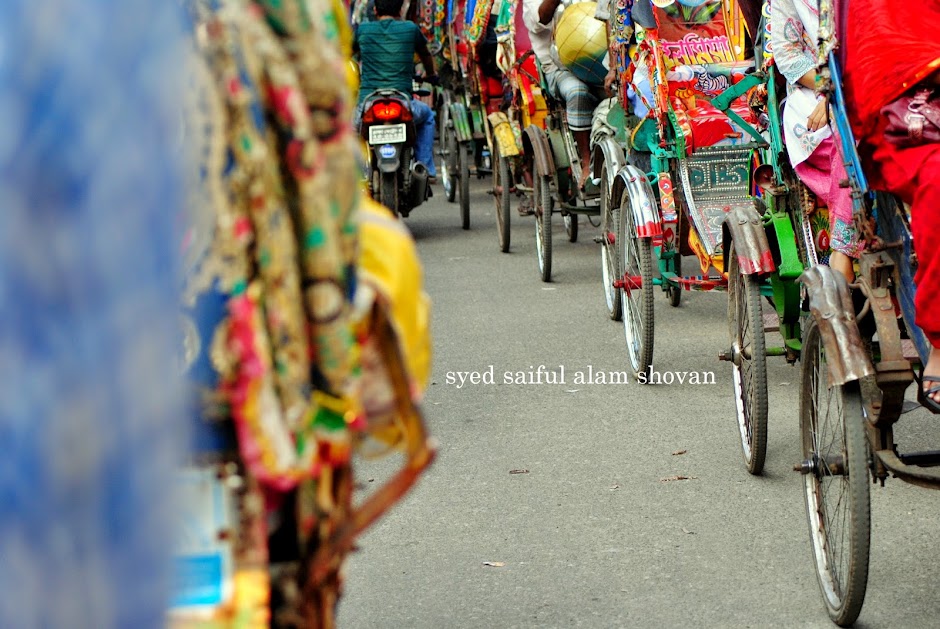
RICKSHAW

Showing posts with label Traffice congestion dhaka. Show all posts

Monday, January 27, 2014

Traffic congestion: are trains the culprit or the solution?

Traffic congestion: are trains the culprit or the solution?

Traffic congestion: are trains the culprit or the solution? A news item in the New Age newspaper on 24 March states that “Bangladesh Railway has agreed to suspend rail operations between Tejgaon and Kamalapur stations during the peak travel hours to reduce tailback in the capital. The move follows a recent request from the Dhaka Metropolitan Police to the railway authorities for assistance in mitigating huge tailbacks that have become a common feature in the capital city.


 According to DMP, many of the city’s roads are too frequently blocked for trains arriving at or leaving Kamalapur Railway Station.” The question naturally arises as to whether we wish to carry out a symbolic measure to reduce congestion on the city’s roads, or actually to facilitate transport of our city’s residents? If the aim of transport policy is the movement of people not cars, then the decision is counter-productive. After all, trains (like cars and buses) move people. But a train can move 20 times as many passengers as cars per land space. Even without trains, there will be traffic jams, but trains do ensure a large number of people moving in small space while using far less fuel than if they were traveling by car. Further, by giving priority to rail, traffic congestion would actually decline, whereas giving priority to cars will only increase driving and thus congestion—and all the related costs in terms of traffic fatalities and pollution. 


A recent comprehensive analysis of transportation system performance in 130 U.S. cities identified a number of benefits to those cities connected by rail rather than only by bus and car. The study found that cities with large, well-established rail systems have lower per-capita traffic congestion costs, lower per-capita traffic fatalities, and lower per capita consumer and government transportation expenditures. The study also found that residents in cities with large, well-established rail systems experience about half the per capita traffic congestion delay as people who live in comparable size cities that lack rail.

This occurs because residents of cities with good train service drive less. Cities with large rail systems have about a third lower per capita traffic fatality rates, as travel is far safer by rail than bus or car. Residents of these cities save approximately $450 annually per capita in transportation costs compared with consumers living in cities that lack rail systems. The study concludes that rail service costs are repaid several times over by reduced congestion, road and parking facility costs, reduced traffic accident costs, and consumer cost savings. Why, then, the priority in Bangladesh of cars and other road-based transport over trains? When people cannot easily travel by rail, they are likely to shift instead to bus or–for the few who can afford to–private car. 

This raises the question of whether the policy is indeed intended to reduce congestion, or simply to raise the profits of bus owners and car salesmen. Rather than cancel trains, rail service should be expanded to give people a positive choice over the use of cars. This would reduce not only traffic congestion but also fuel use, transport costs, and road deaths and injuries. With the possibility of saving lives, reducing costs, and effectively reducing congestion, the choice is clear: it is private cars, not trains that need to be taken out of service at peak hours. 

Sunday, May 31, 2009


Restriction on rickshaw movement fails to stop traffic jam in city
Mahbubur Rahman Khan


Imposing ban on rickshaw movement on different roads of the capital could not stop traffic jam rather it accentuated the economic woes of people, pushed more rickshaw pullers into poverty trap and created transport problem for a large number of commuters.


Hundreds of poor people in the capital mange their bare necessities of life by pulling rickshaw. The earnings of the rickshaw pullers, however meager, could make dent on poverty and alleviate sufferings of their family members in the countryside at least to some extent. Rickshaw pullers of the Dhaka city remit about tk 2 crore to their village homes each month. But imposition of ban on rickshaw movement on certain roads in the capital has robbed a good number of rickshaw pullers of their means of livelihood, according to Human Resource Centre (HRC).


The revenue earnings of the government from the rickshaw related industry and trade are much higher than those of the small automobiles. The government earned Tk 1,980 crore in revenue from rickshaw sector compared to Tk 64 crore from small automobiles in 2004-05 fiscal, said a report of the Bangladesh Bureau of Statistics.


Rickshaws in Dhaka city alone save fuel worth Tk 5,000 core every year and the yearly savings from the point of environment stand at Tk 10,000 crore, said a survey report of Paribash Bachao Andolon (PABA),an NGO.
There is no updated statistics on the actual number of rickshaws plying on different roads in the capital. Its number varies from two lakh to five lakh.
Imposition of ban on non-automobile transports on particular roads could not stop traffic congestion. A survey conducted by Human Development Resource Centre (HDRC) in 2004 found that the expenditure of rickshaw users has increased after the ban on rickshaws. Ban on the movement of rickshaws on certain roads in Mirpur area in the capital on the plea of reducing traffic jam has not produced the desired result. Rather the step increased traffic congestion on the roads which were made off-limit to rickshaws.
Citing example, the survey report said that following the imposition of ban on the movement of rickshaws on those roads, 25 percent of the commuters were compelled to walk through the roads in the absence of footpath. 42 percent of the people, who used to travel by rickshaws before the imposition of ban, are now hiring different modes of automobiles to go to different destinations. Extra pressure of mechanised transports on these roads made off-limit to rickshaws has simply choked them creating much discomfort for the commuters, the survey report added.


The imposition of ban on the movement of rickshaws has also reduced the income of rickshaw pullers by 32 percent, it claimed.


A survey report of Dhaka Urban Transport Project (DUTP) said rickshaws in no way create obstacle in the movement of mechanized transports. After making some roads in Mirpur off limit to rickshaws the average speed of buses plying in the area rather dropped by 3.8 kilometer, it mentioned.
Shakil Bin Kashem, Professor, Department of Urban and Regional Planning of Bangladesh University of Engineering and Technology (BUET), told The New Nation that the traffic system has deteriorated after imposition of ban on rickshaw on some roads in the capital.

Syed Saiful Alam
Save The Environment Movement
shovan1209[at]yahoo.com

Sunday, September 28, 2008

Sustainable Transport for Developing Countries and STP initiatives for Dhaka City

Dear Sir or Madam,

On behalf of Roads for People, a movement dedicated to the development of an eco-friendly and sustainable transport system in Dhaka City, I would like to draw your attention to some of the features of your recently concluded symposium.

First of all I would like to congratulate the organisers of the symposium for undertaking initiatives for sustainable transport development in developing countries. However, it is a matter of deep concern that in the name of sustainable transport development, the forum was mainly used to promote unsustainable, capital intensive, car-friendly and anti-fuel free transport policy directives, notably the Strategic Transport Plan (STP) for Dhaka City. The STP initiatives cannot be regarded as sustainable transport initiatives under any circumstances because the approach:

· Shows total disregard to the majority of trips, i.e. all short trips (76% of the total trips) and fuel free transport (48% of the trips);

· Takes a stand against sustainable transport modes by banning fuel free transport and restricting intercity buses and railways, etc.;

· Invests the maximum amount of resources (237% more) for the less optimal transport solution;

· Promotes car friendly and unsustainable policy directives like change of modal share in favour of cars, promotion of more car parking facilities, etc.;

· Promotes auto-friendly, inefficient and environmentally disastrous projects like the Eastern Bypass, elevated expressways and other unnecessary road projects, defying the findings of the STP study itself;

· Develops transport alternatives considering only the supply side of the problem under the assumption of unconstrained demand, which would likely promote unsustainable use of scarce resources;

· Takes important transport policy decisions solely on the basis of arbitrary reasoning without any valid supporting scientific analysis;

· Promotes long distance trips and encourages the need for more travel, which is likely to induce more congestion and pollution;

· Provides a disproportionate amount of resources for car-friendly and capital intensive projects and allocates inadequate provisions and funding for sustainable transport systems such as walking, fuel-free vehicles (bicycles and rickshaws), public transit and an integrated waterway system;

· Promotes inequality and social injustice.


A detailed review of the main features of the STP and ongoing unsustainable transport interventions is attached herewith, which you may find useful.
In this connection, it might be appropriate to learn lessons from the dismal failure of Dhaka Urban Transport Project (DUTP) (DUTP 2006, Bari and Efroymson 2006). The approach adopted in the DUTP was very much similar to that of the recommended solutions of STP. Key features of the project include: construction of a number of flyovers, banning of fuel-free transport from main roads, forcing the pedestrians to take elevated crossings, widening of roads at the expense of footpaths, etc. It may be mentioned here that the total travel time disbenefits of the project were at least twenty times more than the tiny savings of travel times. The moral from the dismal failure of DUTP is that in planning for a multimodal transport system, there is no scope to take decisions on the basis of prejudices while defying standard approaches of transport appraisal. Yet a similar unscientific approach is evident both in DUTP and in STP.
The main conclusion of the project is that there is no justification for wasting public money in the name of so-called development projects, such as DUTP, which cause colossal damage to the economy (well over Tk 7.78 billion per year), reduce mobility of people and goods, divide neighbourhoods and sever service facilities, inflict environmental degradation, destroy the basic fabric of sustainable development, deny vulnerable sections of the society their fundamental rights to accessibility and income, promote social inequality, and exacerbate poverty and hunger. An independent assessor appointed by the World Bank (World Bank 2007) also came down heavily on the justification of the key initiative of the project which attempted to ban fuel-free transport in favour of a tiny minority of car owners, who represent less than 5% of the population.

The dual role currently being played by a section of academics related to some higher learning institutions in Bangladesh is a matter of serious concern. These academics seem to be directly involved in formulating unsustainable, capital-intensive and environmentally disastrous policy directives like the banning of fuel-free transport, promotion of more free car parking facilities, and construction of flyovers and elevated expressways. It is difficult to understand how it could be appropriate to, one the one hand, be key members of STP or DUTP, while at the same time being directly involved in lucrative consultancy services for these wasteful and capital-intensive infrastructure projects. Such consultants would seem to assign more time to promoting lucrative infrastructure projects rather than for research and academic activities. Such behaviour not only represents a serious conflict of interest but also acts as a hindrance for the congenial development of academic and research activities, particularly at the postgraduate level. I would like to draw the attention of such malpractices to the University Grant Commission and other relevant authorities and hope that concerned academics will keep them above criticism and uphold the dignity and sanctity of higher learning institutions of Bangladesh.

The use of a sustainable transport development forum to promote such unsustainable STP or DUTP policy directives represents both insult and injury to the genuine movement for sustainable transport development. Those of us in that movement strongly deplore such practice and hope that organisers will in future be careful to avoid allowing their forum to promote such misguided transport initiatives.

We also hope that the sponsors of the symposium would constitute an enquiry committee comprising an international panel of experts on sustainable transport development to review the activities of the so-called sustainable transport development symposium and undertake requisite corrective measures to avoid such controversies in future and hence to uphold the dignity of the basic philosophy of sustainable transport development, that is, to promote low-cost, eco-friendly, space- and energy-efficient transport that recognizes the rights of the majority rather than prioritizing the elite.

Sincerely,

Mahabubul Bari
International Expert on Transportation Infrastructure
Independent Adviser to the Ministry of Infrastructure
Republic of Rwanda
Kigali
Post Box: 4989
Rwanda

Mobile: +250 0341 6508


www.dhaka-rickshaw.blogspot.com/ Dhaka Rickshaw
www.dhaka-transport.blogspot.com/ Pro-people Transport Plan www.dhakanewspapers.blogspot.com/ All Newspapers on one click

Syed Saiful Alam
Save The Environment Movement
shovan1209[at]yahoo.com
Scott Pilgrim vs. the World (Two-Disc Blu-ray/DVD Combo + Digital Copy)Kindle Leather Cover, Black (Fits 6" Display, Latest Generation Kindle)Scott Pilgrim vs. the World (Two-Disc Blu-ray/DVD Combo + Digital Copy)

Wednesday, September 3, 2008

Work for a Better Dhaka

No Traffic on a Saturday? Well, No Cars, Anyway

With a few simple steps, we could make Dhaka more livable. The first step is to change our priorities, by emphasizing access, not mobility, short rather than long distance travel, children, not cars, and livable environments, not just transport. To achieve this, we must change our policies; for instance, by enforcing the ban on parking on footpaths; reducing parking and charging a fair market rate for it; creating positive infrastructure for non polluters: pedestrians, cyclists, and rickshaws; and by putting children first: building more or better schools, libraries, and parks, and by making streets safer. In short, “We need a model in which happiness, rather than consumption levels, is the measure of success.”


www.dhaka-rickshaw.blogspot.com/ Dhaka Rickshaw
www.dhaka-transport.blogspot.com/ Pro-people Transport Plan www.dhakanewspapers.blogspot.com/ All Newspapers on one click

Syed Saiful Alam
shovan1209 [at] yahoo.com