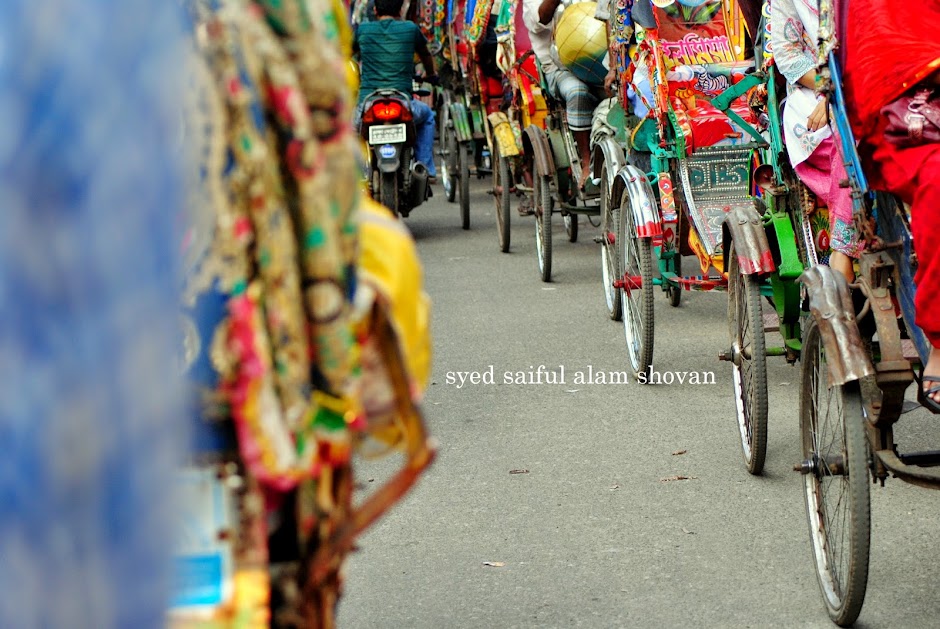
RICKSHAW

Showing posts with label non-motorize. Show all posts

Wednesday, April 6, 2011

Wrong-minded modernization: rickshaw bans

Wrong-minded modernization: rickshaw bans


A new wave of rickshaw bans has just occurred in Dhaka. How appropriate were those bans? How sound are the arguments against rickshaws?

The rickshaw has for decades been attacked by the media and others in Bangladesh as being slow, causing traffic jams and thus congestion, being an inhuman occupation for the pullers, and holding Dhaka back from modernization. Just how true are those claims?

First, does the experience with rickshaw bans to date suggest that such bans effectively reduce traffic congestion? On the contrary; even government reports show that rickshaw bans do nothing to improve traffic, and sometimes traffic speed even further deteriorates following rickshaw bans. In addition, people’s travel cost as well as time increase. Are VIP roads free of traffic congestion? Will the government blame rickshaws for congestion until there are no rickshaws left, and then what will they blame? Cities around the world with no rickshaws waste millions of dollars in lost time and wasted fuel due to traffic jams caused entirely by cars. Why are we so eager to join them?

Are rickshaws slow? Government reports indicate that in many cases, it is faster to walk than to take a bus. Average car speed in many Asian cities is no greater than the speed of a rickshaw. The fact that cars can on empty streets move faster than rickshaw is meaningless in Dhaka traffic situations, except in the danger it implies: when cars race on empty roads, they regularly kill pedestrians. How many fatal accidents are caused by rickshaws? Meanwhile, congestion makes cars slow; too many cars cause congestion. Rickshaws not only do not kill pedestrians, but they play a very important role in reducing pollution, as they themselves are completely emission-free vehicles, even when stuck in traffic.

It is not just the (potential) speed of a vehicle that matters; vehicles also take up space when parked. Cars are typically parked for most of the day, so the road or other valuable urban space they occupy is the space not only on the streets when moving but space for parking space. Imagine taking a series of short trips around Dhaka by car: everywhere you go, you must park the car somewhere. Although many apartment units now have car parking, they do not allow visitors to use the spaces, even if the lot is empty. So parked cars clutter the streets. As an alternative, we could work on turning our city into a series of high-rise parking lots (as Bangkok has done, much to the detriment of its liveability), or we could maintain a city with many urban amenities by reducing car parking and making conditions good for taking short trips by rickshaw, which require little space when parked and in any case spend most of the day carrying people about.

How inhuman is the business of pedaling a rickshaw? It might not be a profession most of you reading this article would like to have, but neither is it likely you would wish to spend hours a day standing in water, bent at the waist, transplanting rice. The measure of whether a profession is inhuman is not whether or not we are willing to engage in it, but rather what those working in it feel about it and what their alternatives are. Rickshaw pulling is a huge source of needed jobs; the pullers themselves clearly prefer it to begging or starving. Further, unlike many other professions, it is fairly well-paid, involves a good deal of independence, and gives the pullers a chance to choose their hours and to rest when they wish. It is thus far less inhuman than many other professions. What is inhuman is denying people the right to earn a living.

How well can we manage without the rickshaw in Dhaka? It is important to remember that many trips taken are short. Does it make sense to wait 10-20 minutes for a bus in order to travel 3 kilometres? What if you have many destinations: say a woman taking her child to school, going to a shop, visiting a relative, going home, then going back to pick up her child? If she had to buy separate bus tickets for each trip segment, the expense would be exorbitant. No wonder 41% of trips to take children to school occur by rickshaw; it is a safe, convenient, and affordable form of door-to-door transport.

As for walking as an alternative, we are all for it: but first there needs to be a better environment for walking. The problems faced by those on foot in Dhaka are numerous: footpaths in bad condition, often occupied by parked cars, and used at times by motorbikes; lack of safe street crossings; bad smells due to the lack of public toilets; lack of safety at night; and the exposure to continual fumes and noise from the traffic on the streets. Rickshaws provide a fairly pleasant alternative to the dismal business of walking in Dhaka; it is unfair to the middle class to take away that option in the assumption that they should either buy a car or suffer on buses, which themselves involve a number of obstacles to comfortable travel and of course only operate on certain routes, causing problems for those traveling with children, carrying heavy items, and so on.

Speaking of the popularity of rickshaws, it is helpful to compare the percentage of trips that occur by rickshaw versus car. No measures have been taken to ban cars from narrow lanes, despite the obvious fact that cars create congestion in the lanes, blocking the easy movement of hundreds of people traveling by rickshaw. Far from it: the building code is insisting on the provision of ever more car parking, providing incentive for ever more cars, even on narrow streets. But how popular is the car versus the rickshaw?

According to the latest government figures, for overall trips in the Dhaka Metropolitan Area and Dhaka City Corporation, 4-5% are made by car versus 29-39% by rickshaw. While men make 32% of their trips by car, that figure is 47.4% for women. As mentioned, 41% of trips to school occur by rickshaw; only 4% are taken by car (yet cars already create hideous congestion around schools and during the times when children go to and from school). While car use is far higher among the wealthy (here defined as those earning over 50,000 taka per month), at 18% of trips, that figure is still dwarfed by rickshaw trips: 35% of trips taken by the wealthy are by rickshaw. That is, rickshaws account for twice the number of trips as cars even among the wealthier, and up to ten times as many trips overall. If it is so important to ban vehicles due to the congestion they create, why on earth is it the rickshaw that is being banned?

Finally, are rickshaws an antiquated vehicle that should be relegated to the past, or instead a glowing emblem of modernity? The most modern, attractive, liveable cities are mostly in western Europe. A significant portion of trips in those cities – say, 30-50% or more – occurs by bicycle. European cities, as well as growing numbers of cities in Australia and North America, promote the bicycle in order to reduce traffic congestion, fumes, noise, and travel expense, and to increase the attractiveness and liveability of cities.

What after all is a rickshaw but a three-wheeled bicycle (imagine trying to cycle through Dhaka...no wonder people prefer rickshaws!). Given the related catastrophes of climate change, peak oil, obesity, and lack of physical activity, governments around the world are trying to get people out of their cars. It is the low-income cities of the world that are heading in the opposite direction, laying out the red carpet for cars while making life difficult and unsafe for pedestrians and cyclists. Why are policymakers in Dhaka insistent on making things worse for the city rather than better? If we really want to reduce traffic congestion, we must do what city after city around the world has been forced to do: actively work to reduce travel by car and increase travel by other means.

Years ago, an international transport expert referred to Dhaka’s modal share as “enviable”: few cars and many rickshaws. Rather than appreciate what we had and work to make things even better, we are instead working to increase traffic congestion, noise, fumes, and expense, and to make moving about the city more difficult for the non-car-owning majority.

It is also interesting to note that the latest rickshaw bans occurred after government decisions to limit car use through a variety of measures. To the best of our knowledge, none of those measures have been implemented to date, while other measures to encourage car use continue. What was done instead, despite significant media attention over the last few years to the problem of private cars, was to ban rickshaws from various streets. Clearly the decision was based on prejudice, not any technical understanding of the situation. It allows the government to say that it is doing something to improve traffic, while only making matters worse, because politically it is difficult to put into places measures to reduce the vehicle preferred by a tiny portion of the most wealthy and powerful.

But it is wrong to believe that only rickshaw pullers are upset by the bans. Dhaka residents have long suffered for the various bans that have been put into place over the years: witness the long lines of people attempting to go to and from New Market by rickshaw, or the anger of women in focus groups discussing the rickshaw bans on Mirpur Road. Of course people want safe, convenient, comfortable transport. People also vote. It is not wise to anger the masses through such wrong-minded decisions.

It is time to raise our voices in support of smart traffic planning: to ensure that all people, not just those with a car, can move about safely and conveniently; that non-polluting modes are given priority; and that international experience in addressing traffic congestion is put to good use here. It is time to say no to further rickshaw bans, to overturn the recent ones, and to work together to make Dhaka a city in which people can move about safely, comfortably, and conveniently on foot, on 2- and 3-wheeled bicycles (rickshaws), and on public transport. We would all benefit from the improved air quality, safety, and convenience.


Syed Saiful Alam
Environmental Activist
+8801552442814
shovan1209@yahoo.com

World Streets

Old Nabble
India streets

Sustran Discuss

News From Bangladesh

Thursday, September 4, 2008

London’s congestion charge cuts traffic jams by 30%

London’s congestion charge cuts traffic jams by 30 percent

By James Monaghan
London Mayor Ken Livingstone’s central London congestion charging system celebrated its first anniversary in February 2004 to general acclaim at home and abroad. Despite of the prophets of doom and even some of its supporters back in 2003, the centre of the UK capital has achieved and maintained its figure of 30 per cent fewer traffic delays inside the charging zone compared with the period before charging was introduced.


Transport for London (TfL), the city’s transport authority, told City Mayors: “Estimates of year-on-year changes in traffic levels show a reduction of 18 per cent in traffic entering the zone during charging hours." In the first six months after the introduction of the scheme in February 2003, the reduction had only dropped by 16 per cent. This is a small but gratifying sign that central London’s streets are becoming safer and more congestion- and pollution-free.


Ken Livingstone, who became London’s first ever directly elected Mayor in 2000, had made transport one of the main planks of his campaign. He stressed the need to ease traffic congestion in central London by persuading people to switch from private cars to public transport. He promised to do this by introducing a congestion charge while at the same time dramatically increasing the number of buses on London roads. Under the scheme, private car drivers entering central London pay a daily fee of five pounds (eight dollars) with heavy goods vehicles paying the same.


To a large extent, Mr Livingstone’s claims to City Mayors in July 2003 seem to have been vindicated. He said then, “It has helped to get London moving again after years of choking traffic. London has become the first of the great world cities to set about substantially reducing congestion in the central area.”


The congestion-charging scheme was at the heart of a larger transport strategy designed from the outset to tackle four key transport priorities for London: reducing congestion; improving bus services; improving journey time reliability for car -users; and making the distribution of goods and services more reliable, sustainable and efficient. It has also been designed to raise significant funds to improve London’s transport system.


The London congestion charge was strongly opposed by Conservative members on the London Assembly (London’s municipal council) and 'The Evening Standard', London’s evening newspaper. The paper’s prediction of traffic chaos never materialised. London’s public has always supported the scheme, while opinion in the business community was divided. Office-based businesses were largely in favour of congestion charging because it was likely to ease travel to work for their staff. Some retailers, on the other hand, claim loss of trade. The Labour Party initially adopted a wait-and-see attitude, but now welcome it since Mr Livingstone rejoined the Party.‘Congestion Charging: Update on scheme impacts and operations’, released at the first anniversary by TfL claims among other things that, • Buses continued to experience significant gains in reliability in and around the charging zone with up to 60 per cent reduction in disruption caused by traffic delays.


• There has been a year-on-year increase of 29,000 bus passengers entering the zone during the morning peak period, for which sufficient additional public transport capacity has been provided.


• When over 700 businesses inside and just outside the charging zone were asked if they supported congestion charging zone, as long as there is continued investment in public transport, 60 per cent agreed, around 20 per cent disagreed. Only 12 per cent said the congestion charge affected business performance.


• On the other hand, net revenues from the scheme are less than anticipated. Instead of raising more than £100 million during the scheme’s first year, “congestion charging contributes £50 million of net transport benefits to London’s economy per year, mainly through quicker and more reliable journeys for road and bus users”. This is partly explained by TfL’s claim that 50,000 fewer cars per day were being driven into central London since the introduction of the charging scheme – although they also claimed that the number of people entering the centre of London had only fallen by some 4,000 in 2003.


Some controversies remain. TfL is carrying out a public and stakeholder consultation on behalf of the Mayor, who is proposing to extend the present central London charging scheme westward into Kensington & Chelsea and Westminster. If accepted, the proposals, which are widely accepted by the Liberal Democrats, opposed by the Conservatives and found to be too restricted by the Greens, would not be implemented before 2006.


TfL also released a report in early March 2004 into Transport in London and its national ramifications. The report warns, “Inadequate transport will limit office development, job creation, house-building and the efficiency of the labour market” unless heavy investment in the transport system takes place.


Within a decade there will be the equivalent of 19 more passengers on each carriage of the Tube (the London underground rail system) during rush hour. Some trains currently are already leaving their first station with no seats left.
The dire warnings are partly due to political manoeuvring to increase central Government funding for transport, but in general congestion charging is becoming less of a hot issue and the Mayor is moving into other areas such as energy efficiency.


www.dhaka-rickshaw.blogspot.com/ Dhaka Rickshaw
www.dhaka-transport.blogspot.com/ Pro-people Transport Plan www.dhakanewspapers.blogspot.com/ All Newspapers on one click

Syed Saiful Alam
shovan1209 [at] yahoo.com

Saturday, August 30, 2008

What If We Loved Our Kids More than Our Cars?

What If We Loved Our Kids More than Our Cars?

For it must be a sick society indeed that can, and does, and continues to, love its cars more than its children.

WITHIN just one generation, the lives of children throughout the world have changed radically, with just one indication among many being that so many children are now driven to school rather than walking. The same change that occurred in the United States has also happened where I now live, in Dhaka, Bangladesh. Even though car owners are very much the minority, children’s freedom has been greatly curtailed by those cars. Those whose parents do have cars are driven everywhere; those whose parents do not, unless they are very poor, are escorted by adults and strictly prohibited from playing outdoors. It sometimes seems the only children in the city who have the opportunity for wholehearted pleasure, and who have confidence and skill in negotiating the streets, are the slum children.


One could, of course, sit back quietly and watch these changes, reflecting that surely it isn’t as bad as it appears or that something else will come along to make things better or that children perhaps don’t need to play outdoors or meet and interact with strangers or get to know those of other social classes or learn how to get around on their own. It is easy to be defeatist and say who am I to fight such changes? And there are those who feel the changes are inevitable, because the only response is to curtail cars – and that is a ‘freedom’ or enjoyment we could never part with. It isn’t that bad, people may argue; in some parts of the world children have access to parks and playgrounds, and while structured sports for children may not deliver all the benefits of street play, it is the best we can do in the modern world and surely nobody wishes to give up the benefits of modernity.


We too, here in Dhaka, watched the changes and despaired. Later, I found inspiration in reading David Engwicht’s Street Reclaiming; we bought sports equipment to give to the children on the street where our office is – a ‘residential’ neighbourhood with homes, NGO offices, a private university, a pharmaceutical company, a car repair centre and a fair amount of traffic – and made signs to put in the streets with such messages as ‘Love us, let us play.’ The kids took the sporting equipment and played on the roof of their apartment building; the signs seemed likely to turn rusty in our office.


Then one day, a few months later, a couple of my colleagues came into my office and announced that on that very afternoon they were starting a cycle training programme. A what? We have been working to promote cycling, and fighting with transport officials on the issue of cycle rickshaw bans in Dhaka; in the process we have collected a good number of small, folding bikes. Out came the bikes. We bought a few more for little kids, and taped paper with the message ‘Cycle training’ over our old signs, and put up a banner, and later made a large sign showing Einstein on a bicycle – an amusing choice, I had to think, in a Muslim country – all to make the car drivers pay attention, slow down, and yield a lane or two to the kids.


The first day we arranged for some friends to come cycle; almost nobody from our street showed up. Curious children and sceptical adults watched from their balconies. Later, a neighbour told us that people believed we couldn’t be offering free cycle training without an underlying motive –which they took to be that we were planning to kidnap their children. How effective the media has proved in frightening parents out of allowing their children freedom of movement or opportunity to play! If only we could compare the likelihood of children being harmed by being kept under lock and key to the likelihood of being kidnapped. But the woman who told us this was brave, or had a better feeling towards humanity, and brought her children, and reported to her neighbours, and the numbers began to increase. We advertised the programme (for free) in newspapers and through handbills, and children and adolescents (and even adults) from different parts of town began to come, and a regular group of children showed up for the inestimable pleasure of riding a bike with other children.


Other organisations have started similar initiatives, though on small fields rather than on streets. Less than a year has passed, and we hope eventually people will realise the good sense of converting quiet streets into temporary children’s playgrounds. In the meantime, other stunning and unanticipated results have occurred. Prior to the programme, no children on the street knew each other, having always being escorted by parents, usually by car; now many friendships have developed.


One of our volunteers, Topon Shikder says: ‘We have created a platform which allows children from different apartment buildings to get to know each other, breaking the isolation which existed, in which everyone lived their separate lives. So now if someone is in trouble – is sick, or there is no male around – they can turn to each other for help. And of course the kids love it, they keep asking me, “give me a bike, give me a bike, when is it my turn?” It’s wonderful to see their excitement.’


We have slum children helping to run the programme and fix the bicycles; like it or not, if you want to ride, you have to interact with these kids, and interact they do. A couple of child servants who have no other opportunity for recreation sneak away to join and revel in being treated the same by our staff as the rich neighbourhood kids. The children who repair the bikes have gained confidence as well as new skills, marching about with great authority; twice a week a few of them eat lunch with our office staff. During school holidays, children from the street come to our office to borrow bikes, usually in groups; it is now perfectly normal to have children moving around as freely as if it were their office.


Another of our volunteers, Muminul Islam says, ‘Street children – those who pick rags or papers, or sell peanuts at the nearby lake, to make a little money – often wander to our street to watch, and stand with their mouths almost hanging open. So I send one of our kids with a bike to ask the child if he wants to ride for a few minutes. I can’t express how happy they are! Sometimes afterwards they get so excited that they come up to me and grab my hand, calling me uncle or brother, and thank me profusely.’


I wish I could say that the adults on our street have also thanked us warmly for the initiative, and that drivers slow down, or avoid entering our dead-end street altogether so as not to disrupt the children. Most adults, including the parents whose kids participate, are delighted; when they see drivers racing on the street, or honking loudly at the kids, they complain about how uncivilised they are. But other adults tell us we should take the programme elsewhere, and one woman – a paediatrician –complained that it’s hard on drivers because ‘we have to slow down;’ others ask why we take so much space (blocking one or two lanes of a three-lane street). Our volunteers shake their heads in wonder – it really seems that people love their cars more than their children, they say.


What we are giving to the children at one level seems so minor – the chance to ride a bike up and down a stretch of road, while passing drivers blare their horns. On the other hand, we are giving them the freedom to leave their homes unescorted, to gain a new skill, to form friendships, to interact with different kinds of people...and to have fun. Perhaps, if things go well, if we are able to continue and expand, we will even succeed in communicating our key message: cars should not be allowed to destroy the joy in children’s lives. Perhaps, people will see that children don’t have to grow up trapped in cars and behind TV, helpless and dependent, growing up in fear of strangers and of the world around them. Perhaps, they will come to see the harm in the mentality that has developed; in which any sacrifice of children’s natural state seems preferable to restrictions on cars. For it must be a sick society indeed that can, and does, and continues to, love its cars more than its children.

Friday, August 15, 2008

Fuel Consumption and Environmental Impact of Rickshaw Bans in Dhaka

Fuel Consumption and Environmental Impact of Rickshaw Bans in Dhaka

Most trips in Dhaka are short in distance, usually one to five kilometers. These trips are perfect of Rickshaws. Rickshaws are cheap and popular mode of transport over short distances. Rickshaws are safe, environmentally friendly and do not rely on fossil fuels. Rickshaws support a significant portion of the population, not only the pullers, but also their families in the villages, the mechanics who fix the rickshaws, as well as street hawkers who sell them food. From the raw materials to the finished product the Rickshaw employs some 38 different professions. Action needs to be taken to support the Rickshaw instead of further banning it in Dhaka. The combined profits of all Rickshaws out earn all other passenger transport modes (bus, rail, boats and airlines) combined. In Dhaka alone, Rickshaw pullers combine to earn 20 million taka a month.


We think that over the coming holiday of Eid du Ajah, new Rickshaw bans will be put into action on roads in Dhaka. Eid was used in the past to place new bans on roads in Dhaka. Last Eid many roads were declared Rickshaw free without public support or approval. By banning Rickshaws roads are clogged with increased private car use as well as increased parking by cars. Banning of Rickshaws on major roads increases the transportation costs for commuters. Not only due to longer trips to avoid roads with bans in effect, but also due to actually having to take more expensive forms of transport such as CNG or Taxi, where in the past a Rickshaw would suffice. The environmental impact of banning Rickshaws is obvious because it exchanges a non-motorized form of transport for a motorized form of transport, thus increasing the pollution and harming the environment. Rickshaw bans harm the most vulnerable in society, mainly the sick, poor, women, children and the elderly; generally those who can not afford or do not feel comfortable on other forms of public transport. To ban Rickshaws also hurts small businesses that rely on them as a cheap and reliable form of transporting their goods. Rickshaws are ideal for urban settings because they can transport a relatively large number of passengers while taking up a small portion of the road. In 1998 the data showed that Rickshaws took up 38% of road space while transporting 54% of passengers in Dhaka . The private cars on the other hand, took up 34% of road space while only transporting 9% of the population (1998 DUTP). This data does not include the parking space on roads that cars take up in Dhaka . If included this would further raise the amount of space taken up by private cars. Every year the Rickshaw saves Bangladesh 100 billion taka in environmental damage.


The government makes many efforts to reduce traffic congestion in Dhaka but with no success. Blaming Rickshaws for traffic congestion and subsequently banning them from major roads has not had the desired affect. Traffic is still as bad now as it was before the Rickshaws were banned on major roads. Rickshaws thus can not be seen as the major cause of traffic congestion. Instead one should look towards private cars and private car parking on roads as the major cause of traffic congestion. The space gained by banning Rickshaws is often used for private car parking. The current trend in transport planning reduces the mobility of the majority for the convenience of the minority. The next time a ban on Rickshaws on another road is discussed please take into consideration who is being hurt and who is being helped. For a better transport system in Dhaka we need to create a city wide network of Rickshaw lanes. If this is done Dhaka can reduce its fuel usage dramatically as well its pollution. We ask your help in our fight to keep Dhaka a Rickshaw city. Any information or help is very much appreciated and sought after. I write you this letter to describe the difficulties we are facing and some solutions but they are by no means exhaustive and we look forward to your help and input.

Syed Saiful Alam
Central member of Save The Environment Movement
Email: shovan1209[at]yahoo.com

Dhaka Rickshaw Pro-people Transport Plan All Newspapers on one click

http://www.dhaka-rickshaw.blogspot.com/ Dhaka Rickshaw
http://www.dhaka-transport.blogspot.com/ Pro-people Transport Plan http://www.dhakanewspapers.blogspot.com/ All Newspapers on one click