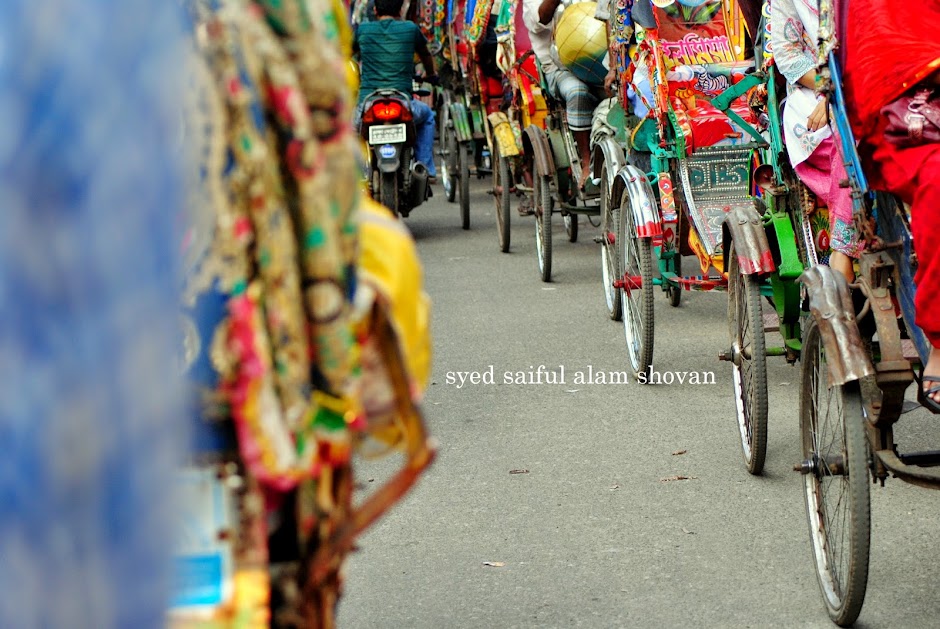
With a few simple steps, we could make Dhaka more livable. The first step is to change our priorities, by emphasizing access, not mobility, short rather than long distance travel, children, not cars, and livable environments, not just transport. “We need a model in which happiness, rather than consumption levels, is the measure of success.”
RICKSHAW
Monday, December 15, 2014
Thursday, November 27, 2014
Breaking records: Dhaka rickshaws make the Guinness Book of World Records
For
years, city officials have complained that “no other city has as many rickshaws
as Dhaka,” somehow equating
rickshaws with poverty and backwardness. Now, with Guinness recognizing Dhaka as an exceptional city for
its many lakh non-polluting, truly green rickshaws, we can proudly say that “no
other city has as many rickshaws as Dhaka!”
The
city streets of Dhaka are choked with cars,
despite only 5% of trips being made by car. Imagine if that figure doubled to
10%? Traffic would come to a complete standstill, or we would have to bulldoze
more and more buildings in order to build ever wider roads, thus making
destinations ever farther apart and generating even more traffic. Rickshaws,
meanwhile, fit easily down all but the narrowest lanes. They move about as
quickly as the average car in crowded streets. They require no fuel to operate
and spew out no poisonous fumes. They provide much-needed employment to
countless people, and offer the comfort and convenience of door-to-door
transport to city dwellers.
European
transport officials talk proudly of the high percentage of trips that are made
by bicycle in their cities. Bicycles represent green transport, requiring no
fuel to operate and very few resources for their construction or disposal. The
“cleanest” car is still dirty when we consider the source of its fuel
(electricity often comes from coal, which is even worse than petrol) and all
the resources needed to build and dispose of it. And what is a rickshaw but a
three-wheeled bicycle?
The
fact that we can still breathe the air in Dhaka, and that it is still
possible to move about the city (albeit slowly and with difficulty) is in large
part thanks to the presence of the rickshaws. Even if we get a great system of
public transit, people will still need “last mile connectivity”: a way to get
to and from the public transit stops. Rickshaws will be essential for that
service. They are also essential for short trips, especially given how miserable
and dangerous the conditions currently are for walking and cycling. Rickshaws
offer a relatively independent mode of travel for people with disabilities. And
all without generating pollution.
The
eyes of the world are now turning to Dhaka. For many years, the
rickshaw has been a symbol of pride, an example of local art cum transport. It
is exhibited in the Dhaka airport, at various hotels,
and at local and international events. Yet there are those who have been keen
to see it banned or restricted on city streets, despite the mounting evidence
that reducing the rickshaw has absolutely no beneficial effect whatsoever on
the flow of traffic, and that rickshaw bans likely contribute to
ever-increasing air pollution. With this welcome recognition from Guinness, it
is time to match our actions to our gestures. The rickshaw should indeed be a
source of national pride, and it should be welcomed and encouraged on our city
streets. We all need to recognize that the rickshaw is a solution, not a
problem, in terms of traffic congestion, pollution, affordable transport, and
employment. Saturday, November 22, 2014
Guinness World Records as the city with the most cycle rickshaws.
I can't express how much happy I am to see this great message Nick !
Thank you so much dear.
Hi Syed,
I sought your expertise earlier this year regarding cycle rickshaws in
Dhaka. I just wanted to inform that Dhaka has been added to the Guinness
World Records as the city with the most cycle rickshaws.
http://goo.gl/CtkB0Z
I sought your expertise earlier this year regarding cycle rickshaws in
Dhaka. I just wanted to inform that Dhaka has been added to the Guinness
World Records as the city with the most cycle rickshaws.
http://goo.gl/CtkB0Z
Tuesday, February 25, 2014
Efficiency on Wheels
| Dhaka Cycle Rickshaw |
Ironically,
while Western Europeans, some of the richest people in the world, are happy to
cycle for transport, here in Bangladesh
we prioritize motorized modes. We have contempt for the rickshaw, despite the
fact that the rickshaw is simply a three-wheeled bicycle, delivering almost all
the benefits of the bicycle to those who cannot use one.
Why
the contempt for the rickshaw? One reason is that the rickshaw provides safe,
convenient, door-to-door transport, and thus makes life easy for those who do
not have a car. Those in the business of selling cars know that the existence
of the rickshaw decreases the demand for a car. Why take out a loan to buy a
vehicle you can’t afford when you can easily move about without one?
Judging
from Western Europe , there is absolutely
nothing outdated or backward about the rickshaw. In fact, the rickshaw, like
the bicycle, is at the peak of civilization and modernity, a vehicle
appropriate for an age of concern about climate change and environmental issues
in general. Just as Europeans—Dutch, Swedes, Danes, Germans, and so
on—appreciate the many advantages of their fuel-free travel option, so we too
should appreciate and value the rickshaw.
Labels:
Cycle Rickshaw
Monday, January 27, 2014
Traffic congestion: are trains the culprit or the solution?
A news item in the New Age newspaper on 24 March states that “Bangladesh Railway has agreed to suspend rail operations between Tejgaon and Kamalapur stations during the peak travel hours to reduce tailback in the capital. The move follows a recent request from the Dhaka Metropolitan Police to the railway authorities for assistance in mitigating huge tailbacks that have become a common feature in the capital city.
According to DMP, many of the city’s roads are too frequently blocked for trains arriving at or leaving Kamalapur Railway Station.”
The question naturally arises as to whether we wish to carry out a symbolic measure to reduce congestion on the city’s roads, or actually to facilitate transport of our city’s residents?
If the aim of transport policy is the movement of people not cars, then the decision is counter-productive. After all, trains (like cars and buses) move people. But a train can move 20 times as many passengers as cars per land space. Even without trains, there will be traffic jams, but trains do ensure a large number of people moving in small space while using far less fuel than if they were traveling by car.
Further, by giving priority to rail, traffic congestion would actually decline, whereas giving priority to cars will only increase driving and thus congestion—and all the related costs in terms of traffic fatalities and pollution.
A recent comprehensive analysis of transportation system performance in 130 U.S. cities identified a number of benefits to those cities connected by rail rather than only by bus and car. The study found that cities with large, well-established rail systems have lower per-capita traffic congestion costs, lower per-capita traffic fatalities, and lower per capita consumer and government transportation expenditures.
The study also found that residents in cities with large, well-established rail systems experience about half the per capita traffic congestion delay as people who live in comparable size cities that lack rail.
This occurs because residents of cities with good train service drive less.
Cities with large rail systems have about a third lower per capita traffic fatality rates, as travel is far safer by rail than bus or car. Residents of these cities save approximately $450 annually per capita in transportation costs compared with consumers living in cities that lack rail systems.
The study concludes that rail service costs are repaid several times over by reduced congestion, road and parking facility costs, reduced traffic accident costs, and consumer cost savings.
Why, then, the priority in Bangladesh of cars and other road-based transport over trains? When people cannot easily travel by rail, they are likely to shift instead to bus or–for the few who can afford to–private car.
This raises the question of whether the policy is indeed intended to reduce congestion, or simply to raise the profits of bus owners and car salesmen.
Rather than cancel trains, rail service should be expanded to give people a positive choice over the use of cars. This would reduce not only traffic congestion but also fuel use, transport costs, and road deaths and injuries. With the possibility of saving lives, reducing costs, and effectively reducing congestion, the choice is clear: it is private cars, not trains that need to be taken out of service at peak hours.
Thursday, September 6, 2012
Do we need any ‘VIP’ roads?
Rickshaw Bans in Dhaka City: An Overview of the Arguments For and Against
In a civilised society every citizen should be treated as a VIP by his or her
own merits, irrespective of social or economic status. No public infrastructure
such as roads should be designated for a specific privileged class. Rather than
assigning roads for a few advantaged sections of the society, functional
classifications should be decided on the basis of scientific approaches.
Consider the irony of feeling that rickshaws are the source of our image
problems. In contrast, widespread corruption, illiteracy, erosion in social
norms and values, unacceptable rates of noise pollution, and lack of good
governance should be our sources of shame. After all, wealthy countries have
rickshaws—but Dhaka constantly outscores the rest of the world on
corruption.
Rickshaw Bans in Dhaka City: An Overview of the Arguments For and Against
Labels:
Rickshaw,
rickshaw ban
Tuesday, May 1, 2012
With a few simple steps, we could make Dhaka more livable. The first step is to change our priorities, by emphasizing access, not mobility, short rather than long distance travel, children, not cars, and livable environments, not just transport. To achieve this, we must change our policies; for instance, by enforcing the ban on parking on footpaths; reducing parking and charging a fair market rate for it; creating positive infrastructure for non polluters: pedestrians, cyclists, and rickshaws; and by putting children first: building more or better schools, libraries, and parks, and by making streets safer. In short, “We need a model in which happiness, rather than consumption levels, is the measure of success.”
Labels:
Dhaka air pollution,
Dhaka transport
Wednesday, April 6, 2011
Wrong-minded modernization: rickshaw bans
A new wave of rickshaw bans has just occurred in Dhaka. How appropriate were those bans? How sound are the arguments against rickshaws?
The rickshaw has for decades been attacked by the media and others in Bangladesh as being slow, causing traffic jams and thus congestion, being an inhuman occupation for the pullers, and holding Dhaka back from modernization. Just how true are those claims?
First, does the experience with rickshaw bans to date suggest that such bans effectively reduce traffic congestion? On the contrary; even government reports show that rickshaw bans do nothing to improve traffic, and sometimes traffic speed even further deteriorates following rickshaw bans. In addition, people’s travel cost as well as time increase. Are VIP roads free of traffic congestion? Will the government blame rickshaws for congestion until there are no rickshaws left, and then what will they blame? Cities around the world with no rickshaws waste millions of dollars in lost time and wasted fuel due to traffic jams caused entirely by cars. Why are we so eager to join them?
Are rickshaws slow? Government reports indicate that in many cases, it is faster to walk than to take a bus. Average car speed in many Asian cities is no greater than the speed of a rickshaw. The fact that cars can on empty streets move faster than rickshaw is meaningless in Dhaka traffic situations, except in the danger it implies: when cars race on empty roads, they regularly kill pedestrians. How many fatal accidents are caused by rickshaws? Meanwhile, congestion makes cars slow; too many cars cause congestion. Rickshaws not only do not kill pedestrians, but they play a very important role in reducing pollution, as they themselves are completely emission-free vehicles, even when stuck in traffic.
It is not just the (potential) speed of a vehicle that matters; vehicles also take up space when parked. Cars are typically parked for most of the day, so the road or other valuable urban space they occupy is the space not only on the streets when moving but space for parking space. Imagine taking a series of short trips around Dhaka by car: everywhere you go, you must park the car somewhere. Although many apartment units now have car parking, they do not allow visitors to use the spaces, even if the lot is empty. So parked cars clutter the streets. As an alternative, we could work on turning our city into a series of high-rise parking lots (as Bangkok has done, much to the detriment of its liveability), or we could maintain a city with many urban amenities by reducing car parking and making conditions good for taking short trips by rickshaw, which require little space when parked and in any case spend most of the day carrying people about.
How inhuman is the business of pedaling a rickshaw? It might not be a profession most of you reading this article would like to have, but neither is it likely you would wish to spend hours a day standing in water, bent at the waist, transplanting rice. The measure of whether a profession is inhuman is not whether or not we are willing to engage in it, but rather what those working in it feel about it and what their alternatives are. Rickshaw pulling is a huge source of needed jobs; the pullers themselves clearly prefer it to begging or starving. Further, unlike many other professions, it is fairly well-paid, involves a good deal of independence, and gives the pullers a chance to choose their hours and to rest when they wish. It is thus far less inhuman than many other professions. What is inhuman is denying people the right to earn a living.
How well can we manage without the rickshaw in Dhaka? It is important to remember that many trips taken are short. Does it make sense to wait 10-20 minutes for a bus in order to travel 3 kilometres? What if you have many destinations: say a woman taking her child to school, going to a shop, visiting a relative, going home, then going back to pick up her child? If she had to buy separate bus tickets for each trip segment, the expense would be exorbitant. No wonder 41% of trips to take children to school occur by rickshaw; it is a safe, convenient, and affordable form of door-to-door transport.
As for walking as an alternative, we are all for it: but first there needs to be a better environment for walking. The problems faced by those on foot in Dhaka are numerous: footpaths in bad condition, often occupied by parked cars, and used at times by motorbikes; lack of safe street crossings; bad smells due to the lack of public toilets; lack of safety at night; and the exposure to continual fumes and noise from the traffic on the streets. Rickshaws provide a fairly pleasant alternative to the dismal business of walking in Dhaka; it is unfair to the middle class to take away that option in the assumption that they should either buy a car or suffer on buses, which themselves involve a number of obstacles to comfortable travel and of course only operate on certain routes, causing problems for those traveling with children, carrying heavy items, and so on.
Speaking of the popularity of rickshaws, it is helpful to compare the percentage of trips that occur by rickshaw versus car. No measures have been taken to ban cars from narrow lanes, despite the obvious fact that cars create congestion in the lanes, blocking the easy movement of hundreds of people traveling by rickshaw. Far from it: the building code is insisting on the provision of ever more car parking, providing incentive for ever more cars, even on narrow streets. But how popular is the car versus the rickshaw?
According to the latest government figures, for overall trips in the Dhaka Metropolitan Area and Dhaka City Corporation, 4-5% are made by car versus 29-39% by rickshaw. While men make 32% of their trips by car, that figure is 47.4% for women. As mentioned, 41% of trips to school occur by rickshaw; only 4% are taken by car (yet cars already create hideous congestion around schools and during the times when children go to and from school). While car use is far higher among the wealthy (here defined as those earning over 50,000 taka per month), at 18% of trips, that figure is still dwarfed by rickshaw trips: 35% of trips taken by the wealthy are by rickshaw. That is, rickshaws account for twice the number of trips as cars even among the wealthier, and up to ten times as many trips overall. If it is so important to ban vehicles due to the congestion they create, why on earth is it the rickshaw that is being banned?
Finally, are rickshaws an antiquated vehicle that should be relegated to the past, or instead a glowing emblem of modernity? The most modern, attractive, liveable cities are mostly in western Europe. A significant portion of trips in those cities – say, 30-50% or more – occurs by bicycle. European cities, as well as growing numbers of cities in Australia and North America, promote the bicycle in order to reduce traffic congestion, fumes, noise, and travel expense, and to increase the attractiveness and liveability of cities.
What after all is a rickshaw but a three-wheeled bicycle (imagine trying to cycle through Dhaka...no wonder people prefer rickshaws!). Given the related catastrophes of climate change, peak oil, obesity, and lack of physical activity, governments around the world are trying to get people out of their cars. It is the low-income cities of the world that are heading in the opposite direction, laying out the red carpet for cars while making life difficult and unsafe for pedestrians and cyclists. Why are policymakers in Dhaka insistent on making things worse for the city rather than better? If we really want to reduce traffic congestion, we must do what city after city around the world has been forced to do: actively work to reduce travel by car and increase travel by other means.
Years ago, an international transport expert referred to Dhaka’s modal share as “enviable”: few cars and many rickshaws. Rather than appreciate what we had and work to make things even better, we are instead working to increase traffic congestion, noise, fumes, and expense, and to make moving about the city more difficult for the non-car-owning majority.
It is also interesting to note that the latest rickshaw bans occurred after government decisions to limit car use through a variety of measures. To the best of our knowledge, none of those measures have been implemented to date, while other measures to encourage car use continue. What was done instead, despite significant media attention over the last few years to the problem of private cars, was to ban rickshaws from various streets. Clearly the decision was based on prejudice, not any technical understanding of the situation. It allows the government to say that it is doing something to improve traffic, while only making matters worse, because politically it is difficult to put into places measures to reduce the vehicle preferred by a tiny portion of the most wealthy and powerful.
But it is wrong to believe that only rickshaw pullers are upset by the bans. Dhaka residents have long suffered for the various bans that have been put into place over the years: witness the long lines of people attempting to go to and from New Market by rickshaw, or the anger of women in focus groups discussing the rickshaw bans on Mirpur Road. Of course people want safe, convenient, comfortable transport. People also vote. It is not wise to anger the masses through such wrong-minded decisions.
It is time to raise our voices in support of smart traffic planning: to ensure that all people, not just those with a car, can move about safely and conveniently; that non-polluting modes are given priority; and that international experience in addressing traffic congestion is put to good use here. It is time to say no to further rickshaw bans, to overturn the recent ones, and to work together to make Dhaka a city in which people can move about safely, comfortably, and conveniently on foot, on 2- and 3-wheeled bicycles (rickshaws), and on public transport. We would all benefit from the improved air quality, safety, and convenience.
Syed Saiful Alam
Environmental Activist
+8801552442814
shovan1209@yahoo.com
World Streets
Old Nabble
India streets
Sustran Discuss
News From Bangladesh
A new wave of rickshaw bans has just occurred in Dhaka. How appropriate were those bans? How sound are the arguments against rickshaws?
The rickshaw has for decades been attacked by the media and others in Bangladesh as being slow, causing traffic jams and thus congestion, being an inhuman occupation for the pullers, and holding Dhaka back from modernization. Just how true are those claims?
First, does the experience with rickshaw bans to date suggest that such bans effectively reduce traffic congestion? On the contrary; even government reports show that rickshaw bans do nothing to improve traffic, and sometimes traffic speed even further deteriorates following rickshaw bans. In addition, people’s travel cost as well as time increase. Are VIP roads free of traffic congestion? Will the government blame rickshaws for congestion until there are no rickshaws left, and then what will they blame? Cities around the world with no rickshaws waste millions of dollars in lost time and wasted fuel due to traffic jams caused entirely by cars. Why are we so eager to join them?
Are rickshaws slow? Government reports indicate that in many cases, it is faster to walk than to take a bus. Average car speed in many Asian cities is no greater than the speed of a rickshaw. The fact that cars can on empty streets move faster than rickshaw is meaningless in Dhaka traffic situations, except in the danger it implies: when cars race on empty roads, they regularly kill pedestrians. How many fatal accidents are caused by rickshaws? Meanwhile, congestion makes cars slow; too many cars cause congestion. Rickshaws not only do not kill pedestrians, but they play a very important role in reducing pollution, as they themselves are completely emission-free vehicles, even when stuck in traffic.
It is not just the (potential) speed of a vehicle that matters; vehicles also take up space when parked. Cars are typically parked for most of the day, so the road or other valuable urban space they occupy is the space not only on the streets when moving but space for parking space. Imagine taking a series of short trips around Dhaka by car: everywhere you go, you must park the car somewhere. Although many apartment units now have car parking, they do not allow visitors to use the spaces, even if the lot is empty. So parked cars clutter the streets. As an alternative, we could work on turning our city into a series of high-rise parking lots (as Bangkok has done, much to the detriment of its liveability), or we could maintain a city with many urban amenities by reducing car parking and making conditions good for taking short trips by rickshaw, which require little space when parked and in any case spend most of the day carrying people about.
How inhuman is the business of pedaling a rickshaw? It might not be a profession most of you reading this article would like to have, but neither is it likely you would wish to spend hours a day standing in water, bent at the waist, transplanting rice. The measure of whether a profession is inhuman is not whether or not we are willing to engage in it, but rather what those working in it feel about it and what their alternatives are. Rickshaw pulling is a huge source of needed jobs; the pullers themselves clearly prefer it to begging or starving. Further, unlike many other professions, it is fairly well-paid, involves a good deal of independence, and gives the pullers a chance to choose their hours and to rest when they wish. It is thus far less inhuman than many other professions. What is inhuman is denying people the right to earn a living.
How well can we manage without the rickshaw in Dhaka? It is important to remember that many trips taken are short. Does it make sense to wait 10-20 minutes for a bus in order to travel 3 kilometres? What if you have many destinations: say a woman taking her child to school, going to a shop, visiting a relative, going home, then going back to pick up her child? If she had to buy separate bus tickets for each trip segment, the expense would be exorbitant. No wonder 41% of trips to take children to school occur by rickshaw; it is a safe, convenient, and affordable form of door-to-door transport.
As for walking as an alternative, we are all for it: but first there needs to be a better environment for walking. The problems faced by those on foot in Dhaka are numerous: footpaths in bad condition, often occupied by parked cars, and used at times by motorbikes; lack of safe street crossings; bad smells due to the lack of public toilets; lack of safety at night; and the exposure to continual fumes and noise from the traffic on the streets. Rickshaws provide a fairly pleasant alternative to the dismal business of walking in Dhaka; it is unfair to the middle class to take away that option in the assumption that they should either buy a car or suffer on buses, which themselves involve a number of obstacles to comfortable travel and of course only operate on certain routes, causing problems for those traveling with children, carrying heavy items, and so on.
Speaking of the popularity of rickshaws, it is helpful to compare the percentage of trips that occur by rickshaw versus car. No measures have been taken to ban cars from narrow lanes, despite the obvious fact that cars create congestion in the lanes, blocking the easy movement of hundreds of people traveling by rickshaw. Far from it: the building code is insisting on the provision of ever more car parking, providing incentive for ever more cars, even on narrow streets. But how popular is the car versus the rickshaw?
According to the latest government figures, for overall trips in the Dhaka Metropolitan Area and Dhaka City Corporation, 4-5% are made by car versus 29-39% by rickshaw. While men make 32% of their trips by car, that figure is 47.4% for women. As mentioned, 41% of trips to school occur by rickshaw; only 4% are taken by car (yet cars already create hideous congestion around schools and during the times when children go to and from school). While car use is far higher among the wealthy (here defined as those earning over 50,000 taka per month), at 18% of trips, that figure is still dwarfed by rickshaw trips: 35% of trips taken by the wealthy are by rickshaw. That is, rickshaws account for twice the number of trips as cars even among the wealthier, and up to ten times as many trips overall. If it is so important to ban vehicles due to the congestion they create, why on earth is it the rickshaw that is being banned?
Finally, are rickshaws an antiquated vehicle that should be relegated to the past, or instead a glowing emblem of modernity? The most modern, attractive, liveable cities are mostly in western Europe. A significant portion of trips in those cities – say, 30-50% or more – occurs by bicycle. European cities, as well as growing numbers of cities in Australia and North America, promote the bicycle in order to reduce traffic congestion, fumes, noise, and travel expense, and to increase the attractiveness and liveability of cities.
What after all is a rickshaw but a three-wheeled bicycle (imagine trying to cycle through Dhaka...no wonder people prefer rickshaws!). Given the related catastrophes of climate change, peak oil, obesity, and lack of physical activity, governments around the world are trying to get people out of their cars. It is the low-income cities of the world that are heading in the opposite direction, laying out the red carpet for cars while making life difficult and unsafe for pedestrians and cyclists. Why are policymakers in Dhaka insistent on making things worse for the city rather than better? If we really want to reduce traffic congestion, we must do what city after city around the world has been forced to do: actively work to reduce travel by car and increase travel by other means.
Years ago, an international transport expert referred to Dhaka’s modal share as “enviable”: few cars and many rickshaws. Rather than appreciate what we had and work to make things even better, we are instead working to increase traffic congestion, noise, fumes, and expense, and to make moving about the city more difficult for the non-car-owning majority.
It is also interesting to note that the latest rickshaw bans occurred after government decisions to limit car use through a variety of measures. To the best of our knowledge, none of those measures have been implemented to date, while other measures to encourage car use continue. What was done instead, despite significant media attention over the last few years to the problem of private cars, was to ban rickshaws from various streets. Clearly the decision was based on prejudice, not any technical understanding of the situation. It allows the government to say that it is doing something to improve traffic, while only making matters worse, because politically it is difficult to put into places measures to reduce the vehicle preferred by a tiny portion of the most wealthy and powerful.
But it is wrong to believe that only rickshaw pullers are upset by the bans. Dhaka residents have long suffered for the various bans that have been put into place over the years: witness the long lines of people attempting to go to and from New Market by rickshaw, or the anger of women in focus groups discussing the rickshaw bans on Mirpur Road. Of course people want safe, convenient, comfortable transport. People also vote. It is not wise to anger the masses through such wrong-minded decisions.
It is time to raise our voices in support of smart traffic planning: to ensure that all people, not just those with a car, can move about safely and conveniently; that non-polluting modes are given priority; and that international experience in addressing traffic congestion is put to good use here. It is time to say no to further rickshaw bans, to overturn the recent ones, and to work together to make Dhaka a city in which people can move about safely, comfortably, and conveniently on foot, on 2- and 3-wheeled bicycles (rickshaws), and on public transport. We would all benefit from the improved air quality, safety, and convenience.
Syed Saiful Alam
Environmental Activist
+8801552442814
shovan1209@yahoo.com
World Streets
Old Nabble
India streets
Sustran Discuss
News From Bangladesh
Labels:
Cycle Rickshaw,
non-motorize,
rickshaw ban,
রিকশা
Sunday, May 2, 2010
Rickshaw puller in Dhaka earns Tk 6,300 per month:

Rickshaw puller in Dhaka earns Tk 6,300 per month: JICA study
Hard-working rickshawpuller earns upto Tk 14,000
Munima Sultana
An hard working rickshaw puller in the capital earns up to Tk14,000 a month --- eight times the basic minimum wages of a garment worker, a Japanese study on city's transport sector has revealed.
Dhaka's half a million rickshaw pullers may be gaunt and emaciated but their average monthly income is more than a police constable or a second tier government officer, the study by Japan International Cooperation Agency said.
"Some 35 per cent of Dhaka's half a million rickshaw-puller earn between Tk5000 and Tk7000 while 25 percent earn between Tk7000 and Tk9000," according to the Dhaka Urban Transport Network Development Study (DHUTS).
On average a rickshaw-puller earns Tk 6300 a month by driving rickshaws six to eight hours a day. Even an irregular rickshaw-puller can earn Tk3000 a month, it said.
"The highest earnings by some rickshaw pullers were found to be Tk 14,000 a month," said Yoichi Sakurada, leader of the study team.
"Some eight per cent of the rickshaw pullers we interviewed said that their monthly income was Tk10,000 or more," he said.
The study demolishes the myth that the rickshaw pullers are one of the lowest earning working groups in the city, regularly portrayed as "oppressed" and "deprived" people in the country's popular media.
According to the study, an average rickshaw puller earns nearly four times more than an average garment worker, whose basic minimum wage is Tk1662.50 set in 2006.
Their average income is also nearly twice the average per capita Gross Domestic Product (GDP) of the country. Bangladesh's per capita GDP was US$620 in the last financial year, or nearly Tk3600 a month.
Rickshaws are the most dominant mode of transporation in Dhaka, accounting for one-thirds of the city's 23 million daily trips.
The study said an average rickshaw puller carries 40 person a day, mostly in shorter trips with median size 2.4 kilometre.
A driver usually demands Tk 10 for every kilometre distance. The maximum distance he drives is 10km, it said.
Students are the most frequent users of rickshaws, making up 52.2 per cent of the vehicles' trips followed by businessmen with 39.5 per cent.
Dhaka Transport Coordination Board commissioned the DHUTS, the most wide-ranging in recent years, as part of its feasibility study on metro rails and elevated expressway in the capital.
In the first phase, the study examines recent trend in the transport sector, current level of public services, trip characteristics and expansion of the Dhaka city.
People having income above Tk 50,000 a month use cars for only 17 per cent of their trips, the study says. They also use rickshaws and buses for daily commuting.
The Financial Express
Labels:
Dhaka transport,
haka,
Rickshaw
Monday, February 22, 2010
Have any other cities of Asia become successful in solving transport problems by banning fuel-free transport (FFT)?
Have any other cities of Asia become successful in solving
transport problems by banning fuel-free transport (FFT)?
It appears that we are going to commit the same mistake as General Suharto,
the then-dictator of Indonesia did by banning rickshaws (locally known as
becak) from Jakarta during the 1980s and thereby turning the city into a
traveller’s nightmare. Be it total or partial fuel-free transport (FFT) bans, past
experiences in other cities of Asia were not very pleasant either. Manila
banned FFT initially in the 1950s but some FFT re-emerged in the 1990s.
Bangkok banned FFT in 1960 and Karachi in 1962. Jakarta and New Delhi
followed suit and banned FFT during the 1980s. Transport statistics suggest
none of the cities that imposed FFT bans were able to solve their transport
problems by banning FFT. In most of the cases the situations became even
worse.
From the modal shares of different vehicles, it is evident that fuel-free vehicles
(FFV) were replaced by either motorcycles or motorised three-wheelers. The
modal share of motorcycles or motorised three-wheelers in these cities
accounts for 35% to 70% of the total vehicles (World Resource Institute 1996),
which is more or less similar to that of rickshaws in Dhaka.
The high growth of motorcycles and motorised three-wheelers contributed to
unbearable congestion and air pollution in the cities that banned FFT. The
alarming rates of growth of motorised two or three wheelers have become a
cause of serious concerns for the authorities of almost all FFT-free cities of
Asia. It is not surprising that banning of FFT promotes growth of such kind of
motorised monsters, which are obviously less efficient both from the
perspectives of traffic management and pollution control. Unlike fuel-free
vehicles, fuel-dependent (motorised) vehicles of all kinds utilise fuel which is
often heavily subsidised by the government and which emits carbon, the
major cause of global warming.
The average travel speeds in most FFT-free cities are generally lower than in
Dhaka. Bangkok and Jakarta are notorious for traffic congestion and
pollution. After almost two decades of suffering due to the ban, about 70% of
residents in the low income neighbourhoods of New Delhi and Jakarta now
favour reintroduction of FFT (Hook 2002). Surabaya, Hanoi and Ho Chi Minh
City restricted FFT movements on certain major roads in the 1990s. However,
banning of FFT from the major roads has proved to be a disaster for these
cities. Hanoi is now trying to limit motorcycle ownership and create bicycle
lanes, as motorcycles are clogging the streets, creating major air and noise
pollution, causing formerly unheard-of traffic jams, and making it difficult for
buses to ply the roads. Surabaya, the second largest city of Indonesia, has also
taken initiative to reverse the trends towards ever-greater motorisation.
It may be pointed out that in Surabaya, 60% of trips of under 3 km are made
by motorised transport, while in Germany, less than 20% of such trips are
motorised, the remaining being made by foot or bicycle. Yet incomes in
Germany are 40 times higher than in Surabaya (Hook 2002).
Banning FFT from main arterials severs continuity of large numbers of short
trips, which results in a significant increase in journey times, expense, and
sufferings to common people. It is very encouraging that the Mayor of
Surabaya has started the process of reintroducing FFT in major roads, where
they were previously banned (GTZ 2000). Being much weaker economically,
how could Bangladesh expect to solve its traffic problems by banning FFT
when the other cities of Asia have failed to do so? And how does Dhaka
anticipate dealing with the again-increasing incidence of air pollution, not to
mention the completely unacceptable levels of noise pollution from all the
cars and motorised three-wheelers?
Rickshaw Bans in Dhaka City: An Overview of the Arguments For and Against
transport problems by banning fuel-free transport (FFT)?
It appears that we are going to commit the same mistake as General Suharto,
the then-dictator of Indonesia did by banning rickshaws (locally known as
becak) from Jakarta during the 1980s and thereby turning the city into a
traveller’s nightmare. Be it total or partial fuel-free transport (FFT) bans, past
experiences in other cities of Asia were not very pleasant either. Manila
banned FFT initially in the 1950s but some FFT re-emerged in the 1990s.
Bangkok banned FFT in 1960 and Karachi in 1962. Jakarta and New Delhi
followed suit and banned FFT during the 1980s. Transport statistics suggest
none of the cities that imposed FFT bans were able to solve their transport
problems by banning FFT. In most of the cases the situations became even
worse.
From the modal shares of different vehicles, it is evident that fuel-free vehicles
(FFV) were replaced by either motorcycles or motorised three-wheelers. The
modal share of motorcycles or motorised three-wheelers in these cities
accounts for 35% to 70% of the total vehicles (World Resource Institute 1996),
which is more or less similar to that of rickshaws in Dhaka.
The high growth of motorcycles and motorised three-wheelers contributed to
unbearable congestion and air pollution in the cities that banned FFT. The
alarming rates of growth of motorised two or three wheelers have become a
cause of serious concerns for the authorities of almost all FFT-free cities of
Asia. It is not surprising that banning of FFT promotes growth of such kind of
motorised monsters, which are obviously less efficient both from the
perspectives of traffic management and pollution control. Unlike fuel-free
vehicles, fuel-dependent (motorised) vehicles of all kinds utilise fuel which is
often heavily subsidised by the government and which emits carbon, the
major cause of global warming.
The average travel speeds in most FFT-free cities are generally lower than in
Dhaka. Bangkok and Jakarta are notorious for traffic congestion and
pollution. After almost two decades of suffering due to the ban, about 70% of
residents in the low income neighbourhoods of New Delhi and Jakarta now
favour reintroduction of FFT (Hook 2002). Surabaya, Hanoi and Ho Chi Minh
City restricted FFT movements on certain major roads in the 1990s. However,
banning of FFT from the major roads has proved to be a disaster for these
cities. Hanoi is now trying to limit motorcycle ownership and create bicycle
lanes, as motorcycles are clogging the streets, creating major air and noise
pollution, causing formerly unheard-of traffic jams, and making it difficult for
buses to ply the roads. Surabaya, the second largest city of Indonesia, has also
taken initiative to reverse the trends towards ever-greater motorisation.
It may be pointed out that in Surabaya, 60% of trips of under 3 km are made
by motorised transport, while in Germany, less than 20% of such trips are
motorised, the remaining being made by foot or bicycle. Yet incomes in
Germany are 40 times higher than in Surabaya (Hook 2002).
Banning FFT from main arterials severs continuity of large numbers of short
trips, which results in a significant increase in journey times, expense, and
sufferings to common people. It is very encouraging that the Mayor of
Surabaya has started the process of reintroducing FFT in major roads, where
they were previously banned (GTZ 2000). Being much weaker economically,
how could Bangladesh expect to solve its traffic problems by banning FFT
when the other cities of Asia have failed to do so? And how does Dhaka
anticipate dealing with the again-increasing incidence of air pollution, not to
mention the completely unacceptable levels of noise pollution from all the
cars and motorised three-wheelers?
Rickshaw Bans in Dhaka City: An Overview of the Arguments For and Against
Subscribe to:
Posts (Atom)